
急性脑梗死患者阻塞性睡眠呼吸暂停与低灌注之间的相关性
Correlation between obstructive sleep apnea and hypoperfusion in patients with acute cerebral infarction.
作者信息
Zhou Yi, Jin Xiaomei, Liu Xiaorong, Tang Jiafan, Song Liyan, Zhu Yu, Zhai Wanqing, Wang Xianhui
机构信息
Department of Neurology, First People's Hospital of Taicang, Taicang City, Jiangsu Province, China.
出版信息
Front Neurol. 2024 Apr 8;15:1363053. doi: 10.3389/fneur.2024.1363053. eCollection 2024.
PURPOSE
To explore the relationship between obstructive sleep apnea (OSA) and hypoperfusion during ultra-early acute cerebral infarction.
PATIENTS AND METHODS
Data were retrospectively collected from patients admitted to our hospital with acute cerebral infarction between January 2020 and January 2022, who underwent comprehensive whole-brain computed tomography perfusion imaging and angiography examinations within 6 h of onset. The F-stroke software automatically assessed and obtained relevant data (Tmax). The patients underwent an initial screening for sleep apnea. Based on their Apnea-Hypopnea Index (AHI), patients were categorized into an AHI ≤15 ( = 22) or AHI >15 ( = 25) group. The pairwise difference of the time-to-maximum of the residue function (Tmax) > 6 s volume was compared, and the correlation between AHI, mean pulse oxygen saturation (SpO2), oxygen desaturation index (ODI), percentage of time with oxygen saturation < 90% (T90%), and the Tmax >6 s volume was analyzed.
RESULTS
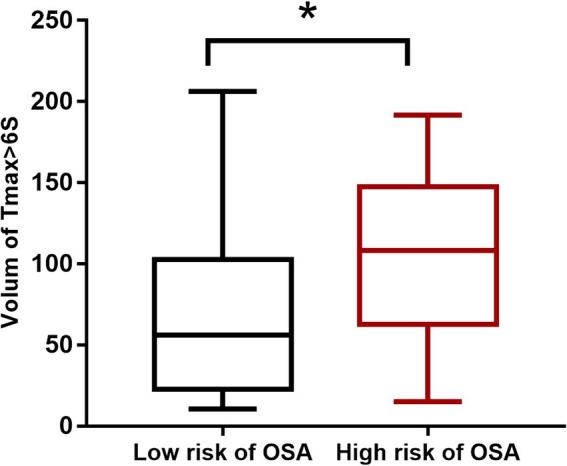
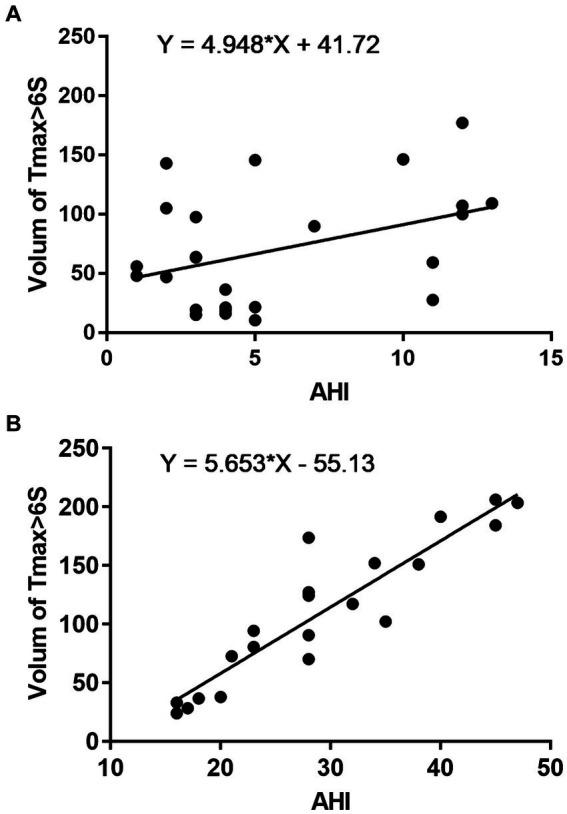
The Tmax >6 s volume in the AHI > 15 group was significantly larger than that in the AHI ≤ 15 group [109 (62-157) vs. 59 (21-106) mL, = 0.013]. Spearman's correlation analysis revealed Tmax >6 s volume was significantly correlated with AHI, mean SpO2, ODI, and T90% in the AHI > 15 group, however, no significant correlations were observed in the AHI ≤ 15 group. Controlling for the site of occlusion and Multiphase CT angiography (mCTA) score, AHI (β = 0.919, < 0.001), mean SpO2 (β = -0.460, = 0.031), ODI (β = 0.467, = 0.032), and T90% (β =0.478, = 0.026) remained associated with early hypoperfusion in the AHI > 15 group.
CONCLUSION
In patients with acute cerebral infarction and AHI > 15, AHI, mean SpO2, ODI and T90% were associated with early hypoperfusion. However, no such relationship exists among patients with AHI ≤ 15.
目的
探讨超早期急性脑梗死期间阻塞性睡眠呼吸暂停(OSA)与脑血流灌注不足之间的关系。
患者与方法
回顾性收集2020年1月至2022年1月我院收治的急性脑梗死患者的数据,这些患者在发病6小时内接受了全脑CT灌注成像和血管造影检查。F-stroke软件自动评估并获取相关数据(Tmax)。对患者进行睡眠呼吸暂停初步筛查。根据呼吸暂停低通气指数(AHI),将患者分为AHI≤15(n = 22)组或AHI>15(n = 25)组。比较残余函数达峰时间(Tmax)>6秒时的血容量的组间差异,并分析AHI、平均脉搏血氧饱和度(SpO2)、氧饱和度下降指数(ODI)、血氧饱和度<90%的时间百分比(T90%)与Tmax>6秒时的血容量之间的相关性。
结果
AHI>15组Tmax>6秒时的血容量显著大于AHI≤15组[109(62 - 157)ml对59(21 - 106)ml,P = 0.013]。Spearman相关性分析显示,AHI>15组中Tmax>6秒时的血容量与AHI、平均SpO2、ODI和T90%显著相关,然而,AHI≤15组中未观察到显著相关性。在控制闭塞部位和多期CT血管造影(mCTA)评分后,AHI(β = 0.919,P < 0.001)、平均SpO2(β = -0.460,P = 0.031)、ODI(β = 0.467,P = 0.032)和T90%(β = 0.478,P = 0.026)与AHI>15组的早期灌注不足仍相关。
结论
在急性脑梗死且AHI>15的患者中,AHI、平均SpO2、ODI和T90%与早期灌注不足相关。然而,AHI≤15的患者中不存在这种关系。

 Zotero 插件