
一种新型 cgMLST 用于法国 感染的基因组监测,可检测和调查 2017-2021 年的暴发。
A novel cgMLST for genomic surveillance of infections in France allowed the detection and investigation of outbreaks in 2017-2021.
机构信息
Institut Pasteur, Université de Paris Cité, Yersinia Research Unit, Yersinia National Reference Laboratory, WHO Collaborating Centre for Plague Fra-140, Paris, France.
Santé publique France, Infectious Diseases Division, Saint-Maurice, France.
出版信息
Microbiol Spectr. 2024 Jun 4;12(6):e0050424. doi: 10.1128/spectrum.00504-24. Epub 2024 Apr 23.
UNLABELLED
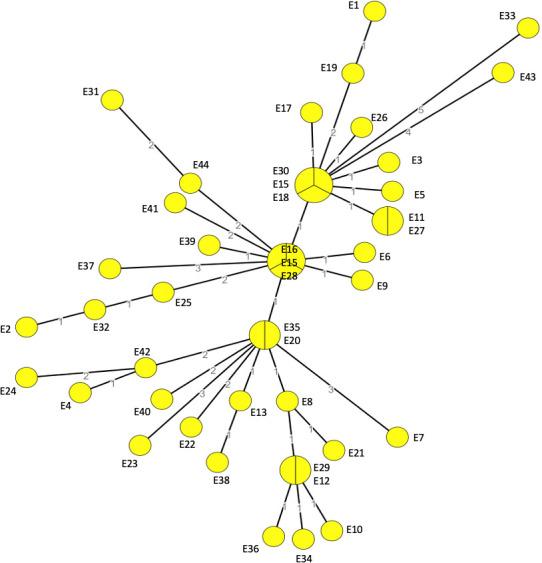
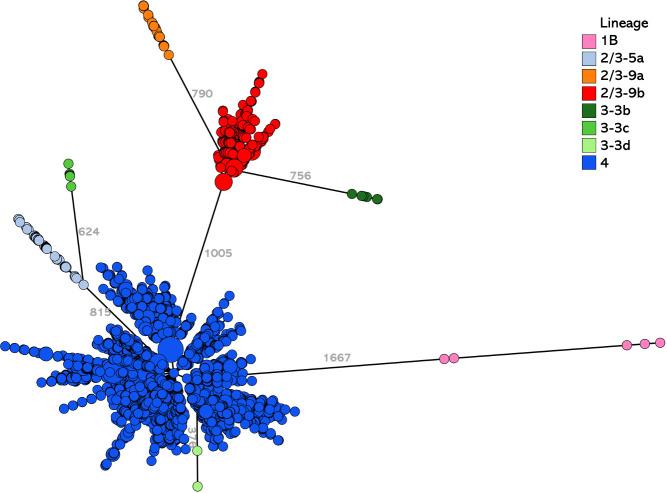
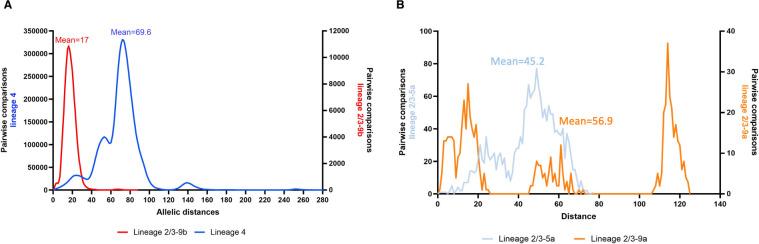
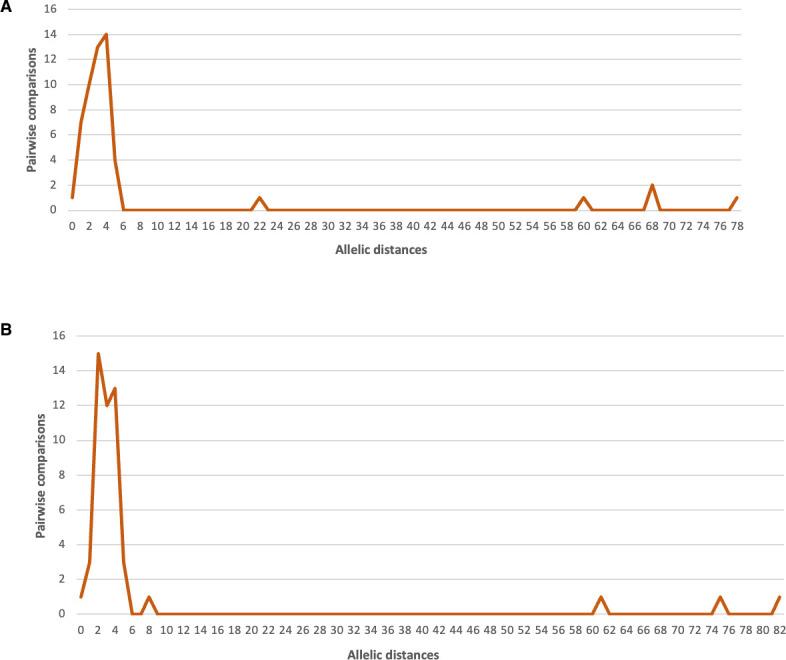
Enteric yersiniosis, the third most common food-borne zoonosis in Europe, is mainly caused by the pathogen . In France the yersiniosis microbiological surveillance is conducted at the National Reference Laboratory (YNRL). Since 2017, isolates have been characterized by whole genome sequencing (WGS) followed by a 500-gene -cgMLST. We report here the data of the WGS-based surveillance on isolates for the 2017-2021 period. The YNRL characterized 7,642 strains distributed in 2,497 non-pathogenic isolates from lineages 1Aa and 1Ab, and 5,145 specimens belonging to 8 pathogenic lineages. Among pathogenic isolates, lineage 4 was the most common (87.2%) followed by lineages 2/3-9b (10.6%), 2/3-5a (1.2%), 2/3-9a (0.6%), 3-3b, 3-3c, 1B, and 3-3d (0.1% per each). Importantly, we developed a routine surveillance system based on a new typing method consisting of a 1,727-genes core genome Multilocus Sequence Typing (cgMLST) specific to the species followed by isolate clustering. Thresholds of allelic distances (AD) were determined and fixed for the clustering of isolates: AD ≤ 5 for lineages 4, 2/3-5a, and 2/3-9a, and AD ≤ 3 for lineage 2/3-9b. Clustering programs were implemented in 2019 in routine surveillance to detect genomic clusters of pathogenic isolates. In total, 419 clusters with at least 2 isolates were identified, representing 2,504 of the 3,503 isolates characterized between 2019 and 2021. Most clusters ( = 325) comprised 2 to 5 isolates. The new typing method proved to be useful for the molecular investigation of unusual grouping of cases as well as for the detection of genomic clusters in routine surveillance.
IMPORTANCE
We describe here the new typing method used for molecular surveillance of infections in France based on a novel core genome Multilocus Sequence Typing (cgMLST) specific to species. This method can reliably identify the pathogenic subspecies and compare the isolates with a high discriminatory power. Between 2017 and 2021, 5,145 pathogenic isolates belonging to 8 lineages were characterized and lineage 4 was by far the most common followed by lineage 2/3-9b. A clustering program was implemented, and detection thresholds were cross-validated by the molecular and epidemiological investigation of three unusual groups of infections. The routine molecular surveillance system has been able to detect genomic clusters, leading to epidemiological investigations.
未加标签
肠耶尔森菌病是欧洲第三大常见的食源性病原体,主要由病原体引起。在法国,耶尔森氏菌病的微生物监测由国家参考实验室(YNRL)进行。自 2017 年以来,通过全基因组测序(WGS)和 500 个基因 -cgMLST 对分离株进行了特征描述。我们在此报告 2017-2021 年期间基于 WGS 的监测的分离株数据。YNRL 对 2497 株来自 1Aa 和 1Ab 谱系的非致病性分离株和 5145 株属于 8 种致病性谱系的标本进行了特征描述。在致病性分离株中,谱系 4 最为常见(87.2%),其次是谱系 2/3-9b(10.6%)、2/3-5a(1.2%)、2/3-9a(0.6%)、3-3b、3-3c、1B 和 3-3d(每种 0.1%)。重要的是,我们开发了一种基于新的分型方法的常规监测系统,该方法包括针对物种的 1727 个基因核心基因组多位点序列分型(cgMLST),然后对分离株进行聚类。确定并固定了等位基因距离(AD)的阈值,用于分离株的聚类:谱系 4、2/3-5a 和 2/3-9a 的 AD≤5,谱系 2/3-9b 的 AD≤3。聚类程序于 2019 年在常规监测中实施,以检测致病性分离株的基因组簇。共确定了 419 个至少包含 2 个分离株的簇,代表了 2019 年至 2021 年期间特征鉴定的 3503 个分离株中的 2504 个。大多数簇(=325)包含 2 到 5 个分离株。新的分型方法对于异常病例分组的分子研究以及常规监测中基因组簇的检测非常有用。
意义
我们在此描述了用于法国感染分子监测的新分型方法,该方法基于针对物种的新型核心基因组多位点序列分型(cgMLST)。该方法能够可靠地识别致病性亚种,并具有高区分能力的分离株进行比较。在 2017 年至 2021 年期间,对属于 8 个谱系的 5145 株致病性分离株进行了特征描述,谱系 4 是迄今为止最常见的,其次是谱系 2/3-9b。实施了聚类程序,并通过对三组不寻常的感染群进行分子和流行病学调查,对检测阈值进行了交叉验证。常规分子监测系统能够检测到基因组簇,从而进行流行病学调查。

 Zotero 插件