
升主动脉手术患者在中等强度抗阻训练期间的血流动力学反应
Hemodynamic Response in Ascending Aorta Surgery Patients during Moderate Intensity Resistance Training.
作者信息
Gottlieb Rikke, Arnskov Kasper, Henriksen Marius, Prescott Eva, Rasmusen Hanne, Dall Christian Have
机构信息
Department of Physical Therapy and Occupational Therapy, Copenhagen University Hospital, Bispebjerg-Frederiksberg Hospital, Copenhagen, Denmark.
Department of Cardiology, Copenhagen University Hospital, Bispebjerg-Frederiksberg Hospital, Copenhagen, Denmark.
出版信息
Transl Sports Med. 2023 Oct 28;2023:7616007. doi: 10.1155/2023/7616007. eCollection 2023.
BACKGROUND
In patients undergoing ascending aortic surgery (AAS), postsurgical physical exercise with a safe and effective exercise prescription is recommended. Resistance training is associated with blood pressure (BP) elevations that may increase the risk of new aortic dissection or rupture. However, the acute hemodynamic response to resistance training for this patient group is unknown.
AIM
The aim of this study was to investigate peak systolic BP (SBP) increases in AAS patients during moderate intensity resistance training.
METHODS
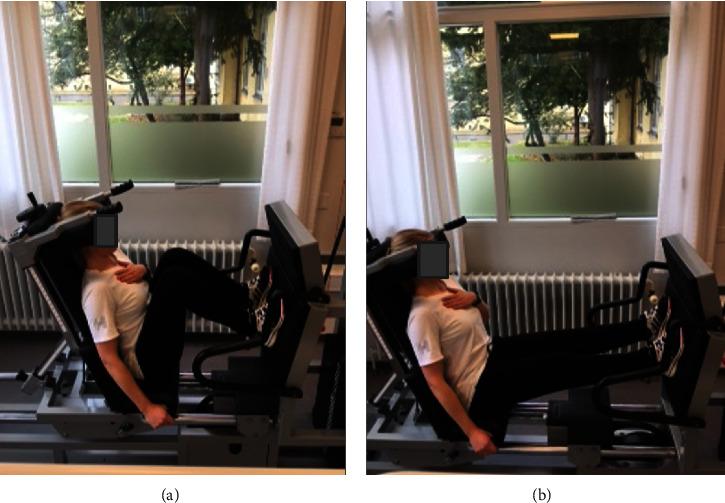
SBP was measured continuously beat-to-beat with a noninvasive method during three sets of leg presses at moderate intensity. A 15-repetition maximum strength test was performed to estimate the maximal amount of resistance a participant could manage 15 times consecutively (equivalent to approximately 60-65% of their maximum strength).
RESULTS
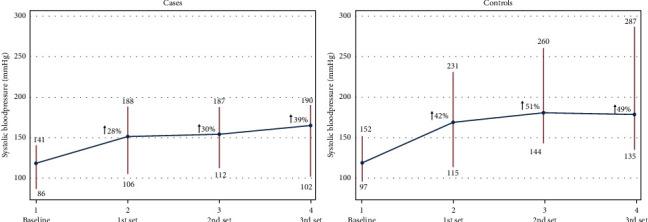
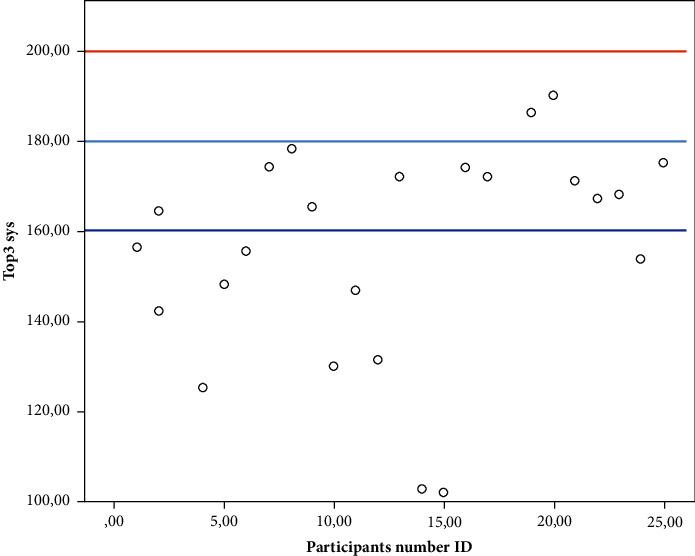
The study had 48 participants in total, i.e., 24 cases and 24 controls. Both groups consisted of 10 females (42%) and 14 males (58%). The case group had a mean age of 60.0 (SD ± 11.9) years and a mean of 16.3 months since surgery (minimum 4.4 and maximum 39.6 months). 22 of the 24 cases received antihypertensive medication. The median baseline BP was 119/74 mmHg among cases and 120/73 mmHg among controls. During the first set of leg presses, the median peak SBP was 152 mmHg, in the second set 154 mmHg, and in the third set 165 mmHg. Corresponding values in controls were 170 mmHg, 181 mmHg, and 179 mmHg. The highest peak SBP registered in an AAS patient was 190 mmHg and in any healthy control was 287 mmHg.
CONCLUSION
The findings indicate that AAS patients in control of their BP have the endurance to perform 3 sets of resistance training at moderate intensity as their SBP increases with a maximum of 39% from the baseline compared to the 51% increase in the control group.
背景
在接受升主动脉手术(AAS)的患者中,建议采用安全有效的运动处方进行术后体育锻炼。阻力训练与血压(BP)升高有关,这可能会增加新发主动脉夹层或破裂的风险。然而,该患者群体对阻力训练的急性血流动力学反应尚不清楚。
目的
本研究的目的是调查AAS患者在中等强度阻力训练期间收缩压(SBP)峰值的升高情况。
方法
在三组中等强度的腿部推举过程中,采用无创方法逐搏连续测量SBP。进行一次15次重复的最大力量测试,以估计参与者能够连续15次承受的最大阻力(相当于其最大力量的约60-65%)。
结果
该研究共有48名参与者,即24例患者和24名对照者。两组均包括10名女性(42%)和14名男性(58%)。病例组的平均年龄为60.0(标准差±11.9)岁,术后平均时间为16.3个月(最短4.4个月,最长39.6个月)。24例患者中有22例接受了抗高血压药物治疗。病例组的基线血压中位数为119/74 mmHg,对照组为120/73 mmHg。在第一组腿部推举期间,SBP峰值中位数为152 mmHg,第二组为154 mmHg,第三组为165 mmHg。对照组的相应值分别为170 mmHg、181 mmHg和179 mmHg。AAS患者记录到的最高SBP峰值为190 mmHg,健康对照者为287 mmHg。
结论
研究结果表明,血压得到控制的AAS患者有耐力进行3组中等强度的阻力训练,因为他们的SBP从基线水平最多升高39%,而对照组升高51%。


 Zotero 插件