
嗜铬细胞瘤患者基于炎症的评分
Inflammation-based Scores in Patients With Pheochromocytoma.
作者信息
Parazzoli Chiara, Prete Alessandro, Favero Vittoria, Aresta Carmen, Pucino Valentina, Ayuk John, Asia Miriam, Elhassan Yasir S, Chiodini Iacopo, Ronchi Cristina L
机构信息
Department of Biotechnology and Translational Medicine, University of Milan, 20100 Milan, Italy.
Institute of Metabolism and Systems Research, University of Birmingham, Birmingham B15 2TT, United Kingdom.
出版信息
J Clin Endocrinol Metab. 2025 Feb 18;110(3):e630-e640. doi: 10.1210/clinem/dgae284.
BACKGROUND
Pheochromocytoma is associated with systemic inflammation but the underlying mechanisms are unclear. Therefore, we investigated the relationship between plasma metanephrine levels and hematological parameters-as a surrogate of inflammation-in patients with pheochromocytoma and the influence of preoperative α-blockade treatment.
DESIGN AND METHODS
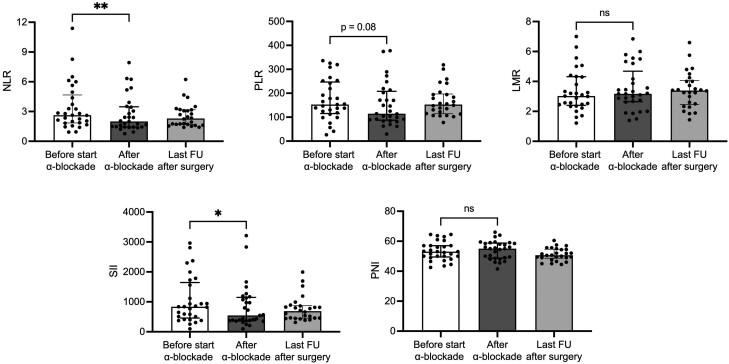
We retrospectively studied 68 patients with pheochromocytoma who underwent adrenalectomy (median age, 53 years; 64.7% females) and 2 control groups matched for age, sex, and body mass index: 68 patients with nonfunctioning adrenocortical tumors and 53 with essential hypertension. The complete blood count and several inflammation-based scores (neutrophil-to-lymphocyte ratio [NLR], platelet-to-lymphocyte ratio [PLR], lymphocyte-to-monocyte ratio [LMR], systemic-immune-inflammation index [SII], prognostic-nutrition index) were assessed in all patients and, in a subset of pheochromocytomas, after adrenalectomy (n = 26) and before and after preoperative α-blockade treatment (n = 29).
RESULTS
A higher inflammatory state, as indicated by both complete blood count and inflammation-based scores, was observed in patients with pheochromocytoma compared with nonfunctioning adrenocortical tumors and essential hypertension. Plasma metanephrine levels showed a positive correlation with NLR (r = 0.4631), PLR (r = 0.3174), and SII (r = 0.3709) and a negative correlation with LMR (r = 0.4368) and prognostic-nutrition index (r = 0.3741), even after adjustment for age, sex, ethnicity, body mass index, and tumor size (except for PLR). After adrenalectomy, we observed a reduction in NLR (P = .001), PLR (P = .003), and SII (P = .004) and a concomitant increase in LMR (P = .0002). Similarly, α-blockade treatment led to a reduction in NLR (P = .007) and SII (P = .03).
CONCLUSION
Inflammation-based scores in patients with pheochromocytoma showed pro-inflammatory changes that correlated with plasma metanephrine levels and are ameliorated by adrenalectomy and α-blockade.
背景
嗜铬细胞瘤与全身炎症相关,但其潜在机制尚不清楚。因此,我们研究了嗜铬细胞瘤患者血浆间甲肾上腺素水平与血液学参数(作为炎症的替代指标)之间的关系以及术前α受体阻滞剂治疗的影响。
设计与方法
我们回顾性研究了68例接受肾上腺切除术的嗜铬细胞瘤患者(中位年龄53岁;64.7%为女性)以及年龄、性别和体重指数相匹配的2个对照组:68例无功能肾上腺皮质肿瘤患者和53例原发性高血压患者。对所有患者进行全血细胞计数和几种基于炎症的评分(中性粒细胞与淋巴细胞比值[NLR]、血小板与淋巴细胞比值[PLR]、淋巴细胞与单核细胞比值[LMR]、全身免疫炎症指数[SII]、预后营养指数)评估,对于一部分嗜铬细胞瘤患者,在肾上腺切除术后(n = 26)以及术前α受体阻滞剂治疗前后(n = 29)进行评估。
结果
与无功能肾上腺皮质肿瘤患者和原发性高血压患者相比,嗜铬细胞瘤患者的全血细胞计数和基于炎症的评分均显示出更高的炎症状态。血浆间甲肾上腺素水平与NLR(r = 0.4631)、PLR(r = 0.3174)和SII(r = 0.3709)呈正相关,与LMR(r = 0.4368)和预后营养指数(r = 0.3741)呈负相关,即使在调整年龄、性别、种族、体重指数和肿瘤大小后(PLR除外)也是如此。肾上腺切除术后,我们观察到NLR(P = 0.001)、PLR(P = 0.003)和SII(P = 0.004)降低,同时LMR升高(P = 0.0002)。同样,α受体阻滞剂治疗导致NLR(P = 0.007)和SII(P = 0.03)降低。
结论
嗜铬细胞瘤患者基于炎症的评分显示出促炎变化,这些变化与血浆间甲肾上腺素水平相关,并通过肾上腺切除术和α受体阻滞剂治疗得到改善。


 Zotero 插件