
共促进聚烯烃塑料在低温下升级循环转化为芳烃。
CO-facilitated upcycling of polyolefin plastics to aromatics at low temperature.
作者信息
Ding Yi, Zhang Shuchi, Liu Cheng, Shao Yu, Pan Xiulian, Bao Xinhe
机构信息
State Key Laboratory of Catalysis, Dalian Institute of Chemical Physics, Chinese Academy of Sciences, Dalian 116023, China.
University of Chinese Academy of Sciences, Beijing 100049, China.
出版信息
Natl Sci Rev. 2024 Mar 15;11(5):nwae097. doi: 10.1093/nsr/nwae097. eCollection 2024 May.
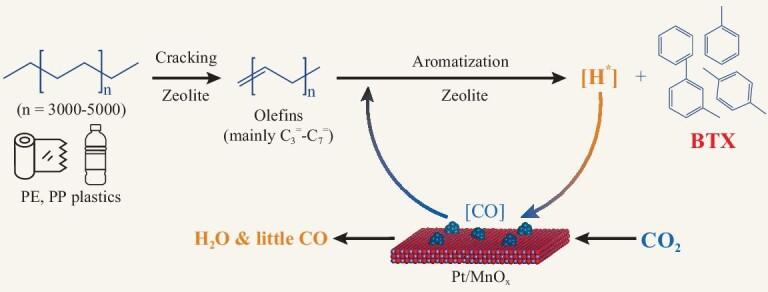
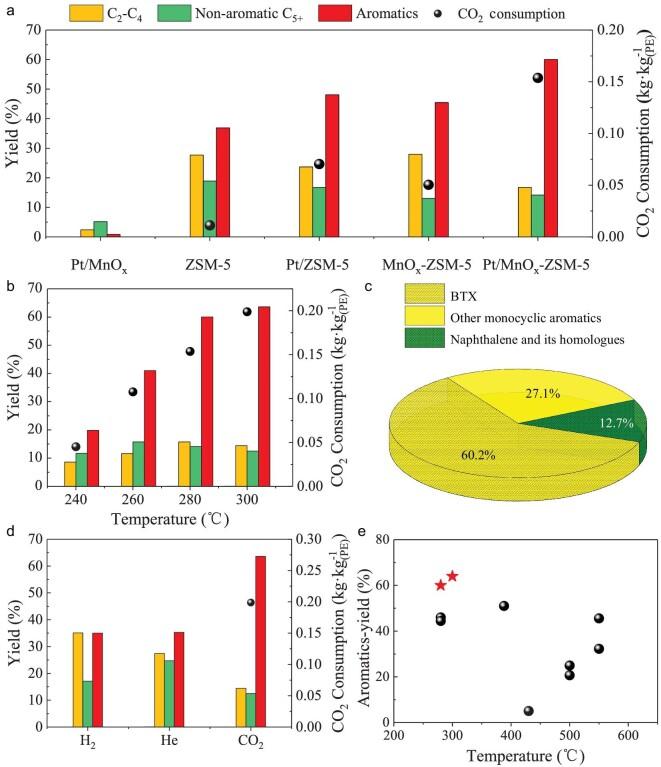
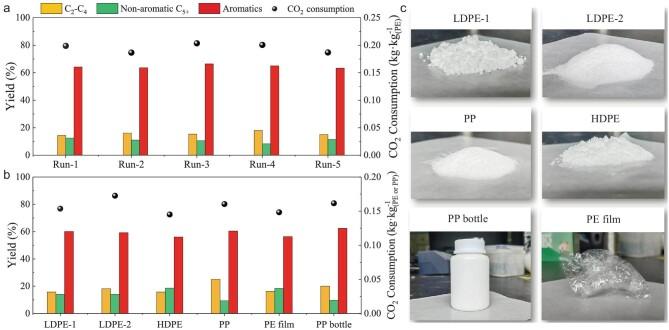
Plastics are one of the most produced synthetic materials and largest commodities, used in numerous sectors of human life. To upcycle waste plastics into value-added chemicals is a global challenge. Despite significant progress in pyrolysis and hydrocracking, which mainly leads to the formation of pyrolysis oil, catalytic upcycling to value-added aromatics, including benzene, toluene and xylene (BTX), in one step, is still limited by high reaction temperatures (>500°C) and a low yield. We report herein CO-facilitated upcycling of polyolefins and their plastic products to aromatics below 300°C, enabled by a bifunctional Pt/MnO-ZSM-5 catalyst. ZSM-5 catalyzes cracking of polyolefins and aromatization, generating hydrogen at the same time, while Pt/MnO catalyzes the reaction of hydrogen with CO, consequently driving the reaction towards aromatization. Isotope experiments reveal that 0.2 kg CO is consumed per 1.0 kg polyethylene and 90% of the consumed CO is incorporated into the aromatic products. Furthermore, this new process yields 0.63 kg aromatics (BTX accounting for 60%), comparing favorably with the conventional pyrolysis or hydrocracking processes, which produce only 0.33 kg aromatics. In this way, both plastic waste and the greenhouse gas CO are turned into carbon resources, providing a new strategy for combined waste plastics upcycling and carbon dioxide utilization.
塑料是产量最高的合成材料之一,也是最大的商品之一,广泛应用于人类生活的众多领域。将废塑料升级转化为高附加值化学品是一项全球性挑战。尽管在热解和加氢裂化方面取得了重大进展,这些方法主要生成热解油,但一步法催化升级转化为包括苯、甲苯和二甲苯(BTX)在内的高附加值芳烃仍受限于高反应温度(>500°C)和低产率。我们在此报告,通过双功能Pt/MnO-ZSM-5催化剂,在低于300°C的温度下实现了聚烯烃及其塑料制品向芳烃的CO促进升级转化。ZSM-5催化聚烯烃的裂解和芳构化,同时生成氢气,而Pt/MnO催化氢气与CO的反应,从而推动反应向芳构化方向进行。同位素实验表明,每1.0千克聚乙烯消耗0.2千克CO,且90%消耗的CO被并入芳烃产物中。此外,这一新工艺可产出0.63千克芳烃(BTX占60%),与传统热解或加氢裂化工艺相比具有优势,传统工艺仅产出0.33千克芳烃。通过这种方式,废塑料和温室气体CO都转化为了碳资源,为废塑料联合升级转化和二氧化碳利用提供了一种新策略。

 Zotero 插件