
中年女性脂肪组织及循环中持久性有机污染物浓度的变化
Changes in Adipose Tissue and Circulating Concentrations of Persistent Organic Pollutants in Midlife Women.
作者信息
Grant-Alfieri Amelia, Devasurendra Amila, Batterman Stuart, Karvonen-Gutierrez Carrie, Park Sung Kyun
机构信息
Department of Environmental Health Sciences, University of Michigan School of Public Health, Ann Arbor, Michigan 48109, United States.
Department of Epidemiology, University of Michigan School of Public Health, Ann Arbor, Michigan 48109, United States.
出版信息
Environ Health (Wash). 2024 Feb 27;2(4):243-252. doi: 10.1021/envhealth.3c00159. eCollection 2024 Apr 19.
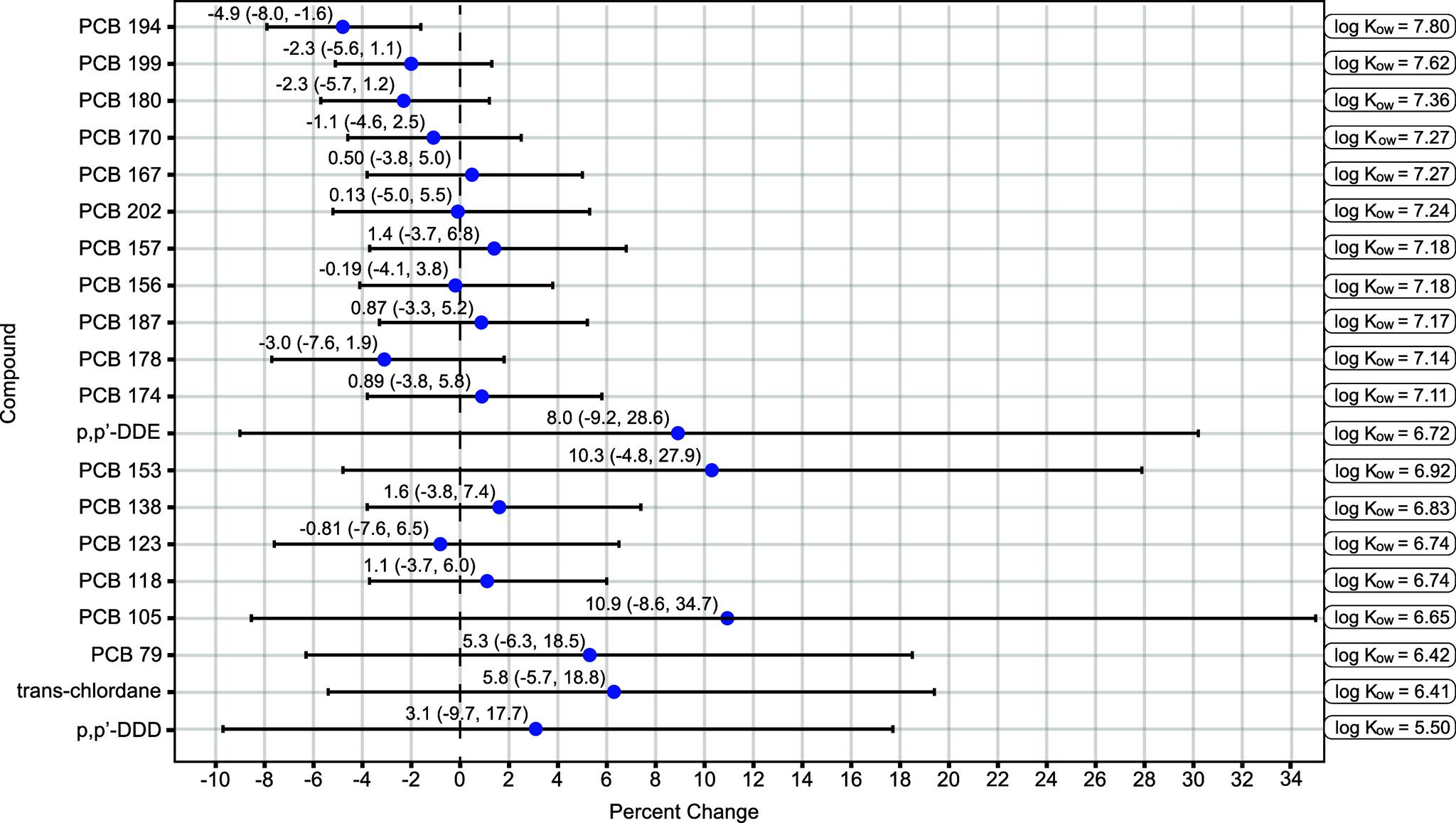
Polychlorinated biphenyls (PCBs) and organochlorine pesticides (OCPs) are persistent organic pollutants (POPs) that bioaccumulate in adipose tissue. We investigated the relationship between change in central adiposity and changes in circulating concentrations of POPs over a 12-year period during the midlife. Serum concentrations of 34 PCBs and 19 OCPs were measured at four time points (1999/2000, 2002/03, 2005/06, 2009/11) in a cohort of midlife women, the Study of Women's Health Across the Nation. Linear mixed models were used to test the association between a change in waist circumference and a change in serum POP concentrations. Sixty-five women contributed 181 PCB observations. Fifty-nine women contributed 151 OCP observations. After adjustment for covariates (study site, race and ethnicity, age at baseline, parity), a one-inch (2.54 cm) increase in the change in waist circumference between visits was associated with a 4.9% decrease in the change in serum concentration of PCB 194 (95% CI: -8.0%, -1.6%). No associations were observed for other PCB congeners or the presence of OCPs. An increase in the difference in waist circumference over time was not associated with a change in the difference in serum concentrations of PCBs and OCPs except for PCB 194, possibly due to the high lipophilicity.
多氯联苯(PCBs)和有机氯农药(OCPs)是持久性有机污染物(POPs),会在脂肪组织中生物累积。我们调查了中年时期12年间中心性肥胖变化与循环中POPs浓度变化之间的关系。在一项针对中年女性的全国女性健康研究队列中,于四个时间点(1999/2000、2002/03、2005/06、2009/11)测量了34种PCBs和19种OCPs的血清浓度。使用线性混合模型来检验腰围变化与血清POPs浓度变化之间的关联。65名女性提供了181份PCB观测数据。59名女性提供了151份OCP观测数据。在对协变量(研究地点、种族和族裔、基线年龄、生育情况)进行调整后,访视间腰围变化每增加1英寸(2.54厘米),与血清中PCB 194浓度变化降低4.9%相关(95%置信区间:-8.0%,-1.6%)。对于其他PCB同系物或OCPs的存在未观察到关联。除了PCB 194外,腰围随时间差异的增加与PCBs和OCPs血清浓度差异的变化无关,这可能是由于其高亲脂性。
 Zotero 插件