
利用机器学习进行下颌骨和牙齿测量的性别判定。
Mandibular and dental measurements for sex determination using machine learning.
机构信息
Department of Orthodontics, Medical Faculty, University Hospital Bonn, Welschnonnenstr. 17, 53111, Bonn, Germany.
Department of Pediatric Dentistry, School of Dentistry of Ribeirão Preto, University of São Paulo, Av. do Café s/n, Ribeirão Preto, São Paulo, 14040-904, Brazil.
出版信息
Sci Rep. 2024 Apr 26;14(1):9587. doi: 10.1038/s41598-024-59556-9.
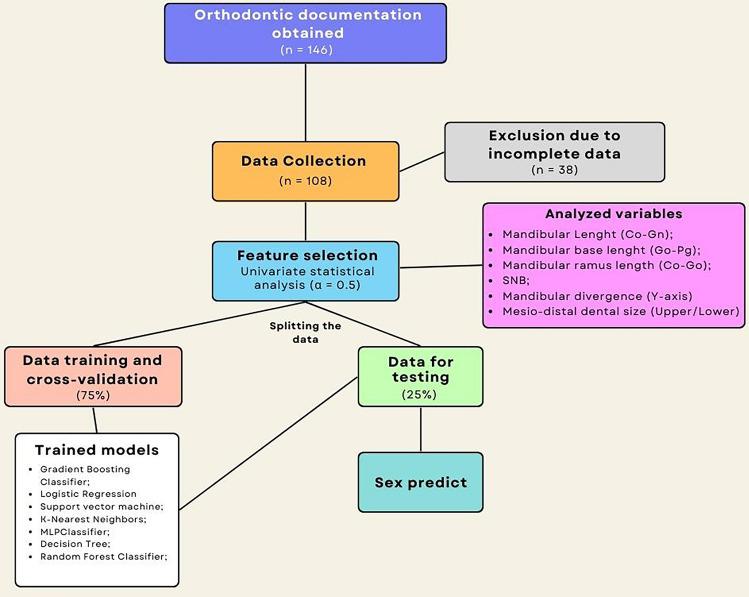
The present study tested the combination of mandibular and dental dimensions for sex determination using machine learning. Lateral cephalograms and dental casts were used to obtain mandibular and mesio-distal permanent teeth dimensions, respectively. Univariate statistics was used for variables selection for the supervised machine learning model (alpha = 0.05). The following algorithms were trained: logistic regression, gradient boosting classifier, k-nearest neighbors, support vector machine, multilayer perceptron classifier, decision tree, and random forest classifier. A threefold cross-validation approach was adopted to validate each model. The areas under the curve (AUC) were computed, and ROC curves were constructed. Three mandibular-related measurements and eight dental size-related dimensions were used to train the machine learning models using data from 108 individuals. The mandibular ramus height and the lower first molar mesio-distal size exhibited the greatest predictive capability in most of the evaluated models. The accuracy of the models varied from 0.64 to 0.74 in the cross-validation stage, and from 0.58 to 0.79 when testing the data. The logistic regression model exhibited the highest performance (AUC = 0.84). Despite the limitations of this study, the results seem to show that the integration of mandibular and dental dimensions for sex prediction would be a promising approach, emphasizing the potential of machine learning techniques as valuable tools for this purpose.
本研究采用机器学习方法检验下颌和牙齿尺寸的组合在性别判定中的应用。侧位头颅片和牙模分别用于获取下颌和近远中永久牙齿的尺寸。采用单变量统计对监督机器学习模型的变量进行选择(alpha=0.05)。训练了以下算法:逻辑回归、梯度提升分类器、k-最近邻、支持向量机、多层感知机分类器、决策树和随机森林分类器。采用三折交叉验证方法对每个模型进行验证。计算曲线下面积(AUC),并构建 ROC 曲线。使用来自 108 个人的数据,使用三个下颌相关测量值和八个牙齿尺寸相关维度来训练机器学习模型。在下颌升支高度和下颌第一磨牙近远中尺寸方面,大多数评估模型都表现出了最大的预测能力。在交叉验证阶段,模型的准确性从 0.64 到 0.74 不等,在测试数据时,准确性从 0.58 到 0.79 不等。逻辑回归模型表现出最高的性能(AUC=0.84)。尽管本研究存在局限性,但结果似乎表明,整合下颌和牙齿尺寸进行性别预测可能是一种很有前途的方法,强调了机器学习技术作为这一目的有价值工具的潜力。


 Zotero 插件