
旨在解决分娩过程中妇女受虐待问题的尊重性孕产护理干预措施:已采取了哪些行动?
Respectful maternity care interventions to address women mistreatment in childbirth: What has been done?
作者信息
Mira-Catalá Pablo, Hernández-Aguado Ildefonso, Chilet-Rosell Elisa
机构信息
Public Health Department, Miguel Hernández University, 03550, Alicante, Spain.
CIBER de Epidemiología y Salud Pública (CIBERESP), 28029, Madrid, Spain.
出版信息
BMC Pregnancy Childbirth. 2024 Apr 26;24(1):322. doi: 10.1186/s12884-024-06524-w.
INTRODUCTION
Over the last decade, there has been an increasing number of studies regarding experiences of mistreatment, disrespect and abuse (D&A) during facility-based childbirth. These negative experiences during labour have been proven to create a barrier for seeking both facility-based childbirth and postnatal health care, as well as increasing severe postpartum depression among the women who experienced them. This constitutes a serious violation of human rights. However, few studies have carried out specifically designed interventions to reduce these practices. The aim of this scoping review is to synthetise available evidence on this subject, and to identify initiatives that have succeeded in reducing the mistreatment, D&A that women suffer during childbirth in health facilities.
METHODS
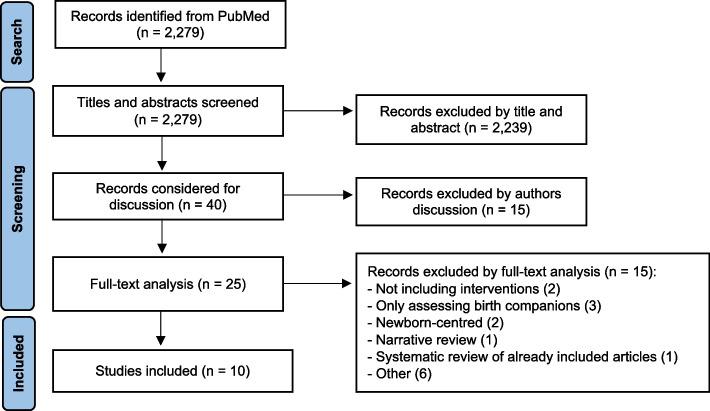
A PubMed search of the published literature was conducted, and all original studies evaluating the efficacy of any type of intervention specifically designed to reduce these negative experiences and promote RMC were selected.
RESULTS
Ten articles were included in this review. Eight studies were conducted in Africa, one in Mexico, and the other in the U.S. Five carried out a before-and-after study, three used mixed-methods, one was a comparative study between birth centres, and another was a quasi-experimental study. The most common feature was the inclusion of some sort of RMC training for providers at the intervention centre, which led to the conclusion that this training resulted in an improvement in the care received by the women in childbirth. Other strategies explored by a small number of articles were open maternity days, clinical checklists, wall posters and constant user feedback.
DISCUSSION
These results indicate that there are promising interventions to reduce D&A and promote RMC for women during childbirth in health facilities. RMC training for providers stands as the most proven strategy, and the results suggest that it improves the experiences of care received by women in labour.
CONCLUSION
The specific types of training and the different initiatives that complement them should be evaluated through further scientific research, and health institutions should implement RMC interventions that apply these strategies to ensure human rights-based maternity care for women giving birth in health facilities around the world.
引言
在过去十年中,关于在医疗机构分娩期间遭受虐待、不尊重和辱骂(D&A)经历的研究越来越多。分娩期间的这些负面经历已被证明会成为寻求医疗机构分娩和产后保健的障碍,同时也会增加经历过这些的女性患严重产后抑郁症的几率。这构成了对人权的严重侵犯。然而,很少有研究开展专门设计的干预措施来减少这些行为。本范围综述的目的是综合关于该主题的现有证据,并确定成功减少女性在医疗机构分娩期间遭受的虐待、不尊重和辱骂行为的举措。
方法
在PubMed上对已发表的文献进行检索,并选择所有评估任何专门设计用于减少这些负面经历并促进尊重产妇保健(RMC)的干预措施效果的原始研究。
结果
本综述纳入了10篇文章。8项研究在非洲进行,1项在墨西哥,另1项在美国。5项进行了前后对照研究,3项采用混合方法,1项是分娩中心之间的比较研究,还有1项是准实验研究。最常见的特征是干预中心为医护人员提供了某种形式的尊重产妇保健培训,由此得出结论,这种培训改善了分娩女性所接受的护理。少数文章探讨的其他策略包括开放产科日、临床检查表、墙贴海报以及持续的用户反馈。
讨论
这些结果表明,有一些有前景的干预措施可减少医疗机构中女性分娩期间的不尊重和辱骂行为并促进尊重产妇保健。为医护人员提供尊重产妇保健培训是最经证实的策略,结果表明它改善了分娩女性的护理体验。
结论
应通过进一步的科学研究评估具体的培训类型及其补充的不同举措,卫生机构应实施采用这些策略的尊重产妇保健干预措施,以确保为世界各地在医疗机构分娩的女性提供基于人权的孕产妇护理。
 Zotero 插件