
用于肿瘤微环境中活化成纤维细胞成像的放射性标记成纤维细胞生长因子-2
Radiolabelled FGF-2 for Imaging Activated Fibroblasts in the Tumor Micro-Environment.
作者信息
Bentivoglio Valeria, Galli Filippo, Varani Michela, Ranieri Danilo, Nayak Pallavi, D'Elia Annunziata, Soluri Andrea, Massari Roberto, Lauri Chiara, Signore Alberto
机构信息
Nuclear Medicine Unit, Department of Medical-Surgical Sciences and of Translational Medicine, Faculty of Medicine and Psychology, "Sapienza" University of Rome, 00189 Rome, Italy.
Department of Life Sciences, Health and Healthcare Professions, University "Link Campus University", 00189 Rome, Italy.
出版信息
Biomolecules. 2024 Apr 18;14(4):491. doi: 10.3390/biom14040491.
UNLABELLED
Tumor associated fibroblasts (TAFs) play a key role in tumor growth and metastatization. TAFs overexpress different biomarkers that are usually expressed at low levels in physiological conditions. Among them are the fibroblast growth factor receptors (FGFRs) that bind the fibroblast growth factors (FGFs). In particular, the overexpression of FGFR-2c in tumors has been associated with advanced clinical stages and increased metastatization. Here, we developed a non-invasive tool to evaluate, in vivo, the expression of FGFR-2c in metastatic cancer. This is based on Tc-labelled FGF-2.
METHODS
Tc-FGF-2 was tested in vitro and in vivo in mice bearing allografts of sarcoma cells. Images of Tc-FGF-2 were acquired using a new portable high-resolution ultra-sensitive gamma camera for small animal imaging.
RESULTS
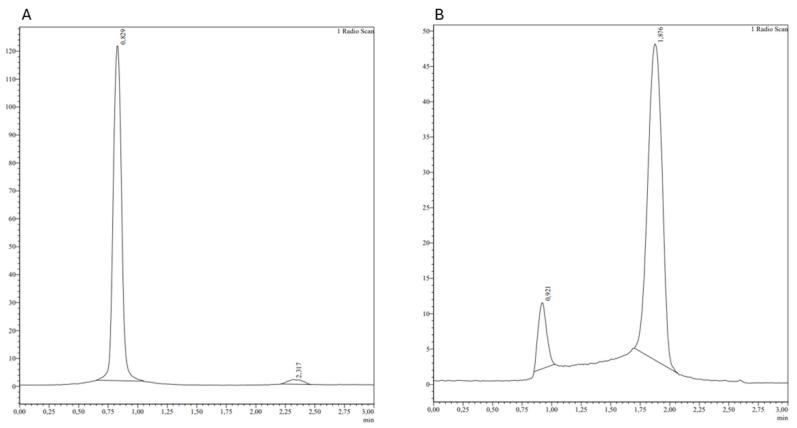
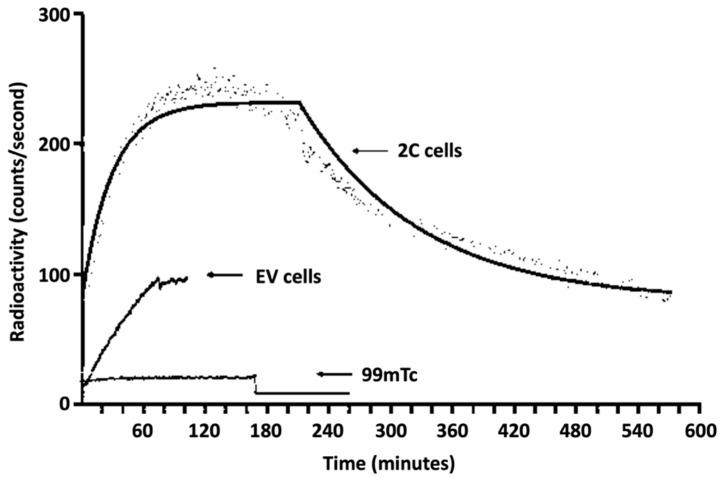
FGF-2 was labeled with high specific activity but low labelling efficiency, thus requiring post-labeling purification by gel-filtration chromatography. In vitro binding to 2C human keratinocytes showed a Kd of 3.36 × 10 M. In mice bearing J774A.1 cell allografts, we observed high and rapid tumor uptake of Tc-FGF-2 with a high Tumor/Blood ratio at 24 h post-injection (26.1 %ID/g and 12.9 %ID) with low kidney activity and moderate liver activity.
CONCLUSIONS
we labeled FGF-2 with Tc and showed nanomolar Kd in vitro with human keratinocytes expressing FGF-2 receptors. In mice, Tc-FGF-2 rapidly and efficiently accumulated in tumors expressing FGF-2 receptors. This new radiopharmaceutical could be used in humans to image TAFs.
未标记
肿瘤相关成纤维细胞(TAFs)在肿瘤生长和转移中起关键作用。TAFs过度表达不同的生物标志物,这些标志物在生理条件下通常低水平表达。其中包括与成纤维细胞生长因子(FGFs)结合的成纤维细胞生长因子受体(FGFRs)。特别是,肿瘤中FGFR-2c的过度表达与晚期临床阶段和转移增加有关。在这里,我们开发了一种非侵入性工具,用于在体内评估转移性癌症中FGFR-2c的表达。这基于锝标记的FGF-2。
方法
在携带肉瘤细胞同种异体移植的小鼠中对锝-FGF-2进行体外和体内测试。使用新型便携式高分辨率超灵敏伽马相机进行小动物成像,获取锝-FGF-2的图像。
结果
FGF-2被高比活度标记但标记效率低,因此需要通过凝胶过滤色谱进行标记后纯化。与2C人角质形成细胞的体外结合显示解离常数为3.36×10 M。在携带J774A.1细胞同种异体移植的小鼠中,我们观察到锝-FGF-2在肿瘤中的摄取高且迅速,注射后24小时肿瘤/血液比高(26.1%ID/g和12.9%ID),肾脏活性低,肝脏活性中等。
结论
我们用锝标记了FGF-2,并在体外与表达FGF-2受体的人角质形成细胞显示出纳摩尔解离常数。在小鼠中,锝-FGF-2在表达FGF-2受体的肿瘤中迅速而有效地积累。这种新的放射性药物可用于人体对TAFs进行成像。





 Zotero 插件