
利用固定化抗菌肽的抗菌水凝胶的抗菌和溶血活性
Antibacterial and Hemolytic Activity of Antimicrobial Hydrogels Utilizing Immobilized Antimicrobial Peptides.
作者信息
Blomstrand Edvin, Posch Elin, Stepulane Annija, Rajasekharan Anand K, Andersson Martin
机构信息
Department of Chemistry and Chemical Engineering, Chalmers University of Technology, Kemigården 4, SE-412 96 Göteborg, Sweden.
Amferia AB, Astra Zeneca BioVentureHub c/o Astra Zeneca, Pepparedsleden 1, SE-431 83 Mölndal, Sweden.
出版信息
Int J Mol Sci. 2024 Apr 10;25(8):4200. doi: 10.3390/ijms25084200.
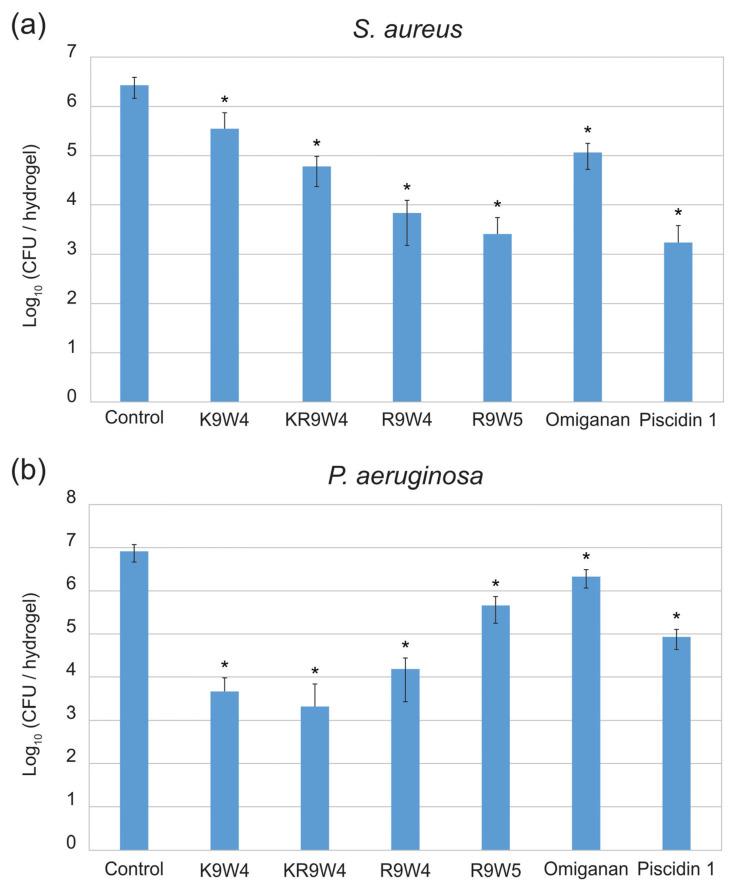
Antimicrobial peptides (AMPs) are viewed as potential compounds for the treatment of bacterial infections. Nevertheless, the successful translation of AMPs into clinical applications has been impeded primarily due to their low stability in biological environments and potential toxicological concerns at higher concentrations. The covalent attachment of AMPs to a material's surface has been sought to improve their stability. However, it is still an open question what is required to best perform such an attachment and the role of the support. In this work, six different AMPs were covalently attached to a long-ranged ordered amphiphilic hydrogel, with their antibacterial efficacy evaluated and compared to their performance when free in solution. Among the tested AMPs were four different versions of synthetic end-tagged AMPs where the sequence was altered to change the cationic residue as well as to vary the degree of hydrophobicity. Two previously well-studied AMPs, Piscidin 1 and Omiganan, were also included as comparisons. The antibacterial efficacy against remained largely consistent between free AMPs and those attached to surfaces. However, the activity pattern against on hydrogel surfaces displayed a marked contrast to that observed in the solution. Additionally, all the AMPs showed varying degrees of hemolytic activity when in solution. This activity was entirely diminished, and all the AMPs were non-hemolytic when attached to the hydrogels.
抗菌肽(AMPs)被视为治疗细菌感染的潜在化合物。然而,AMPs在临床应用中的成功转化主要受到其在生物环境中稳定性低以及高浓度时潜在毒理学问题的阻碍。人们试图将AMPs共价连接到材料表面以提高其稳定性。然而,如何最佳地进行这种连接以及载体的作用仍是一个悬而未决的问题。在这项工作中,六种不同的AMPs被共价连接到一种长程有序的两亲性水凝胶上,评估了它们的抗菌效果,并与它们在溶液中游离时的性能进行了比较。在测试的AMPs中,有四种不同版本的合成末端标记AMPs,其序列被改变以改变阳离子残基并改变疏水性程度。还包括两种先前研究充分的AMPs,即Piscidin 1和Omiganan作为对照。游离AMPs和附着在表面的AMPs对[具体细菌名称缺失]的抗菌效果基本一致。然而,在水凝胶表面对[具体细菌名称缺失]的活性模式与在溶液中观察到的有明显差异。此外,所有的AMPs在溶液中时都表现出不同程度的溶血活性。当附着在水凝胶上时,这种活性完全消失,所有的AMPs都无溶血活性。

 Zotero 插件