
使用吲哚菁绿检测机器人减肥手术中的术中吻合钉线渗漏:一项观察性队列研究。
Use of Indocyanine Green to Detect Intraoperative Staple-Line Leaks in Robotic Bariatric Surgery: An Observational Cohort Study.
作者信息
Meng Muzi, Saini Jaskaran, Fan David, Singh Ajit, Farkas Daniel T
机构信息
School of Medicine, American University of the Carribean, Cupecoy, SXM.
General Surgery, BronxCare Health System, Bronx, USA.
出版信息
Cureus. 2024 Mar 26;16(3):e56991. doi: 10.7759/cureus.56991. eCollection 2024 Mar.
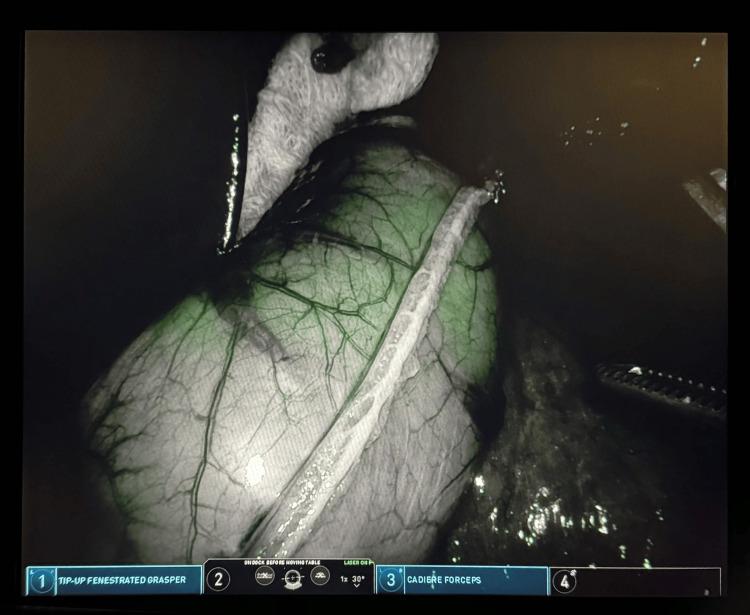
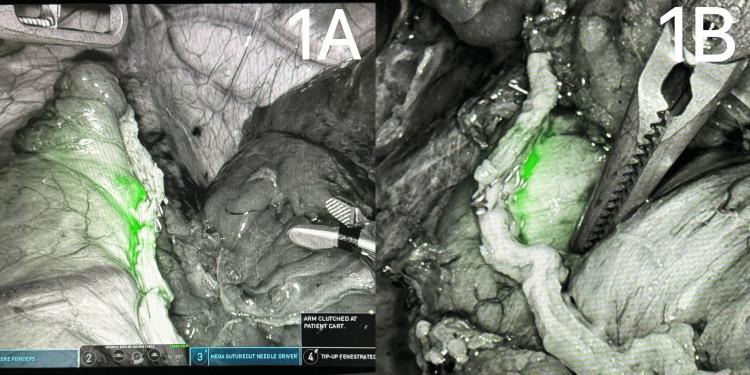
Background Bariatric surgeries aid weight loss in patients with morbid obesity, yet staple-line leaks pose safety concerns. Multiple methods are used to help identify these links. Intraluminal indocyanine green (ICG) has been shown to be useful in other applications, and its use in robotic bariatric surgeries is underexplored. Objective The primary objective of this research project was to demonstrate the usage of intraluminal ICG in detecting staple-line leaks during robotic sleeve gastrectomy and robotic gastric bypass. Settings The research was conducted at Bronxcare Health System between June 2022 and June 2023. Methods We studied 150 consecutive participants undergoing robotic sleeve gastrectomy or robotic gastric bypass. Intraluminal ICG was used in each case in order to identify leaks. Data on comorbidities, detected intraoperative leaks, and detected postoperative leaks were collected. Results Out of the 150 patients who underwent robotic bariatric surgeries (139 for sleeve gastrectomy and 11 for gastric bypass), four cases (two for each procedure) were identified with intraoperative leaks using ICG, resulting in an overall 2.66% incidence rate. In those four patients with intraoperative leaks, reinforcing sutures and a drain were placed. Following the surgeries, none of the patients had radiologic or clinical leaks identified. Conclusions Intraluminal ICG presents a novel approach for detecting staple-line leaks in robotic bariatric surgery. Future studies can be done to look at a larger series of patients and compare leak detection rates between ICG and other methods.
背景
减肥手术有助于病态肥胖患者减重,但吻合钉线渗漏存在安全隐患。人们采用多种方法来帮助识别这些渗漏。腔内吲哚菁绿(ICG)已被证明在其他应用中有用,而其在机器人减肥手术中的应用尚未得到充分探索。目的:本研究项目的主要目的是证明腔内ICG在机器人袖状胃切除术和机器人胃旁路手术中检测吻合钉线渗漏的用途。背景:该研究于2022年6月至2023年6月在布朗克斯医疗系统进行。方法:我们研究了150例连续接受机器人袖状胃切除术或机器人胃旁路手术的参与者。每例均使用腔内ICG来识别渗漏。收集了合并症、术中检测到的渗漏和术后检测到的渗漏数据。结果:在150例行机器人减肥手术的患者中(139例行袖状胃切除术,11例行胃旁路手术),使用ICG识别出4例术中渗漏(每种手术各2例),总体发生率为2.66%。在这4例术中渗漏的患者中,放置了加强缝线和引流管。手术后,所有患者均未发现影像学或临床渗漏。结论:腔内ICG为机器人减肥手术中检测吻合钉线渗漏提供了一种新方法。未来可以开展研究,观察更多患者,并比较ICG与其他方法的渗漏检测率。
 Zotero 插件