
2023年春季立陶宛基于人群的研究样本中SARS-CoV-2特异性抗体的流行情况。
Prevalence of SARS-CoV-2-specific antibodies in a sample of the Lithuanian population-based study in Spring 2023.
作者信息
Simanavičius Martynas, Kučinskaitė-Kodzė Indrė, Kaselienė Snieguolė, Sauliūnė Skirmantė, Gudas Dainius, Jančorienė Ligita, Jasinskienė Rūta, Vitkauskienė Astra, Žūtautienė Rasa, Žvirblienė Aurelija, Stankūnas Mindaugas
机构信息
Institute of Biotechnology, Life Sciences Center, Vilnius University, Saulėtekio al. 7, LT-10257, Vilnius, Lithuania.
Department of Health Management, Lithuanian University of Health Sciences, Tilžės g. 18, LT-47181, Kaunas, Lithuania.
出版信息
Heliyon. 2024 Apr 12;10(8):e29343. doi: 10.1016/j.heliyon.2024.e29343. eCollection 2024 Apr 30.
OBJECTIVES
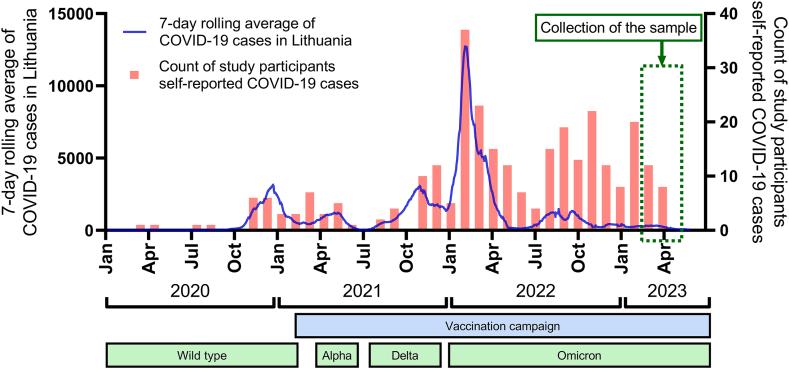
Despite positive trends in SARS-CoV-2 epidemiology, seroprevalence surveys remain an important tool for estimating the magnitude of the COVID-19 pandemic. This study aimed to investigate the prevalence of IgG antibodies against SARS-CoV-2 nucleocapsid (N) and spike (S) proteins in a sample of the Lithuanian population (N = 517) and evaluate how the pattern of seropositivity correlates with the levels of SARS-CoV-2 infection and vaccination.
METHODS
Study participants (aged 18-88 years) filled in the questionnaire self-reporting their demographic-social variables, health status, and SARS-CoV-2-related status. The anti-S and anti-N IgG levels were estimated using a microarray ELISA test.
RESULTS
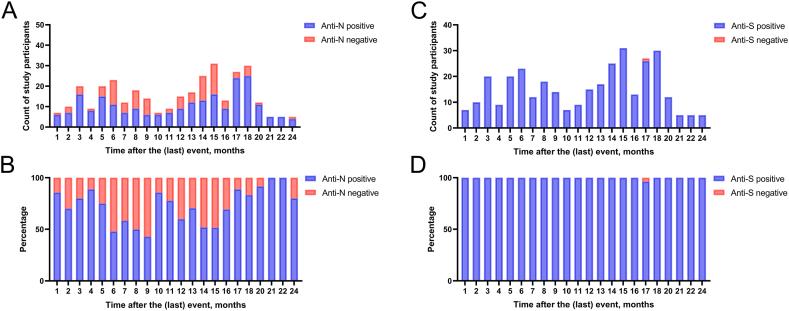
After several pandemic waves and vaccination campaign, the seroprevalence of SARS-CoV-2-specific IgG in the analyzed sample was 97.87 % by March-May 2023. We determined the 96.91 % prevalence of anti-S and 58.03 % prevalence of anti-N IgG. The majority of study participants (71.18 %) had hybrid immunity induced by vaccination and SARS-CoV-2 infection. 20.3 % of study participants were anti-N IgG positive without reporting any previous symptoms or a positive SARS-CoV-2 test. A decline of anti-N IgG positivity within 9 months after infection was observed.
CONCLUSIONS
This study demonstrates high total seroprevalence in March-May 2023 in all age groups indicating a widely established humoral immunity against SARS-CoV-2 in Lithuania.
目的
尽管新冠病毒流行病学呈积极趋势,但血清流行率调查仍是估计新冠疫情规模的重要工具。本研究旨在调查立陶宛人群样本(N = 517)中针对新冠病毒核衣壳(N)蛋白和刺突(S)蛋白的IgG抗体流行情况,并评估血清阳性模式与新冠病毒感染和疫苗接种水平之间的相关性。
方法
研究参与者(年龄在18 - 88岁之间)填写问卷,自我报告其人口统计学 - 社会变量、健康状况以及与新冠病毒相关的状况。使用微阵列ELISA检测法估计抗S和抗N IgG水平。
结果
在经历几次疫情浪潮和疫苗接种活动后,截至2023年3月至5月,分析样本中新冠病毒特异性IgG的血清流行率为97.87%。我们确定抗S IgG的流行率为96.91%,抗N IgG的流行率为58.03%。大多数研究参与者(71.18%)具有由疫苗接种和新冠病毒感染诱导的混合免疫力。20.3%的研究参与者抗N IgG呈阳性,但未报告任何先前症状或新冠病毒检测呈阳性。观察到感染后9个月内抗N IgG阳性率下降。
结论
本研究表明,2023年3月至5月所有年龄组的总血清流行率都很高,这表明立陶宛针对新冠病毒已广泛建立了体液免疫。
 Zotero 插件