
基于 SEER 的人群研究:IA 期非小细胞肺癌的治疗策略。
Treatment strategies for stage IA non-small cell lung cancer: A SEER-based population study.
机构信息
Department of Thoracic Surgery, The Second Affiliated Hospital, Jiangxi Medical College, Nanchang University, Nanchang, 330006, China.
Department of Traditional Chinese Medicine, The Second Affiliated Hospital, Jiangxi Medical College, Nanchang University, Nanchang, 330006, China.
出版信息
PLoS One. 2024 Apr 29;19(4):e0298470. doi: 10.1371/journal.pone.0298470. eCollection 2024.
BACKGROUND
There are various therapeutic methods for treating stage IA (T1N0M0) non-small cell lung cancer (NSCLC), but no studies have systematically assessed multiple treatments to determine the most effective therapy.
METHODS
Stage IA NSCLC patient data collected between 2004 and 2018 were gathered from the Surveillance, Epidemiology, and End Results (SEER) database. Treatment modalities included observation, chemotherapy alone (CA), radiation alone (RA), radiation+chemotherapy (RC), surgery alone (SA), surgery+chemotherapy (SC), surgery+radiation (SR) and surgery+radiation+chemotherapy (SRC). Comparisons were made of overall survival (OS) and lung cancer-specific survival (LCSS) among patients based on different therapeutic methods by survival analysis.
RESULTS
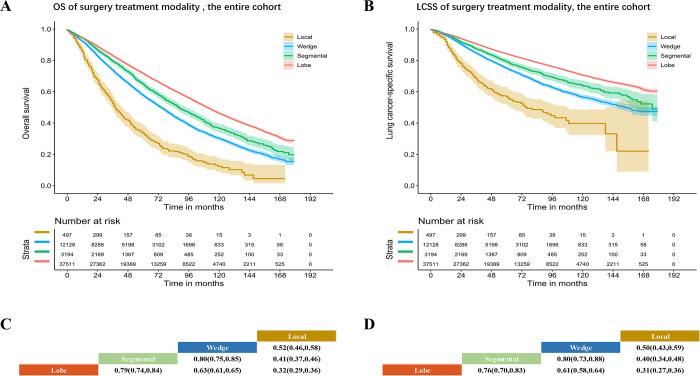
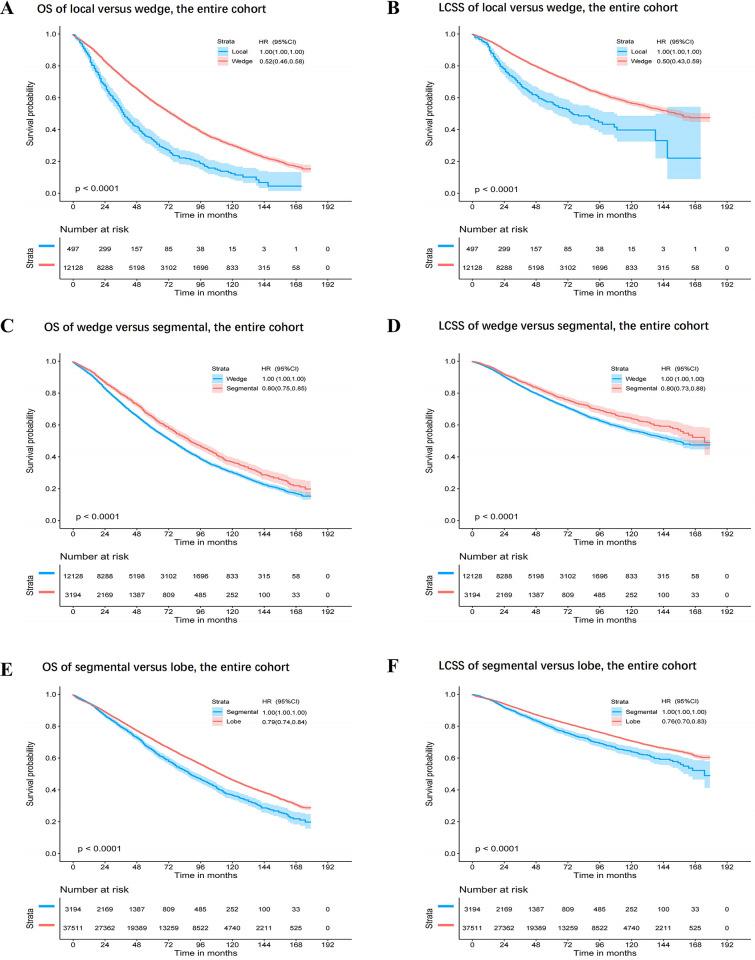
Ultimately, 89147 patients with stage IA NSCLC between 2004 and 2018 were enrolled in this study. The order of multiple treatment modalities based on the hazard ratio (HR) for OS for the entire cohort revealed the following results: SA (HR: 0.20), SC (HR: 0.25), SR (HR: 0.42), SRC (HR: 0.46), RA (HR: 0.56), RC (HR: 0.72), CA (HR: 0.91) (P<0.001), and observation (HR: Ref). The SA group had the best OS and LCSS, and similar results were found in most subgroup analyses (all P<0.001). The order of surgical modalities based on the HR for OS for the entire cohort revealed the following results: lobectomy (HR: 0.32), segmentectomy (HR: 0.41), wedge resection (HR: 0.52) and local tumor destruction (HR: Ref). Lobectomy had the best effects on OS and LCSS, and similar results were found in all subgroup analyses (all P<0.001).
CONCLUSION
SA appeared to be the optimal treatment modality for patients with stage IA NSCLC, and lobectomy was associated with the best prognosis. There may be some indication and selection bias in our study, and the results of this study should be confirmed in a prospective study.
背景
对于治疗 IA 期(T1N0M0)非小细胞肺癌(NSCLC),有多种治疗方法,但尚无研究系统评估多种治疗方法以确定最有效的治疗方法。
方法
从监测、流行病学和最终结果(SEER)数据库中收集了 2004 年至 2018 年期间的 IA 期 NSCLC 患者数据。治疗方式包括观察、单纯化疗(CA)、单纯放疗(RA)、放化疗(RC)、单纯手术(SA)、手术+化疗(SC)、手术+放疗(SR)和手术+放疗+化疗(SRC)。通过生存分析比较不同治疗方法患者的总生存期(OS)和肺癌特异性生存期(LCSS)。
结果
最终,本研究共纳入 2004 年至 2018 年期间的 89147 例 IA 期 NSCLC 患者。基于整个队列的 OS 风险比(HR),多种治疗方式的顺序如下:SA(HR:0.20)、SC(HR:0.25)、SR(HR:0.42)、SRC(HR:0.46)、RA(HR:0.56)、RC(HR:0.72)、CA(HR:0.91)(P<0.001)和观察(HR:Ref)。SA 组的 OS 和 LCSS 最佳,大多数亚组分析结果均相似(均 P<0.001)。基于整个队列的 OS 风险比(HR),手术方式的顺序如下:肺叶切除术(HR:0.32)、肺段切除术(HR:0.41)、楔形切除术(HR:0.52)和局部肿瘤破坏(HR:Ref)。肺叶切除术对 OS 和 LCSS 的效果最佳,所有亚组分析结果均相似(均 P<0.001)。
结论
SA 似乎是 IA 期 NSCLC 患者的最佳治疗方式,肺叶切除术与最佳预后相关。本研究可能存在一定的指示和选择偏倚,需要前瞻性研究进一步证实。


 Zotero 插件