
婚姻自我表露干预对中国胃癌恐惧癌症复发患者的影响:一项准实验研究方案。
Marital Self-Disclosure Intervention for the Fear of Cancer Recurrence in Chinese Patients With Gastric Cancer: Protocol for a Quasiexperimental Study.
机构信息
Nursing Department, Jingjiang People's Hospital, Taizhou, China.
Chinese Nursing Journals Publishing House Co, Ltd, Beijing, China.
出版信息
JMIR Res Protoc. 2024 Apr 29;13:e55102. doi: 10.2196/55102.
BACKGROUND
Patients with gastric cancer experience different degrees of fear of cancer recurrence. The fear of cancer recurrence can cause and worsen many physical and psychological problems. We considered the "intimacy and relationship processes in couples' psychosocial adaptation" model.
OBJECTIVE
The study aims to examine the effectiveness of a marital self-disclosure intervention for improving the level of fear of cancer recurrence and the dyadic coping ability among gastric cancer survivors and their spouses.
METHODS
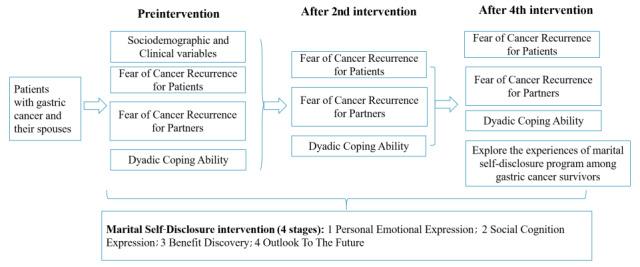
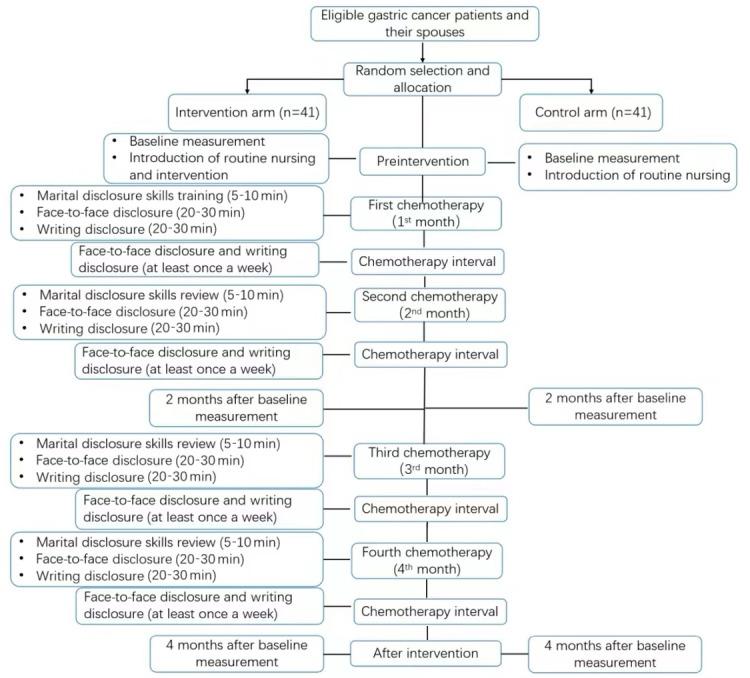
This is a quasiexperimental study with a nonequivalent (pretest-posttest) control group design. The study will be conducted at 2 tertiary hospitals in Taizhou City, Jiangsu Province, China. A total of 42 patients with gastric cancer undergoing chemotherapy and their spouses will be recruited from each hospital. Participants from Jingjiang People's Hospital will be assigned to an experimental group, while participants from Taizhou People's Hospital will be assigned to a control group. The participants in the experimental group will be involved in 4 phases of the marital self-disclosure (different topics, face-to-face) intervention. Patients will be evaluated at baseline after a diagnosis of gastric cancer and reassessed 2 to 4 months after baseline. The primary outcome is the score of the Fear of Progression Questionnaire-Short Form (FoP-Q-SF) for patients. The secondary outcomes are the scores of the FoP-Q-SF for partners and the Dyadic Coping Inventory.
RESULTS
Research activities began in October 2022. Participant enrollment and data collection began in February 2023 and are expected to be completed in 12 months. The primary results of this study are anticipated to be announced in June 2024.
CONCLUSIONS
This study aims to assess a marital self-disclosure intervention for improving the fear of cancer recurrence in Chinese patients with gastric cancer and their spouses. The study is likely to yield desirable positive outcomes as marital self-disclosure is formulated based on evidence and inputs obtained through stakeholder interviews and expert consultation. The study process will be carried out by nurses who have received psychological training, and the quality of the intervention will be strictly controlled.
TRIAL REGISTRATION
ClinicalTrials.gov NCT05606549; https://clinicaltrials.gov/study/NCT05606549.
INTERNATIONAL REGISTERED REPORT IDENTIFIER (IRRID): DERR1-10.2196/55102.
背景
胃癌患者会经历不同程度的癌症复发恐惧。这种对癌症复发的恐惧会导致并加重许多身体和心理问题。我们考虑了“夫妻社会心理适应中的亲密关系和过程”模型。
目的
本研究旨在检验婚姻自我表露干预对改善胃癌幸存者及其配偶的癌症复发恐惧水平和夫妻应对能力的效果。
方法
这是一项准实验研究,采用非等效(前后测)对照组设计。该研究将在江苏省泰州市的两家三级医院进行。每家医院将招募 42 名正在接受化疗的胃癌患者及其配偶。靖江人民医院的参与者将被分配到实验组,而泰州人民医院的参与者将被分配到对照组。实验组的参与者将参与 4 个阶段的婚姻自我表露(不同主题、面对面)干预。患者将在被诊断为胃癌后进行基线评估,并在基线后 2 至 4 个月进行重新评估。主要结局是患者的恐惧进展问卷-短表(FoP-Q-SF)评分。次要结局是伴侣的 FoP-Q-SF 评分和夫妻应对量表。
结果
研究活动于 2022 年 10 月开始。参与者招募和数据收集于 2023 年 2 月开始,预计在 12 个月内完成。预计该研究的主要结果将于 2024 年 6 月公布。
结论
本研究旨在评估一种婚姻自我表露干预措施,以改善中国胃癌患者及其配偶对癌症复发的恐惧。由于婚姻自我表露是基于证据和通过利益相关者访谈和专家咨询获得的投入制定的,因此该研究很可能产生理想的积极结果。研究过程将由接受过心理培训的护士进行,干预质量将得到严格控制。
试验注册
ClinicalTrials.gov NCT05606549;https://clinicaltrials.gov/study/NCT05606549。
国际注册报告标识符(IRRID):DERR1-10.2196/55102。
 Zotero 插件