
绝经后炎症性肠病妇女发生不良心血管结局的风险。
Risk of Adverse Cardiovascular Outcomes in Postmenopausal Women with Inflammatory Bowel Disease.
机构信息
Division of Gastroenterology, Montefiore Medical Center/Albert Einstein College of Medicine, 111 East 210th St, Bronx, NY, 10467, USA.
Fred Hutchinson Cancer Research Center, Seattle, WA, USA.
出版信息
Dig Dis Sci. 2024 Jul;69(7):2586-2594. doi: 10.1007/s10620-024-08348-2. Epub 2024 Apr 29.
BACKGROUND
Individuals with inflammatory bowel disease (IBD) who lack traditional cardiovascular disease (CVD) risk factors, such as young females, are observed to experience adverse CVD outcomes. Whether women with IBD have increased CVD risk after the menopause transition is unclear.
METHODS
We conducted a survival analysis of Women's Health Initiative (WHI) participants and excluded those with missing IBD diagnosis, model covariate data, follow-up data, or a baseline history of the following CVD outcomes: coronary heart disease (CHD), ischemic stroke, venous thromboembolism (VTE), peripheral arterial disease (PAD). Risk of outcomes between IBD and non-IBD women was performed using Cox proportional hazard models, stratified by WHI trial and follow-up. Models were adjusted for age, socio-demographics, comorbidities (e.g., hypertension, diabetes, hypercholesterolemia, etc.), family history, and lifestyle factors (e.g., smoking, alcohol, physical activity, body mass index, etc.).
RESULTS
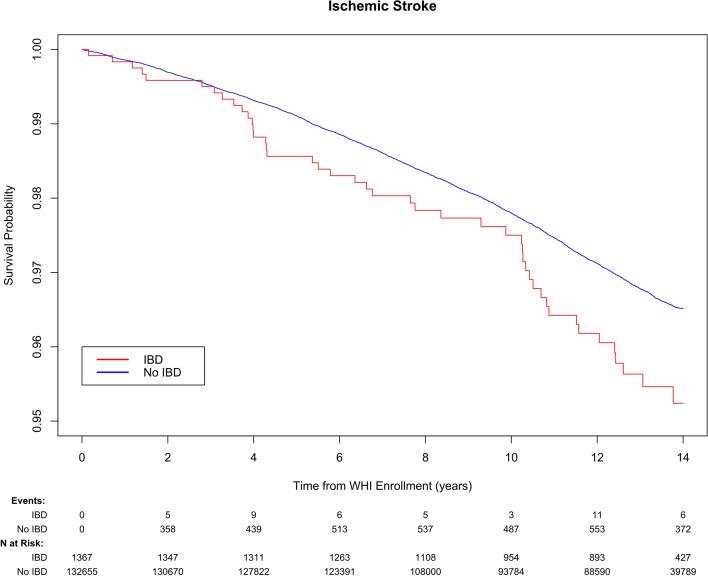
Of 134,022 WHI participants meeting inclusion criteria, 1367 (1.0%) reported IBD at baseline. Mean baseline age was 63.4 years. After adjusting for age and other confounders, no significant difference was observed between IBD and non-IBD women for the risk of CHD (HR 0.96, 95% CI 0.73-1.24), VTE (HR 1.11, 95% CI 0.81-1.52) or PAD (HR 0.64, 95% CI 0.28-1.42). After adjusting for age, risk of ischemic stroke was significantly higher (HR 1.41, 95% CI 1.06-1.88) in IBD than non-IBD women. With further adjustment, the excess risk of ischemic stroke among IBD women was attenuated and no longer statistically significant (HR 1.31, 95% CI 0.98-1.76).
CONCLUSIONS
Among postmenopausal women with IBD, risk of ischemic stroke may be higher than in non-IBD women.
背景
患有炎症性肠病(IBD)且缺乏传统心血管疾病(CVD)危险因素的个体,如年轻女性,观察到存在不良 CVD 结局。IBD 患者在绝经过渡后是否存在更高的 CVD 风险尚不清楚。
方法
我们对妇女健康倡议(WHI)参与者进行了生存分析,并排除了那些缺失 IBD 诊断、模型协变量数据、随访数据或以下 CVD 结局基线史的参与者:冠心病(CHD)、缺血性中风、静脉血栓栓塞(VTE)、外周动脉疾病(PAD)。使用 Cox 比例风险模型对 IBD 和非 IBD 女性的风险进行了分析,按 WHI 试验和随访分层。模型根据年龄、社会人口统计学、合并症(如高血压、糖尿病、高胆固醇血症等)、家族史和生活方式因素(如吸烟、饮酒、身体活动、体重指数等)进行了调整。
结果
在符合纳入标准的 134022 名 WHI 参与者中,有 1367 名(1.0%)在基线时报告患有 IBD。平均基线年龄为 63.4 岁。在调整年龄和其他混杂因素后,IBD 和非 IBD 女性的 CHD(HR 0.96,95%CI 0.73-1.24)、VTE(HR 1.11,95%CI 0.81-1.52)或 PAD(HR 0.64,95%CI 0.28-1.42)风险无显著差异。在调整年龄后,IBD 女性发生缺血性中风的风险显著更高(HR 1.41,95%CI 1.06-1.88)。进一步调整后,IBD 女性缺血性中风的超额风险减弱且不再具有统计学意义(HR 1.31,95%CI 0.98-1.76)。
结论
在患有 IBD 的绝经后妇女中,缺血性中风的风险可能高于非 IBD 妇女。
 Zotero 插件