
骨-神经串扰:骨组织工程神经化的新状态——一篇综述
Bone-nerve crosstalk: a new state for neuralizing bone tissue engineering-A mini review.
作者信息
Damiati Laila A, El Soury Marwa
机构信息
Department of Biological Sciences, College of Science, University of Jeddah, Jeddah, Saudi Arabia.
Department of Clinical and Biological Sciences, University of Torino, Torino, Italy.
出版信息
Front Med (Lausanne). 2024 Apr 16;11:1386683. doi: 10.3389/fmed.2024.1386683. eCollection 2024.
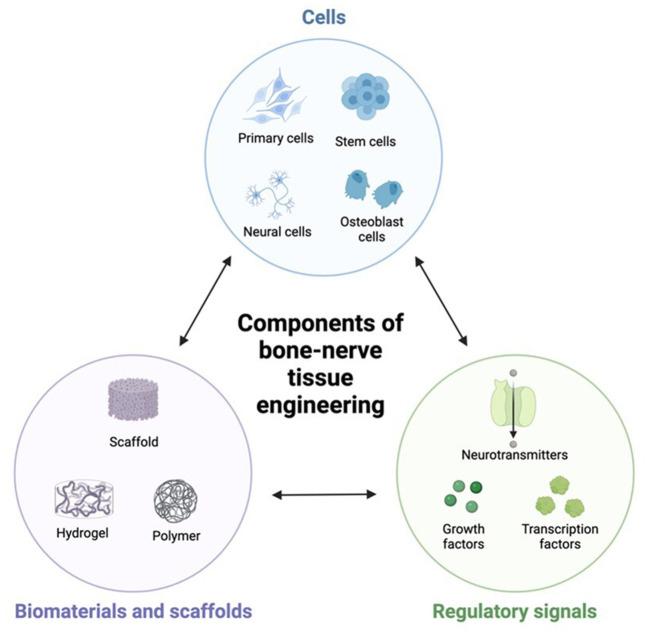
Neuro bone tissue engineering is a multidisciplinary field that combines both principles of neurobiology and bone tissue engineering to develop innovative strategies for repairing and regenerating injured bone tissues. Despite the fact that regeneration and development are considered two distinct biological processes, yet regeneration can be considered the reactivation of development in later life stages to restore missing tissues. It is noteworthy that the regeneration capabilities are distinct and vary from one organism to another (teleost fishes, hydra, humans), or even in the same organism can vary dependent on the injured tissue itself (Human central nervous system vs. peripheral nervous system). The skeletal tissue is highly innervated, peripheral nervous system plays a role in conveying the signals and connecting the central nervous system with the peripheral organs, moreover it has been shown that they play an important role in tissue regeneration. Their regeneration role is conveyed by the different cells' resident in it and in its endoneurium (fibroblasts, microphages, vasculature associated cells, and Schwann cells) these cells secrete various growth factors (NGF, BDNF, GDNF, NT-3, and bFGF) that contribute to the regenerative phenotype. The peripheral nervous system and central nervous system synchronize together in regulating bone homeostasis and regeneration through neurogenic factors and neural circuits. Receptors of important central nervous system peptides such as Serotonin, Leptin, Semaphorins, and BDNF are expressed in bone tissue playing a role in bone homeostasis, metabolism and regeneration. This review will highlight the crosstalk between peripheral nerves and bone in the developmental stages as well as in regeneration and different neuro-bone tissue engineering strategies for repairing severe bone injuries.
神经骨组织工程是一个多学科领域,它结合了神经生物学和骨组织工程的原理,以开发修复和再生受损骨组织的创新策略。尽管再生和发育被认为是两个不同的生物学过程,但再生可以被视为在生命后期阶段发育的重新激活,以恢复缺失的组织。值得注意的是,再生能力各不相同,在不同生物体(硬骨鱼、水螅、人类)之间存在差异,甚至在同一生物体中,也会因受损组织本身而有所不同(人类中枢神经系统与外周神经系统)。骨骼组织有丰富的神经支配,外周神经系统在传递信号以及将中枢神经系统与外周器官连接方面发挥作用,此外,已经表明它们在组织再生中起重要作用。它们的再生作用是由驻留在其中及其神经内膜的不同细胞(成纤维细胞、巨噬细胞、血管相关细胞和雪旺细胞)来传递的,这些细胞分泌各种生长因子(神经生长因子、脑源性神经营养因子、胶质细胞源性神经营养因子、神经营养因子-3和碱性成纤维细胞生长因子),这些因子有助于再生表型。外周神经系统和中枢神经系统通过神经源性因子和神经回路共同调节骨稳态和再生。重要的中枢神经系统肽如血清素、瘦素、信号素和脑源性神经营养因子的受体在骨组织中表达,在骨稳态、代谢和再生中发挥作用。本综述将重点介绍外周神经与骨在发育阶段以及再生过程中的相互作用,以及修复严重骨损伤的不同神经骨组织工程策略。
 Zotero 插件