
青少年感知身体素养与肥胖相关结局的关系:EHDLA 研究。
Relationship between perceived physical literacy and obesity-related outcomes in adolescents: the EHDLA study.
机构信息
Consejería de Educación, Region of Murcia, Murcia, Spain.
Departamento de Ciencias Médicas, Facultad de Medicina, Universidad de Castilla-La Mancha, Albacete, Spain.
出版信息
Front Public Health. 2024 Apr 16;12:1321361. doi: 10.3389/fpubh.2024.1321361. eCollection 2024.
PURPOSE
The aim of the present study was to examine the relationship between perceived physical literacy and obesity-related outcomes among adolescents from Spain.
METHODS
This is a secondary cross-sectional analysis including a total sample of 845 Spanish adolescents (55.3% girls) aged 12-17 years from the (Region of Murcia) from the Eating Healthy and Daily Life Activities (EHDLA) project. Physical literacy was evaluated using the Spanish Perceived Physical Literacy Instrument for adolescents (S-PPLI). Body mass index was computed by taking the participants' body weight in kilograms and dividing it by the square of their height in meters, and body mass index ( score) and overweight/obesity and obesity were computed by the World Health Organization age- and sex-specific thresholds. Waist circumference was measured using a constant tension tape. Moreover, the waist-to-height ratio was calculated, and therefore, abdominal obesity was determined. Skinfold measurements were taken at the triceps and medial calf using calibrated steel calipers.
RESULTS
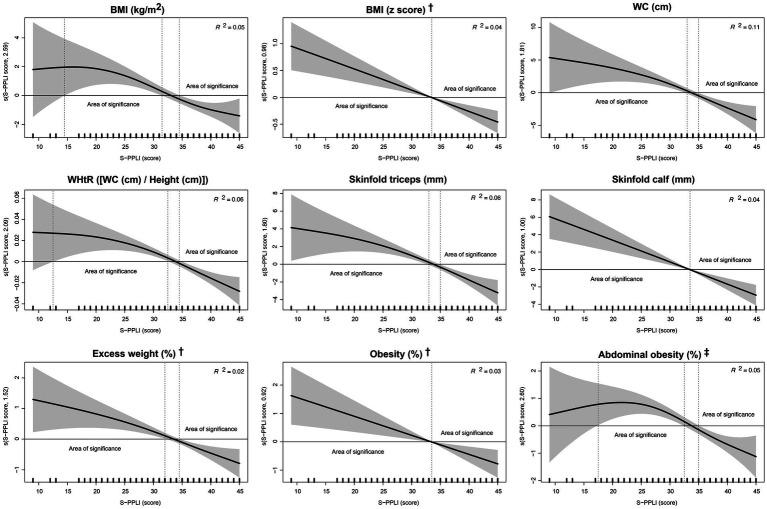
In general, the overall trend was downward (i.e., the higher the PPLI score the lower the obesity-related indicators), with the approximate significance of smooth terms being statistically significant for all models examined ( < 0.001). Adolescents with lower perceived physical literacy (PPL) showed the highest estimated marginal means of body mass index, body mass index score, waist circumference, waist-to-height ratio, and skinfold (triceps and calf) and predictive probabilities of having excess weight, obesity, and abdominal obesity, while their counterparts with high PPL had the lowest. In addition, significant differences were observed for all the obesity-related indications between adolescents with low PPL and those with medium PPL (-adjusted < 0.05 for all indicators), as well as with those with high PPL (-adjusted < 0.05 for all indicators). Moreover, these significant differences were also shown for most indicators between adolescents with medium PPL and those with high PPL (except for obesity).
CONCLUSION
Physical literacy could play a crucial role in maintaining more desirable obesity-related outcomes in adolescents. Adolescents with high perceived physical literacy showed lower obesity-related indicators (i.e., body mass index, body mass index score, waist circumference, waist-to-height ratio, skinfolds), as well as a lower probability of having excess weight, obesity, and abdominal obesity.
目的
本研究旨在探讨西班牙青少年感知身体素养与肥胖相关结局之间的关系。
方法
这是一项包括西班牙埃西哈健康饮食和日常生活活动(EHDLA)项目中 845 名 12-17 岁青少年(55.3%为女孩)的二次横断面分析。使用西班牙青少年感知身体素养量表(S-PPLI)评估身体素养。体重指数(BMI)通过将参与者的体重(kg)除以身高(m)的平方得出,使用世界卫生组织特定年龄和性别的阈值计算 BMI 得分和超重/肥胖及肥胖。腰围使用恒张力带测量。此外,计算腰高比,从而确定腹部肥胖。使用校准钢卡尺在肱三头肌和小腿内侧测量皮褶厚度。
结果
总体而言,趋势呈下降趋势(即,身体素养得分越高,肥胖相关指标越低),所有检查模型的平滑项大致具有统计学意义( < 0.001)。感知身体素养较低(PPL)的青少年,其 BMI、BMI 得分、腰围、腰高比和皮褶(肱三头肌和小腿)的估计边缘均值以及超重、肥胖和腹部肥胖的预测概率最高,而感知身体素养较高的青少年则相反。此外,在所有肥胖相关指标上,低 PPL 青少年与中 PPL 青少年之间(所有指标的调整后 < 0.05)以及与高 PPL 青少年之间(所有指标的调整后 < 0.05)存在显著差异。此外,在大多数肥胖相关指标上,中 PPL 青少年与高 PPL 青少年之间也存在显著差异(肥胖除外)。
结论
身体素养可能在维持青少年更理想的肥胖相关结局方面发挥关键作用。感知身体素养较高的青少年显示出较低的肥胖相关指标(即 BMI、BMI 得分、腰围、腰高比、皮褶),以及较低的超重、肥胖和腹部肥胖的概率。
 Zotero 插件