
认知障碍患者及其护理伙伴的直播群体运动项目:一项随机临床试验。
Livestream, group movement program for people living with cognitive impairment and care partners: A randomized clinical trial.
作者信息
Barnes Deborah E, Jiang Fei, Benjamin Cynthia, Lee Jennifer A, Sudore Rebecca L, Mehling Wolf E, Chesney Margaret A, Chao Linda L, Nicosia Francesca M
机构信息
Department of Psychiatry and Behavioral Sciences University of California, San Francisco San Francisco California USA.
Department of Epidemiology & Biostatistics University of California, San Francisco San Francisco California USA.
出版信息
Alzheimers Dement (N Y). 2024 May 2;10(2):e12467. doi: 10.1002/trc2.12467. eCollection 2024 Apr-Jun.
INTRODUCTION
There are few widely-available, evidence-based options to support quality of life (QOL) for people living with Alzheimer's disease and related dementias.
METHODS
We performed a randomized, controlled trial with a Waitlist control group to determine whether an online, livestream, mind-body, group movement program (Moving Together, 1 hour, 2 days/week, 12 weeks) improves QOL in people with cognitive impairment (PWCI) or care partners (CPs) and explore mechanisms of action. The primary outcome for both participants was self-reported QOL. Secondary outcomes and potential mediators included mobility, isolation, well-being, cognitive function, and sleep in PWCI and burden, positive emotions, caregiver self-efficacy, stress management, and sleep in CPs. Blinded assessors collected outcome data at baseline, 12, and 24 weeks. We assessed adverse events including falls through monthly check-in surveys and collected qualitative data through evaluation surveys. Intention-to-treat analyses used linear mixed models to compare mean change over time between groups and calculated standardized effect sizes (ESs).
RESULTS
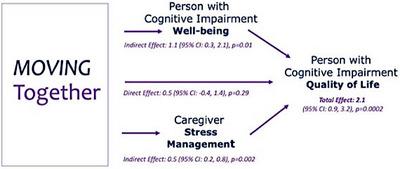
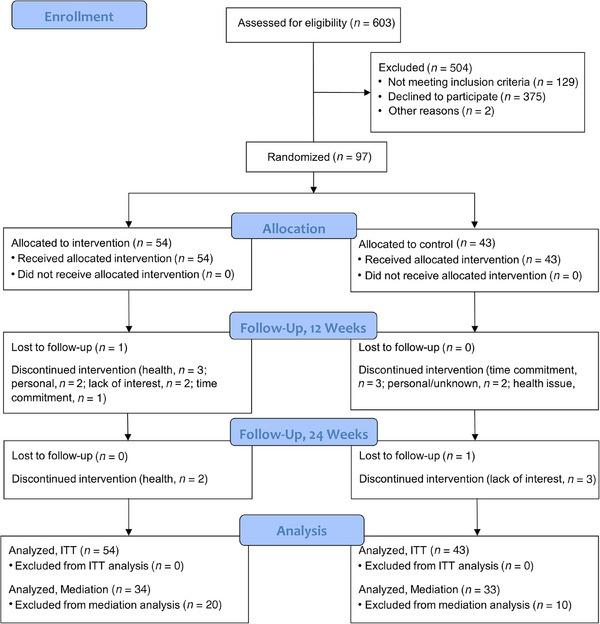
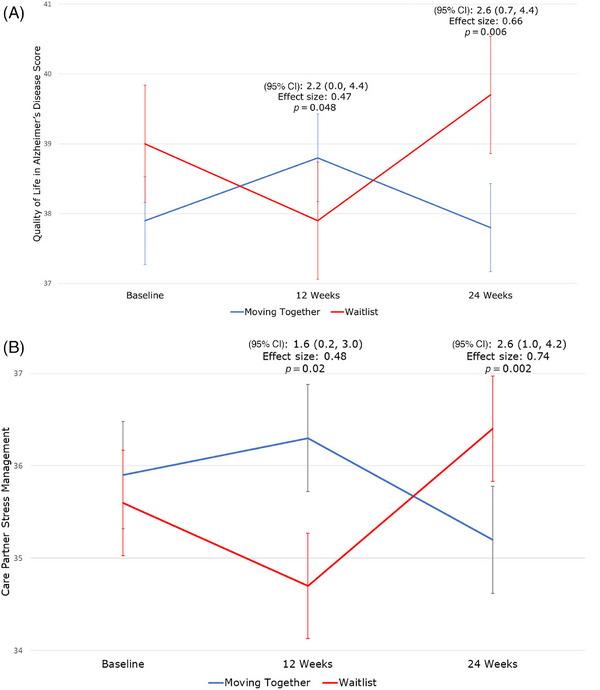
Ninety-seven dyads enrolled (PWCI: age 76 ± 11 years, 43% female, 80% non-Hispanic White; CPs: age 66 ± 12 years, 78% female, 71% non-Hispanic White); 15% withdrew before 12 weeks and 22% before 24 weeks. PWCI self-reported significantly better QOL from baseline to 12 weeks in the Moving Together group compared to the Waitlist group (ES = 0.474, = 0.048) and CPs self-reported improved ability to manage stress (ES = 0.484, = 0.021). Improvements in participant self-reported QOL were mediated by improvements in their self-reported well-being and CP-reported ability to manage stress. Results were similar when the Waitlist group participated in the program (QOL ES = 0.663, = 0.006; stress management ES = 0.742, = 0.002) and were supported by qualitative data. Exploratory analyses suggested possible fall reduction in PWCI. There were no study-related serious adverse events.
DISCUSSION
Online programs such as Moving Together offer a scalable strategy for supporting high QOL for PWCI and helping CPs manage stress.
TRIAL REGISTRATION
ClinicalTrials.gov NCT04621448.
HIGHLIGHTS
The approval of new medications that slow cognitive decline in people living with Alzheimer's disease and related disorders (ADRD) has raised hope and excitement. However, these medications do not appear to impact quality of life, which is often considered by patients and care partners to be the most important outcome.In this randomized clinical trial, we found that an evidence-based, online, livestream, mind-body, group movement program significantly and meaningfully improves self-rated quality of life in people with ADRD and helps care partners manage stress. Mediation analyses revealed that the key drivers of improvements in participants' quality of life were improvements in their feelings of well-being and care partners' ability to manage stress. Exploratory analyses also suggested a 30% reduction in falls.These results are important because they suggest that an online program, which is available now and can be performed by people from the comfort of home or other location of choice, could be recommended as a complement or alternative to new therapies to help maximize quality of life for people living with ADRD and their care partners.
引言
对于患有阿尔茨海默病及相关痴呆症的人来说,几乎没有广泛可用的、基于证据的方法来支持其生活质量(QOL)。
方法
我们进行了一项随机对照试验,设有等待名单对照组,以确定一个在线直播的身心团体运动项目(一起运动,1小时,每周2天,共12周)是否能改善认知障碍患者(PWCI)或护理伙伴(CPs)的生活质量,并探索其作用机制。两组参与者的主要结局均为自我报告的生活质量。次要结局和潜在中介因素包括PWCI的活动能力、孤独感、幸福感、认知功能和睡眠,以及CPs的负担、积极情绪、护理者自我效能感、压力管理和睡眠。盲法评估人员在基线、12周和24周时收集结局数据。我们通过每月的签到调查评估包括跌倒在内的不良事件,并通过评估调查收集定性数据。意向性分析使用线性混合模型比较组间随时间的平均变化,并计算标准化效应量(ESs)。
结果
97对参与者入组(PWCI:年龄76±11岁,43%为女性,80%为非西班牙裔白人;CPs:年龄66±12岁,78%为女性,71%为非西班牙裔白人);15%在12周前退出,22%在24周前退出。与等待名单组相比,一起运动组的PWCI从基线到12周自我报告的生活质量显著更好(ES = 0.474,P = 0.048),CPs自我报告的压力管理能力有所改善(ES = 0.484,P = 0.021)。参与者自我报告的生活质量改善是由他们自我报告的幸福感和CP报告的压力管理能力的改善所介导的。当等待名单组参与该项目时,结果相似(生活质量ES = 0.663,P = 0.006;压力管理ES = 0.742,P = 0.002),定性数据也支持这一结果。探索性分析表明PWCI的跌倒可能减少。没有与研究相关的严重不良事件。
讨论
像一起运动这样的在线项目为支持PWCI的高生活质量和帮助CPs管理压力提供了一种可扩展的策略。
试验注册
ClinicalTrials.gov NCT04621448。
要点
批准用于减缓阿尔茨海默病及相关疾病(ADRD)患者认知衰退的新药物带来了希望和兴奋。然而,这些药物似乎并未影响生活质量,而生活质量通常被患者和护理伙伴视为最重要的结局。在这项随机临床试验中,我们发现一个基于证据的在线直播身心团体运动项目能显著且有意义地改善ADRD患者的自我评定生活质量,并帮助护理伙伴管理压力。中介分析表明,参与者生活质量改善的关键驱动因素是他们幸福感的提升和护理伙伴压力管理能力的提高。探索性分析还表明跌倒减少了30%。这些结果很重要,因为它们表明一个现在就可获得、人们可以在舒适的家中或其他选择的地点进行的在线项目,可以被推荐作为新疗法的补充或替代方案,以帮助最大限度地提高ADRD患者及其护理伙伴的生活质量。
 Zotero 插件