
回避/限制性食物摄入障碍的病程:对体型/体重过度重视的出现。
Course of avoidant/restrictive food intake disorder: Emergence of overvaluation of shape/weight.
作者信息
Kambanis P Evelyna, Mancuso Christopher J, Becker Kendra R, Eddy Kamryn T, Thomas Jennifer J, De Young Kyle P
机构信息
Eating Disorders Clinical and Research Program, Massachusetts General Hospital, Suite 200, Boston, MA, 02114, USA.
Department of Psychiatry, Harvard Medical School, Boston, MA, USA.
出版信息
J Eat Disord. 2024 May 3;12(1):54. doi: 10.1186/s40337-024-01001-3.
BACKGROUND
Avoidant/restrictive food intake disorder (ARFID) is a feeding/eating disorder characterized by avoidance/restriction of food intake by volume and/or variety. The emergence of shape/weight-related eating disorder symptoms in the longitudinal course of ARFID is an important clinical phenomenon that is neither robustly documented nor well understood. We aimed to characterize the emergence of eating disorder symptoms among adults with an initial diagnosis of ARFID who ultimately developed other eating disorders.
METHOD
Thirty-five participants (94% female; M = 23.17 ± 5.84 years) with a history of ARFID and a later, separate eating disorder completed clinical interviews (i.e., Structured Clinical Interview for DSM-5 - Research Version and Longitudinal Interval Follow-Up Evaluation) assessing the period between ARFID and the later eating disorder. Participants used calendars to aid in recall of symptoms over time. Descriptive statistics characterized the presence, order of, and time to each symptom. Paired samples t-tests compared weeks to emergence between symptoms.
RESULTS
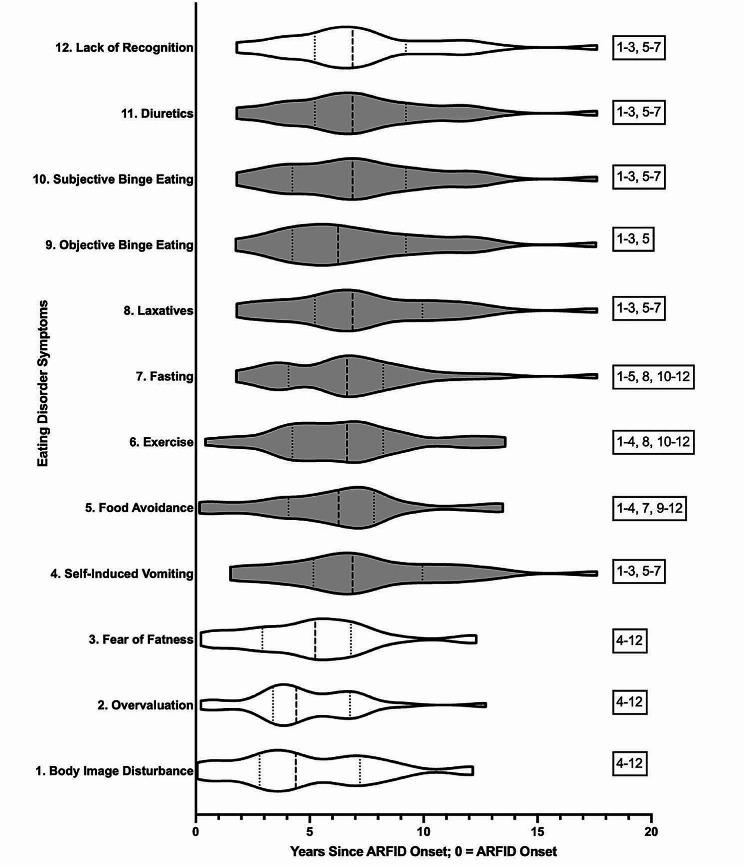
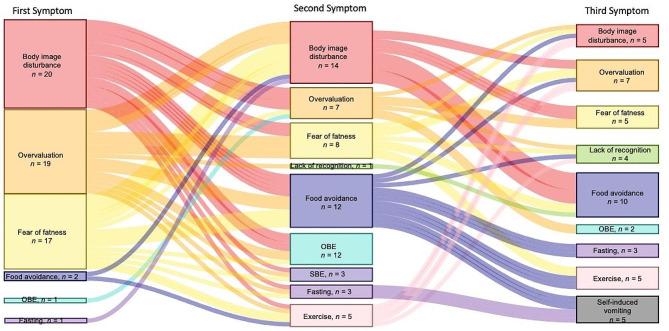
Most participants (71%) developed restricting eating disorders; the remainder (29%) developed binge-spectrum eating disorders. Cognitive symptoms (e.g., shape/weight concerns) tended to onset initially and were followed by behavioral symptoms. Shape/weight-related food avoidance presented first, objective binge eating, fasting, and excessive exercise occurred next, followed by subjective binge eating and purging.
CONCLUSIONS
Diagnostic crossover from ARFID to another (typically restricting) eating disorder following the development of shape/weight concerns may represent the natural progression of a singular clinical phenomenon. Findings identify potential pathways from ARFID to the development of another eating disorder, highlighting possible clinical targets for preventing this outcome.
背景
回避/限制性食物摄入障碍(ARFID)是一种喂养/进食障碍,其特征是食物摄入量和/或种类的回避/限制。在ARFID的纵向病程中出现与体型/体重相关的进食障碍症状是一个重要的临床现象,但尚未得到充分记录和理解。我们旨在描述最初诊断为ARFID并最终发展为其他进食障碍的成年人中进食障碍症状的出现情况。
方法
35名有ARFID病史且后来患有另一种进食障碍的参与者(94%为女性;平均年龄23.17±5.84岁)完成了临床访谈(即《精神疾病诊断与统计手册》第5版研究版结构化临床访谈和纵向间隔随访评估),评估了从ARFID到后来进食障碍的时间段。参与者使用日历来帮助回忆症状出现的时间。描述性统计描述了每种症状的存在情况、出现顺序和出现时间。配对样本t检验比较了症状出现的周数。
结果
大多数参与者(71%)发展为限制性进食障碍;其余参与者(29%)发展为暴食谱系进食障碍。认知症状(如对体型/体重的关注)往往首先出现,随后是行为症状。与体型/体重相关的食物回避首先出现,客观的暴饮暴食、禁食和过度运动随后出现,接着是主观的暴饮暴食和清除行为。
结论
在出现对体型/体重的关注后,从ARFID诊断转变为另一种(通常是限制性的)进食障碍可能代表了一种单一临床现象的自然发展过程。研究结果确定了从ARFID发展为另一种进食障碍的潜在途径,突出了预防这一结果的可能临床靶点。
 Zotero 插件