
通过烯烃中间体过程进行聚乙烯解聚的串联多相催化。
Tandem Heterogeneous Catalysis for Polyethylene Depolymerization via an Olefin-Intermediate Process.
作者信息
Ellis Lucas D, Orski Sara V, Kenlaw Grace A, Norman Andrew G, Beers Kathryn L, Román-Leshkov Yuriy, Beckham Gregg T
机构信息
Renewable Resources and Enabling Sciences Center, National Renewable Energy Laboratory, Golden, Colorado 80401, United States.
Materials Science and Engineering Division, National Institute of Standards and Technology, Gaithersburg, Maryland 20899, United States.
出版信息
ACS Sustain Chem Eng. 2021 Jan 8;9(2):623-628. doi: 10.1021/acssuschemeng.0c07612. eCollection 2021 Jan 18.
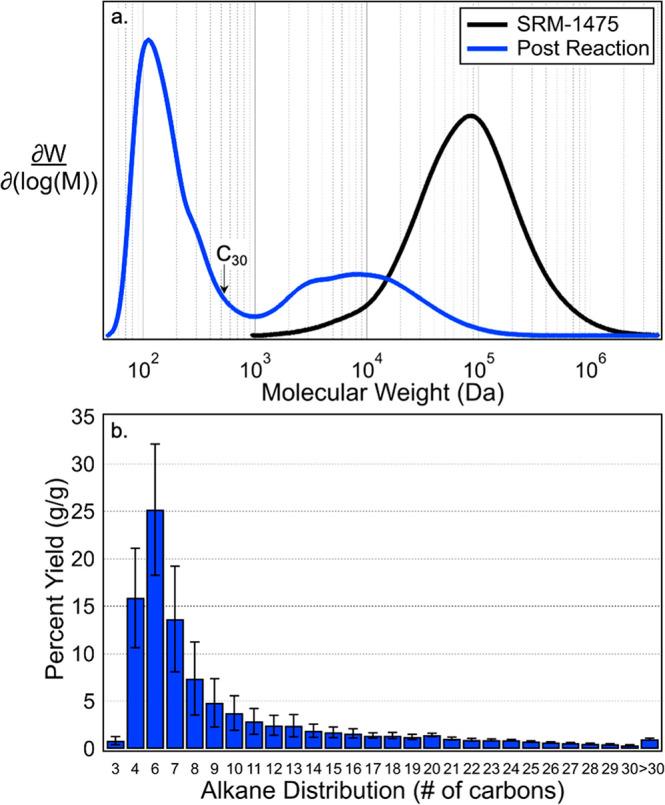
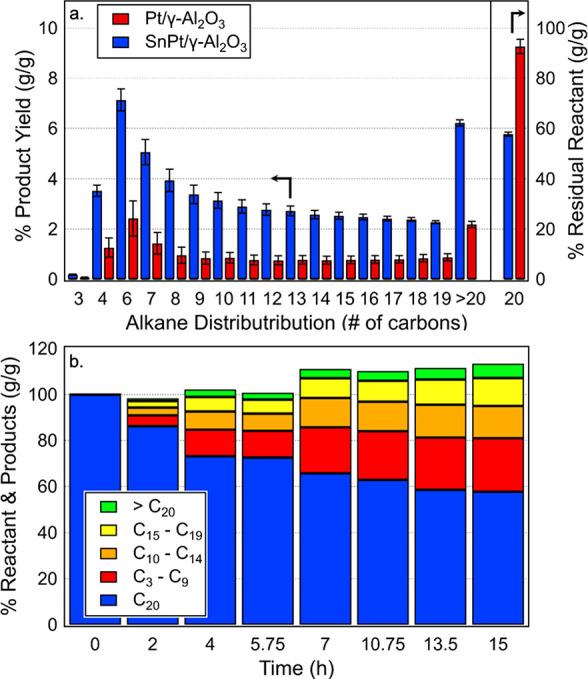
The accumulation of plastic waste in the environment has prompted the development of new chemical recycling technologies. A recently reported approach employed homogeneous organometallic catalysts for tandem dehydrogenation and olefin cross metathesis to depolymerize polyethylene (PE) feedstocks to a mixture of alkane products. Here, we build on that prior work by developing a fully heterogeneous catalyst system using a physical mixture of SnPt/γ-AlO and ReO/γ-AlO. This heterogeneous catalyst system produces a distribution of linear alkane products from a model, linear C alkane, -eicosane, and from a linear PE substrate (which is representative of high-density polyethylene), both in an -pentane solvent. For the PE substrate, a molecular weight decrease of 73% was observed at 200 °C in 15 h. This type of tandem chemistry is an example of an olefin-intermediate process, in which poorly reactive aliphatic substrates are first activated through dehydrogenation and then functionalized or cleaved by a highly-active olefin catalyst. Olefin-intermediate processes like that examined here offer both a selective and versatile means to depolymerize polyolefins at lower severity than traditional pyrolysis or cracking conditions.
环境中塑料废物的积累促使了新型化学回收技术的发展。最近报道的一种方法采用均相有机金属催化剂进行串联脱氢和烯烃交叉复分解反应,将聚乙烯(PE)原料解聚为烷烃产物的混合物。在此,我们基于之前的工作,开发了一种使用SnPt/γ -AlO和ReO/γ -AlO物理混合物的全非均相催化剂体系。这种非均相催化剂体系在正戊烷溶剂中,能从模型线性C烷烃(二十烷)和线性PE底物(代表高密度聚乙烯)中产生一系列线性烷烃产物。对于PE底物,在200℃下15小时内观察到分子量降低了73%。这种串联化学反应是烯烃中间体过程的一个例子,在该过程中,反应性较差的脂肪族底物首先通过脱氢被活化,然后由高活性烯烃催化剂进行官能化或裂解。像这里所研究的烯烃中间体过程提供了一种选择性且通用的方法,能够在比传统热解或裂解条件更低的苛刻程度下解聚聚烯烃。

 Zotero 插件