
问题智能手机使用对中国年轻人睡眠质量的影响:在一项三波纵向研究中探究焦虑和抑郁作为中介因素的作用
The Impact of Problematic Smartphone Use on Sleep Quality Among Chinese Young Adults: Investigating Anxiety and Depression as Mediators in a Three-Wave Longitudinal Study.
作者信息
Wu Ruipeng, Niu Qiong, Wang Yingting, Dawa Yundan, Guang Zixuan, Song Dongji, Xue Bei, Lu Ciyong, Wang Shaokang
机构信息
Key Laboratory for Molecular Genetic Mechanisms and Intervention Research on High Altitude Disease of Tibet Autonomous Region, School of Medicine, Xizang Minzu University, Xianyang, 712082, People's Republic of China.
Key Laboratory of High Altitude Hypoxia Environment and Life Health, School of Medicine, Xizang Minzu University, Xianyang, 712082, People's Republic of China.
出版信息
Psychol Res Behav Manag. 2024 Apr 29;17:1775-1786. doi: 10.2147/PRBM.S455955. eCollection 2024.
BACKGROUND
Sleep disorders are a significant health issue that urgently needs to be addressed among undergraduate students, and one of the potential underlying problems could be problematic smartphone use (PSU). This study aimed to clarify the relationship between PSU and poor sleep quality by investigating the independent and serial mediating roles of anxiety and depressive symptoms in a population of university students in Tibet, China.
METHODS
A total of 2993 Tibetan college students completed three waves of data surveys, with all participants completing questionnaires on PSU, anxiety, depressive symptoms, and sleep quality (Time 1 (T1) -Time 3 (T3)). Bootstrapped mediation analysis was used to explore the mediating role of anxiety and depressive symptoms in the longitudinal relationship between PSU and sleep quality.
RESULTS
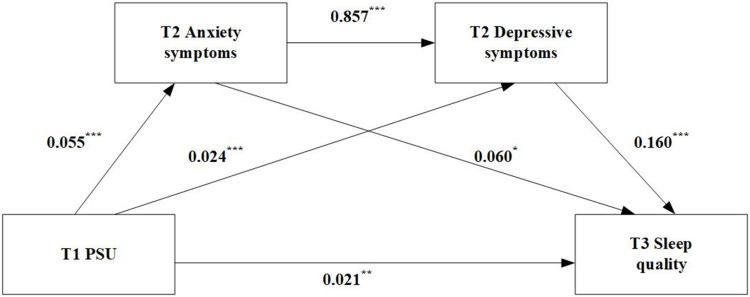
Both direct and indirect effects of PSU on poor sleep quality were found. PSU (T1) can had not only a direct negative influence on poor sleep quality (T3) among young adults (direct effect = 0.021, = 0.010-0.033) but also an indirect negative impact via three pathways: the independent mediating effect of anxiety symptoms (T2) (indirect effect 1 = 0.003, = 0.001-0.006), the independent mediating effect of depressive symptoms (T2) (indirect effect 2 = 0.004, = 0.002-0.006), and the serial mediating effects of anxiety (T2) and depressive symptoms (T2) (indirect effect 3 = 0.008, =0.005-0.011).
CONCLUSION
These findings highlight the role of anxiety and depression symptoms as joint mediating factors in the relationship between PSU and sleep disturbances. Interventions focused on improving sleep that incorporate behavioural measures could benefit from treatment approaches targeting mental disorders.
背景
睡眠障碍是大学生中一个亟待解决的重大健康问题,而潜在的根本问题之一可能是问题性智能手机使用(PSU)。本研究旨在通过调查焦虑和抑郁症状在中国西藏大学生群体中的独立和连续中介作用,阐明PSU与睡眠质量差之间的关系。
方法
共有2993名藏族大学生完成了三轮数据调查,所有参与者均完成了关于PSU、焦虑、抑郁症状和睡眠质量的问卷调查(时间1(T1) - 时间3(T3))。采用自抽样中介分析来探讨焦虑和抑郁症状在PSU与睡眠质量纵向关系中的中介作用。
结果
发现PSU对睡眠质量差既有直接影响,也有间接影响。PSU(T1)不仅对年轻人的睡眠质量差(T3)有直接负面影响(直接效应 = 0.021, = 0.010 - 0.033),还通过三条途径产生间接负面影响:焦虑症状(T2)的独立中介效应(间接效应1 = 0.003, = 0.001 - 0.006)、抑郁症状(T2)的独立中介效应(间接效应2 = 0.004, = 0.002 - 0.006)以及焦虑(T2)和抑郁症状(T2)的连续中介效应(间接效应3 = 0.008, = 0.005 - 0.011)。
结论
这些发现突出了焦虑和抑郁症状作为PSU与睡眠障碍关系中的联合中介因素的作用。侧重于改善睡眠的干预措施,若纳入行为措施,可能会从针对精神障碍的治疗方法中受益。
 Zotero 插件