
用于外泌体微小RNA级联放大传感的哑铃型双发夹触发DNA纳米网组装
Dumbbell Dual-Hairpin Triggered DNA Nanonet Assembly for Cascade-Amplified Sensing of Exosomal MicroRNA.
作者信息
Li Yongxing, Tang Xiaoqi, Deng Ruijia, Feng Liu, Xie Shuang, Chen Ming, Zheng Ji, Chang Kai
机构信息
Department of Clinical Laboratory Medicine, Southwest Hospital, Third Military Medical University (Army Medical University), 30 Gaotanyan, Shapingba District, Chongqing 400038, P. R. China.
Department of Urology, Urologic Surgery Center, Xinqiao Hospital, Third Military Medical University (Army Medical University), 183 Xinqiao, Shapingba District, Chongqing 400037, P. R. China.
出版信息
ACS Omega. 2024 Apr 22;9(17):19723-19731. doi: 10.1021/acsomega.4c02652. eCollection 2024 Apr 30.
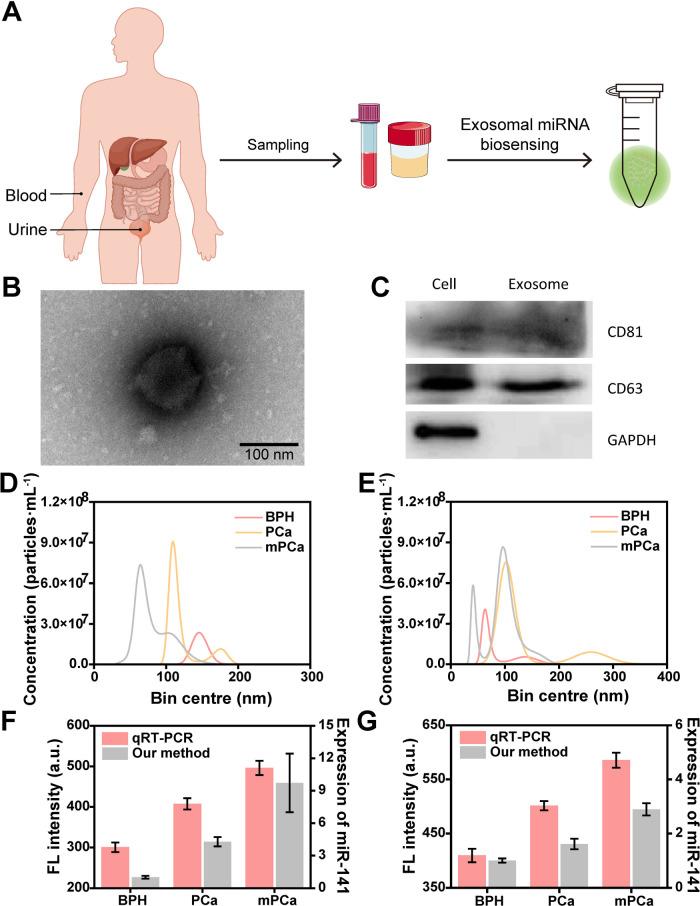
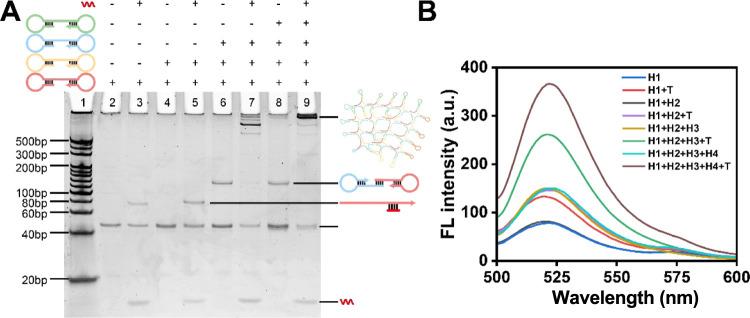
Exosomal microRNAs (miRNAs) are valuable biomarkers closely associated with cancer progression. Therefore, sensitive and specific exosomal miRNA biosensing has been employed for cancer diagnosis, prognosis, and prediction. In this study, a miRNA-based DNA nanonet assembly strategy is proposed, enabling the biosensing of exosomal miRNAs through dumbbell dual-hairpin under isothermal enzyme-free conditions. This strategy dexterously designs a specific dumbbell dual-hairpin that can selectively recognize exosomal miRNA, inducing conformational changes to cascade-generated X-shaped DNA structures, facilitating the extension of the X-shaped DNA in three-dimensional space, ultimately forming a DNA nanonet assembly. On the basis of the target miRNA, our design enriches the fluorescence signal through the cascade assembly of DNA nanonet and realizes the secondary signal amplification. Using exosomal miR-141 as the target, the resultant fluorescence sensing demonstrates an impressive detection limit of 57.6 pM and could identify miRNA sequences with single-base variants with high specificity. Through the analysis of plasma and urine samples, this method effectively distinguishes between benign prostatic hyperplasia, prostate cancer, and metastatic prostate cancer. Serving as a novel noninvasive and accurate screening and diagnostic tool for prostate cancer, this dumbbell dual-hairpin triggered DNA nanonet assembly strategy is promising for clinical applications.
外泌体微小RNA(miRNA)是与癌症进展密切相关的有价值的生物标志物。因此,灵敏且特异的外泌体miRNA生物传感已被用于癌症诊断、预后评估和预测。在本研究中,提出了一种基于miRNA的DNA纳米网组装策略,能够在等温无酶条件下通过哑铃型双发夹实现外泌体miRNA的生物传感。该策略巧妙地设计了一种特异性哑铃型双发夹,其可选择性识别外泌体miRNA,诱导构象变化以级联生成X形DNA结构,促进X形DNA在三维空间中的延伸,最终形成DNA纳米网组装。基于靶标miRNA,我们的设计通过DNA纳米网的级联组装富集荧光信号并实现二次信号放大。以外泌体miR-141为靶标,所得荧光传感表现出令人印象深刻的57.6 pM的检测限,并且能够高度特异性地识别具有单碱基变体的miRNA序列。通过对血浆和尿液样本的分析,该方法能够有效区分良性前列腺增生、前列腺癌和转移性前列腺癌。作为一种用于前列腺癌的新型非侵入性且准确的筛查和诊断工具,这种哑铃型双发夹触发的DNA纳米网组装策略在临床应用方面具有广阔前景。



 Zotero 插件