
湖泊塑料球时空演替过程中的趋同效应:优先效应的丧失和微生物物种的更替
Convergence effect during spatiotemporal succession of lacustrine plastisphere: loss of priority effects and turnover of microbial species.
作者信息
Zhang Weihong, Liang Shuxin, Grossart Hans-Peter, Christie-Oleza Joseph Alexander, Gadd Geoffrey Michael, Yang Yuyi
机构信息
Key Laboratory of Aquatic Botany and Watershed Ecology, Wuhan Botanical Garden, Chinese Academy of Sciences, Wuhan 430074, China.
University of Chinese Academy of Sciences, Beijing 100049, China.
出版信息
ISME Commun. 2024 Apr 18;4(1):ycae056. doi: 10.1093/ismeco/ycae056. eCollection 2024 Jan.
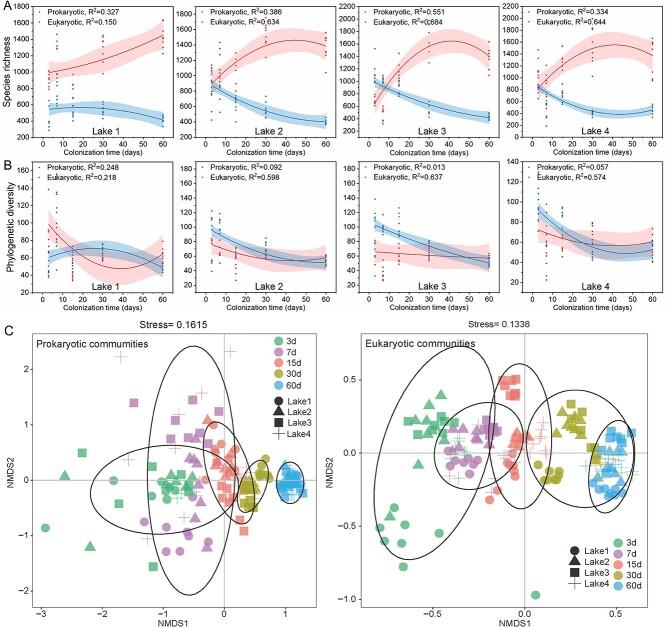
Succession is a fundamental aspect of ecological theory, but studies on temporal succession trajectories and ecological driving mechanisms of plastisphere microbial communities across diverse colonization environments remain scarce and poorly understood. To fill this knowledge gap, we assessed the primary colonizers, succession trajectories, assembly, and turnover mechanisms of plastisphere prokaryotes and eukaryotes from four freshwater lakes. Our results show that differences in microbial composition similarity, temporal turnover rate, and assembly processes in the plastisphere do not exclusively occur at the kingdom level (prokaryotes and eukaryotes), but also depend on environmental conditions and colonization time. Thereby, the time of plastisphere colonization has a stronger impact on community composition and assembly of prokaryotes than eukaryotes, whereas for environmental conditions, the opposite pattern holds true. Across all lakes, deterministic processes shaped the assembly of the prokaryotes, but stochastic processes influenced that of the eukaryotes. Yet, they share similar assembly processes throughout the temporal succession: species turnover over time causes the loss of any priority effect, which leads to a convergent succession of plastisphere microbial communities. The increase and loss of microbial diversity in different kingdoms during succession in the plastisphere potentially impact the stability of entire microbial communities and related biogeochemical cycles. Therefore, research needs to integrate temporal dynamics along with spatial turnovers of the plastisphere microbiome. Taking the heterogeneity of global lakes and the diversity of global climate patterns into account, we highlight the urgency to investigate the spatiotemporal succession mechanism of plastisphere prokaryotes and eukaryotes in more lakes around the world.
演替是生态理论的一个基本方面,但关于不同定殖环境下塑料球微生物群落的时间演替轨迹和生态驱动机制的研究仍然很少,且了解不足。为了填补这一知识空白,我们评估了来自四个淡水湖的塑料球原核生物和真核生物的初级定殖者、演替轨迹、组装和更替机制。我们的结果表明,塑料球中微生物组成相似性、时间周转率和组装过程的差异不仅发生在界水平(原核生物和真核生物),还取决于环境条件和定殖时间。因此,塑料球定殖时间对原核生物群落组成和组装的影响比对真核生物的影响更大,而对于环境条件,情况则相反。在所有湖泊中,确定性过程塑造了原核生物的组装,但随机过程影响了真核生物的组装。然而,它们在整个时间演替过程中具有相似的组装过程:随着时间的推移物种更替导致任何优先效应的丧失,这导致塑料球微生物群落的趋同演替。塑料球演替过程中不同界微生物多样性的增加和丧失可能会影响整个微生物群落的稳定性以及相关的生物地球化学循环。因此,研究需要整合塑料球微生物组的时间动态以及空间更替。考虑到全球湖泊的异质性和全球气候模式的多样性,我们强调迫切需要在世界上更多的湖泊中研究塑料球原核生物和真核生物的时空演替机制。



 Zotero 插件