
肝动脉灌注化疗联合卡瑞利珠单抗加瑞戈非尼治疗伴有门静脉癌栓的肝细胞癌:一项多中心倾向评分匹配分析。
Hepatic artery infusion chemotherapy combined with camrelizumab plus rivoceranib for hepatocellular carcinoma with portal vein tumor thrombosis: a multicenter propensity score-matching analysis.
机构信息
Department of Interventional Radiology and Vascular Surgery, The First Affiliated Hospital of Jinan University, No.613 of West Huangpu Avenue, Guangzhou, Guangdong, 510630, People's Republic of China.
Department of Interventional Therapy, Guangdong Provincial Hospital of Chinese Medicine and Guangdong Provincial Academy of Chinese Medical Sciences, No. 111 Dade Road, 510080, Guangzhou, Guangdong, People's Republic of China.
出版信息
Hepatol Int. 2024 Aug;18(4):1286-1298. doi: 10.1007/s12072-024-10672-8. Epub 2024 May 8.
BACKGROUND
Portal vein tumor thrombosis (PVTT) signifies late-stage hepatocellular carcinoma (HCC) with high-risk progression and poor prognosis. As a standard treatment, sorafenib monotherapy has limited the efficacy in managing HCC with PVTT. Currently, both hepatic arterial infusion chemotherapy (HAIC) and the combination of camrelizumab and rivoceranib have shown favorable survival benefits for advanced HCC, surpassing the standard sorafenib treatment. In this study, we investigate the safety and efficacy of HAIC combined with camrelizumab and rivoceranib in treating HCC patients with PVTT.
METHODS
From January 2020 to December 2021, HCC patients with PVTT, who received either a triple regime of HAIC combined with camrelizumab and rivoceranib or a dual regime of camrelizumab and rivoceranib as their first-line treatment, were reviewed for eligibility at four hospital centers in China. To balance any intergroup differences, propensity score matching (PSM) was applied. The aim of this study is to compare the efficacy of the dual and triple combination treatment regimens based on survival prognosis and tumor response and evaluate the safety based on the occurrence of adverse reactions.
RESULT
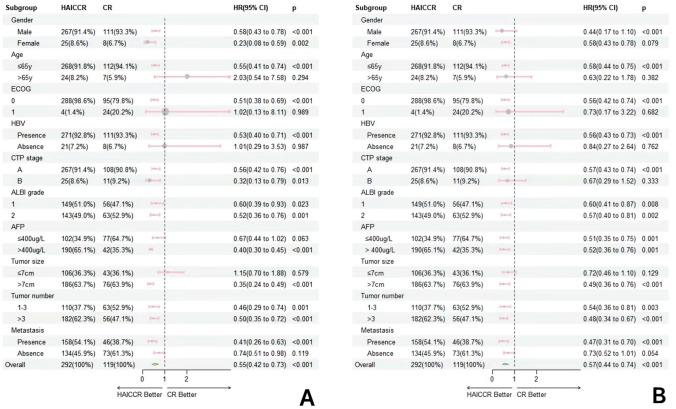
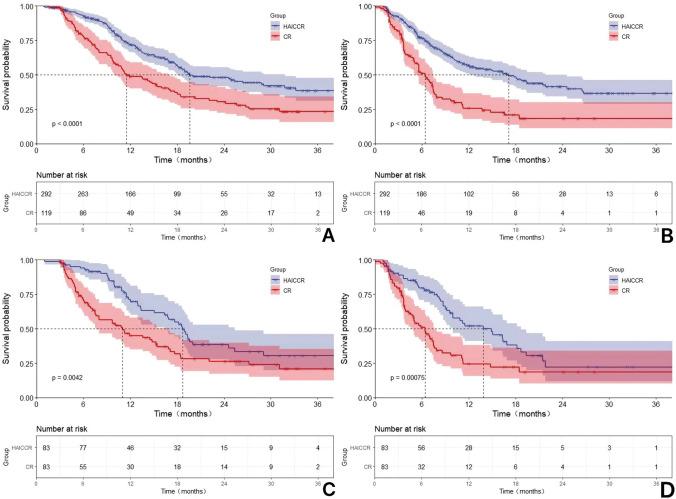
In this study, a total of 411 patients who received either the triple treatment regime (HAIC combined with camrelizumab plus rivoceranib, referred to as the HAICCR group, n = 292) or the dual treatment regime (camrelizumab combined with rivoceranib, referred to as the CR group, n = 119) between January 2020 and December 2021 were included. The results showed that the HAICCR group exhibited significantly better overall survival (mOS: 19.60 months vs. 11.50 months, p < 0.0001) and progression-free survival (mPFS: 10.0 months vs. 5.6 months, p < 0.0001) compared to the CR group in the overall cohort. Moreover, the HAICCR group also had a significantly higher ORR (objective response rate, 55.5% vs. 42.0%, p = 0.013) and DCR (disease control rate, 89.0% vs. 79.0%) compared to the CR group. After PSM, a final matched cohort of 83 pairs was obtained, and the survival benefits were consistent in this cohort as well (mOS: 18.70 months vs. 11.0 months, p < 0.0001; mPFS: 10.0 months vs. 5.6 months, p < 0.0001). However, there was no significant difference in the ORR between the triple and dual combination regimes. Univariate and multivariate analysis showed that CTP (Child-Turcotte-Pugh) stage, ALBI (albumin-bilirubin index) grade, tumor number, and treatment regime were significant risk factors affecting overall survival, while AFP (α-fetoprotein) level, tumor number, metastasis, and treatment regime were significant risk factors affecting progression-free survival. As for safety, hypertension and hand-foot syndrome were the two most common adverse reactions in both groups, with no significant difference in the occurrence of adverse reactions between the two groups (p < 0.05).
CONCLUSION
In the context of advanced HCC patients with PVTT, the combination regime of HAIC and camrelizumab plus rivoceranib demonstrates more excellent capacity for prolonging survival and offers a well-tolerated safety compared to the CR dual therapy approach. This triple regime represents a therapeutic modality of broad prospects and vast potential for HCC patients with PVTT.
背景
门静脉癌栓(PVTT)表示肝细胞癌(HCC)已进入晚期,具有较高的进展风险和预后不良。索拉非尼单药治疗是 HCC 合并 PVTT 的标准治疗方法,但疗效有限。目前,肝动脉灌注化疗(HAIC)和卡瑞利珠单抗联合仑伐替尼的联合治疗在晚期 HCC 中均显示出良好的生存获益,超过了标准索拉非尼治疗。本研究旨在探讨 HAIC 联合卡瑞利珠单抗和仑伐替尼治疗 HCC 合并 PVTT 的安全性和有效性。
方法
2020 年 1 月至 2021 年 12 月,4 家中国医院共纳入了 411 例 HCC 合并 PVTT 患者,他们接受了 HAIC 联合卡瑞利珠单抗和仑伐替尼(HAICCR 组,n=292)或卡瑞利珠单抗联合仑伐替尼(CR 组,n=119)一线治疗。采用倾向性评分匹配(PSM)来平衡任何组间差异。本研究旨在比较基于生存预后和肿瘤反应的双重和三重联合治疗方案的疗效,并根据不良反应的发生情况评估安全性。
结果
HAICCR 组的总生存期(mOS:19.60 个月 vs. 11.50 个月,p<0.0001)和无进展生存期(mPFS:10.0 个月 vs. 5.6 个月,p<0.0001)明显优于 CR 组。此外,HAICCR 组的客观缓解率(ORR,55.5% vs. 42.0%,p=0.013)和疾病控制率(DCR,89.0% vs. 79.0%)也明显高于 CR 组。PSM 后,最终获得了 83 对匹配的队列,该队列的生存获益也一致(mOS:18.70 个月 vs. 11.0 个月,p<0.0001;mPFS:10.0 个月 vs. 5.6 个月,p<0.0001)。然而,三重联合和双重联合方案的 ORR 无显著差异。单因素和多因素分析表明,CTP(Child-Turcotte-Pugh)分期、ALBI(albumin-bilirubin index)分级、肿瘤数量和治疗方案是影响总生存期的显著危险因素,而 AFP(α-fetoprotein)水平、肿瘤数量、转移和治疗方案是影响无进展生存期的显著危险因素。在安全性方面,高血压和手足综合征是两组中最常见的不良反应,两组不良反应的发生率无显著差异(p<0.05)。
结论
在 HCC 合并 PVTT 患者中,HAIC 联合卡瑞利珠单抗加仑伐替尼的联合方案在延长生存方面表现出更优异的能力,并且与 CR 双重治疗相比具有更好的耐受性。这种三重方案为 HCC 合并 PVTT 患者提供了一种具有广阔前景和巨大潜力的治疗方式。

 Zotero 插件