
韩国老年人的社会隔离与心理健康:以居住安排为重点。
Social isolation and mental well-being among Korean older adults: a focus on living arrangements.
机构信息
Department of Public Administration, Hanyang University, Seoul, Republic of Korea.
Department of Public Administration, Gachon University, Seongnam, Republic of Korea.
出版信息
Front Public Health. 2024 Apr 24;12:1390459. doi: 10.3389/fpubh.2024.1390459. eCollection 2024.
INTRODUCTION
The aging population in South Korea, characterized by an increasing number of older adults living alone, has raised concerns about its implications on mental health, specifically social isolation and loneliness that accompanies solitary living arrangements. This study explores the impact of living arrangements on the mental well-being of Korean older adults by focusing on the prevalence of depression and the role of social isolation in the context of evolving family structures and the COVID-19 pandemic.
METHODS
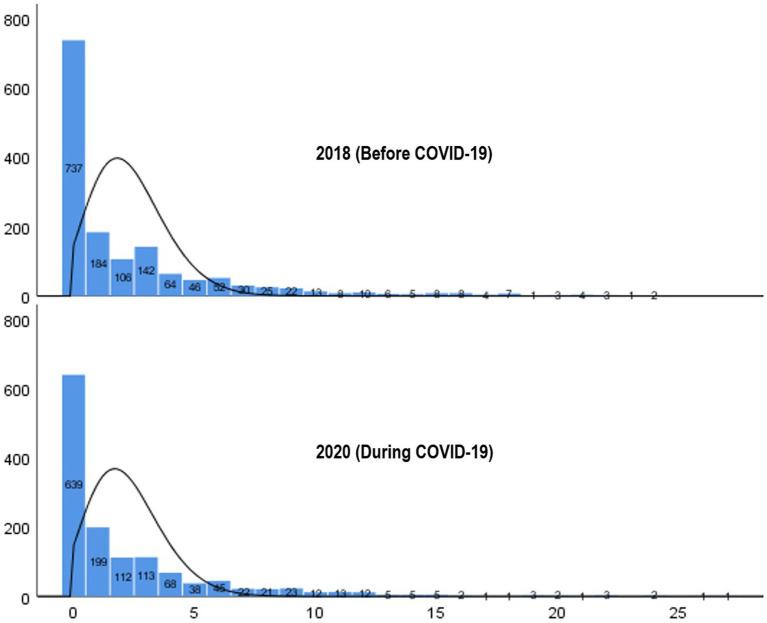
This cross-sectional study analyzed the responses of older adults aged 65 years and above (mean: 73.1, SD: 5.1) by using data from the Korea National Health and Nutrition Examination Survey conducted in 2018 and 2020. In total, responses from 3,365 older adults (1,653 in 2018 and 1,712 in 2020) were employed in this research. The participants' mental health status was assessed using the Patient Health Questionnaire-9, with living arrangements categorized by household size. A zero-inflated Poisson regression analysis was employed to investigate the relationship between living arrangements and depression severity, controlling for demographic, socioeconomic, and psychological factors.
RESULTS
The study found that older adults living with others exhibited a lower depression severity than those living alone. Notably, the severity of depression decreased as the number of household members increased up to a certain threshold. Socio-economic factors, such as income level, marital status, and psychological stress were also identified as significant predictors of depression severity. However, the COVID-19 pandemic did not have a statistically significant impact on depression rates among older adults during the study period.
CONCLUSION
Living arrangements play a critical role in the mental health of Korean older adults, with solitary living being associated with higher levels of depression. These findings underscore the importance of social support systems and suggest the need for policies and interventions that promote social connectivity and address the challenges of loneliness faced by them. Future research should explore longitudinal and qualitative studies to further understand causal relationships and develop targeted interventions to improve the mental well-being of the aging population.
简介
韩国人口老龄化,老年人独居人数不断增加,这引发了人们对其心理健康的担忧,特别是独居生活方式所带来的社会隔离和孤独感。本研究聚焦于家庭结构变化和新冠疫情背景下,探讨了生活安排对韩国老年人心理健康的影响,重点关注抑郁的流行程度以及社会隔离在其中的作用。
方法
本横断面研究分析了 2018 年和 2020 年韩国国家健康与营养检查调查中 65 岁及以上老年人(平均年龄:73.1 岁,标准差:5.1 岁)的反应。共有 3365 名老年人(2018 年 1653 名,2020 年 1712 名)参与了本研究。使用患者健康问卷-9 评估参与者的心理健康状况,根据家庭规模对生活安排进行分类。采用零膨胀泊松回归分析,控制人口统计学、社会经济和心理因素,探讨生活安排与抑郁严重程度之间的关系。
结果
研究发现,与独居者相比,与他人同住的老年人抑郁严重程度较低。值得注意的是,随着家庭成员数量的增加,抑郁严重程度会降低,但达到一定阈值后就会趋于稳定。社会经济因素,如收入水平、婚姻状况和心理压力,也被确定为抑郁严重程度的重要预测因素。然而,在研究期间,新冠疫情对老年人的抑郁率没有产生统计学上的显著影响。
结论
生活安排对韩国老年人的心理健康起着关键作用,独居与更高水平的抑郁相关。这些发现强调了社会支持系统的重要性,并表明需要制定政策和干预措施,以促进社交联系,解决老年人所面临的孤独挑战。未来的研究应探索纵向和定性研究,以进一步了解因果关系,并制定有针对性的干预措施,以改善老年人口的心理健康。
 Zotero 插件