
比较使用手持眼底相机的 21 种人工智能算法在自动化糖尿病性视网膜病变筛查中的应用。
Comparison of 21 artificial intelligence algorithms in automated diabetic retinopathy screening using handheld fundus camera.
机构信息
Department of Ophthalmology, Oulu University Hospital, Oulu, Finland.
Research Unit of Clinical Medicine, Oulu, Finland.
出版信息
Ann Med. 2024 Dec;56(1):2352018. doi: 10.1080/07853890.2024.2352018. Epub 2024 May 13.
BACKGROUND
Diabetic retinopathy (DR) is a common complication of diabetes and may lead to irreversible visual loss. Efficient screening and improved treatment of both diabetes and DR have amended visual prognosis for DR. The number of patients with diabetes is increasing and telemedicine, mobile handheld devices and automated solutions may alleviate the burden for healthcare. We compared the performance of 21 artificial intelligence (AI) algorithms for referable DR screening in datasets taken by handheld Optomed Aurora fundus camera in a real-world setting.
PATIENTS AND METHODS
Prospective study of 156 patients (312 eyes) attending DR screening and follow-up. Both papilla- and macula-centred 50° fundus images were taken from each eye. DR was graded by experienced ophthalmologists and 21 AI algorithms.
RESULTS
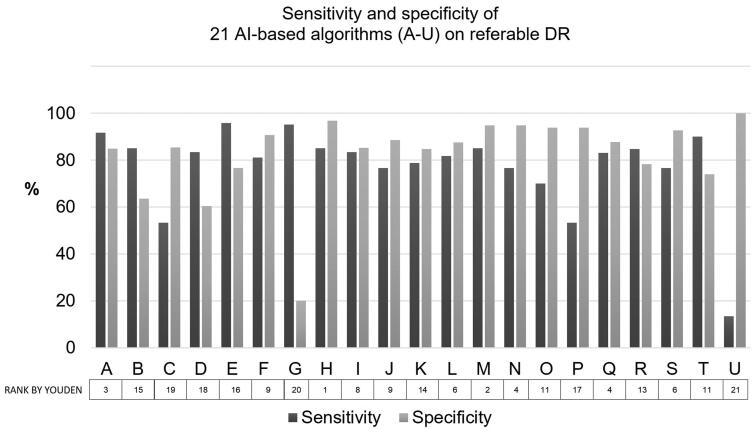
Most eyes, 183 out of 312 (58.7%), had no DR and mild NPDR was noted in 21 (6.7%) of the eyes. Moderate NPDR was detected in 66 (21.2%) of the eyes, severe NPDR in 1 (0.3%), and PDR in 41 (13.1%) composing a group of 34.6% of eyes with referable DR. The AI algorithms achieved a mean agreement of 79.4% for referable DR, but the results varied from 49.4% to 92.3%. The mean sensitivity for referable DR was 77.5% (95% CI 69.1-85.8) and specificity 80.6% (95% CI 72.1-89.2). The rate for images ungradable by AI varied from 0% to 28.2% (mean 1.9%). Nineteen out of 21 (90.5%) AI algorithms resulted in grading for DR at least in 98% of the images.
CONCLUSIONS
Fundus images captured with Optomed Aurora were suitable for DR screening. The performance of the AI algorithms varied considerably emphasizing the need for external validation of screening algorithms in real-world settings before their clinical application.
背景
糖尿病视网膜病变(DR)是糖尿病的常见并发症,可能导致不可逆转的视力丧失。糖尿病和 DR 的有效筛查和治疗改善了 DR 的视力预后。糖尿病患者人数不断增加,远程医疗、移动手持设备和自动化解决方案可能会减轻医疗保健的负担。我们比较了 21 种人工智能(AI)算法在真实环境中使用 Optomed Aurora 手持眼底相机采集的数据集进行可转诊 DR 筛查的性能。
患者和方法
前瞻性研究了 156 名(312 只眼)接受 DR 筛查和随访的患者。每只眼均拍摄了乳头和黄斑中心 50°眼底图像。DR 由有经验的眼科医生和 21 种 AI 算法进行分级。
结果
在 312 只眼中,183 只(58.7%)没有 DR,21 只(6.7%)眼中有轻度非增生性糖尿病视网膜病变(NPDR)。66 只(21.2%)眼中有中度 NPDR,1 只(0.3%)眼中有重度 NPDR,41 只(13.1%)眼中有增生性糖尿病视网膜病变(PDR),占可转诊 DR 的 34.6%。AI 算法对可转诊 DR 的平均一致性为 79.4%,但结果从 49.4%到 92.3%不等。可转诊 DR 的平均敏感性为 77.5%(95%CI 69.1-85.8),特异性为 80.6%(95%CI 72.1-89.2)。AI 无法分级的图像比例从 0%到 28.2%(平均 1.9%)不等。21 种 AI 算法中有 19 种(90.5%)至少对 98%的图像进行了 DR 分级。
结论
Optomed Aurora 拍摄的眼底图像适合 DR 筛查。AI 算法的性能差异很大,强调在临床应用之前,需要在真实环境中对筛选算法进行外部验证。
 Zotero 插件