
揭示“点击”衍生的查尔酮修饰的1,2,3-三唑异构体对Pb(ii)和Cu(ii)离子的离子传感能力:密度泛函理论分析
Unveiling the ion sensing capabailities of 'click' derived chalcone-tailored 1,2,3-triazolic isomers for Pb(ii) and Cu(ii) ions: DFT analysis.
作者信息
Singh Riddima, Singh Gurleen, George Nancy, Singh Gurjaspreet, Malik Pooja, Singh Harminder, Kaur Gurpreet, Singh Jandeep
机构信息
School of Chemical Engineering and Physical Sciences, Lovely Professional University Phagwara-144411 Punjab India
Department of Chemistry and Centre of Advanced Studies in Chemistry, Panjab University Chandigarh-160014 India.
出版信息
RSC Adv. 2024 May 13;14(22):15374-15390. doi: 10.1039/d4ra01471e. eCollection 2024 May 10.
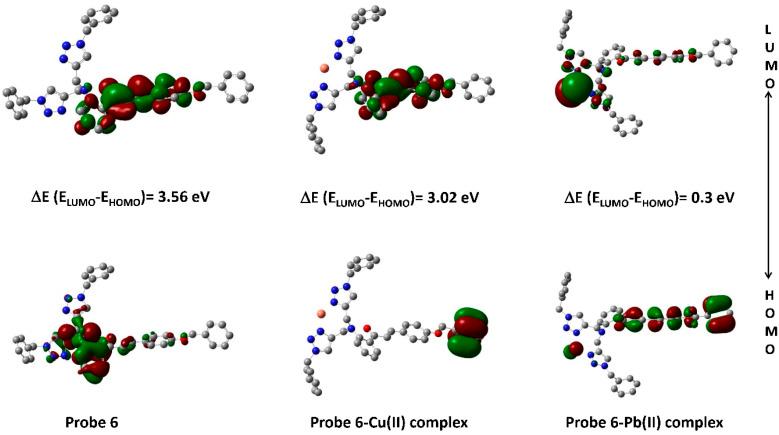
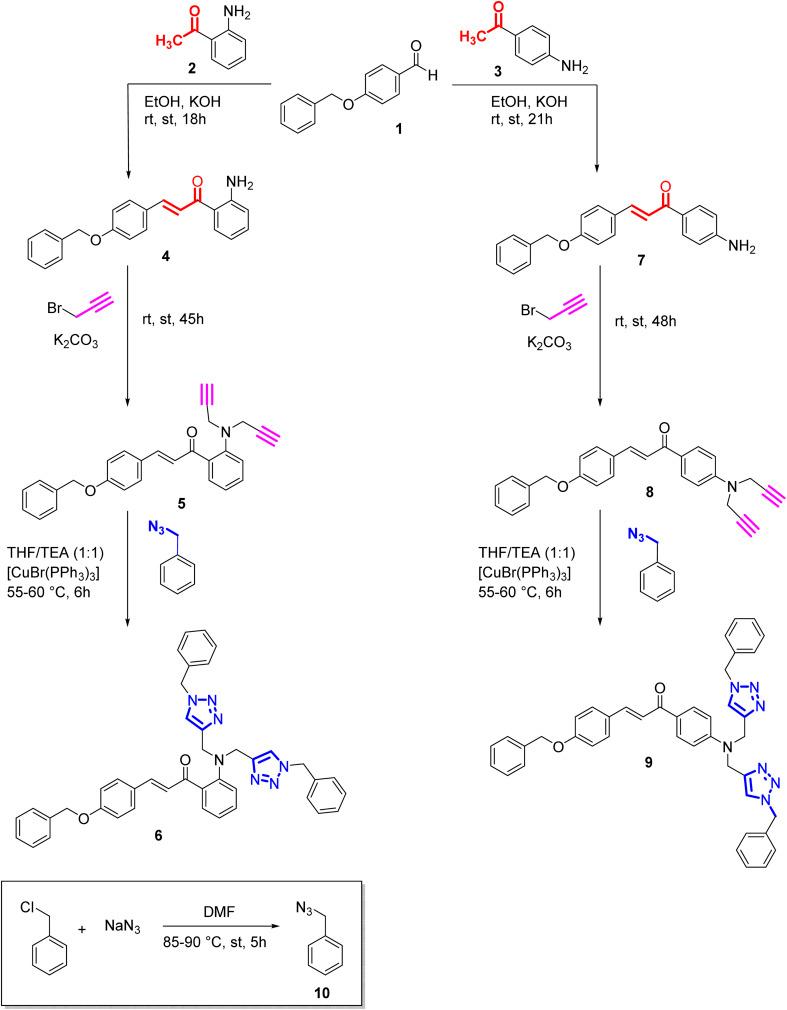
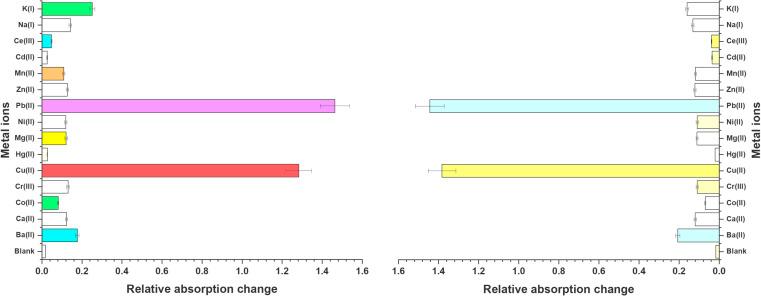
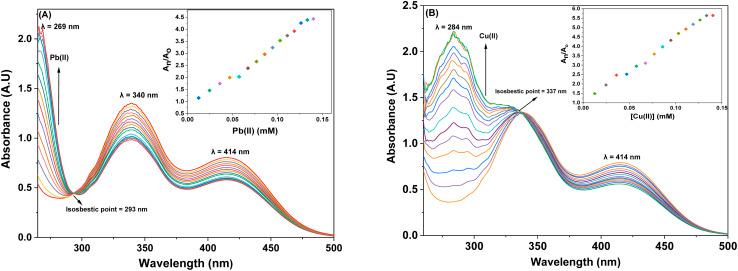
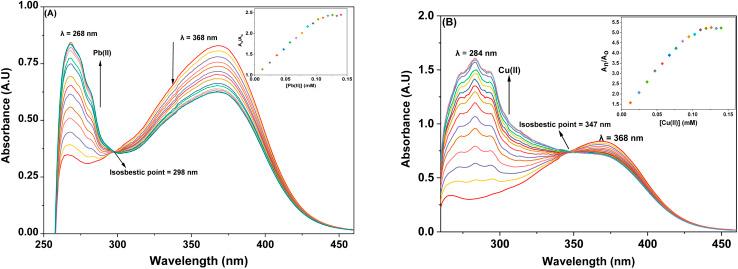
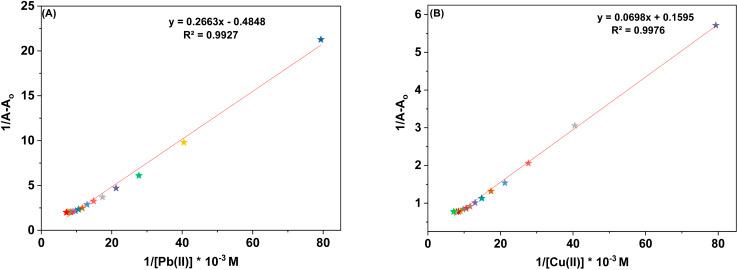
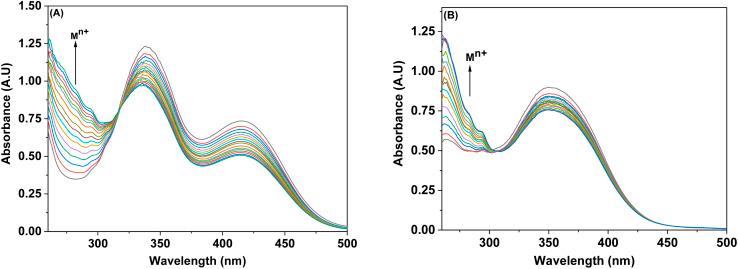
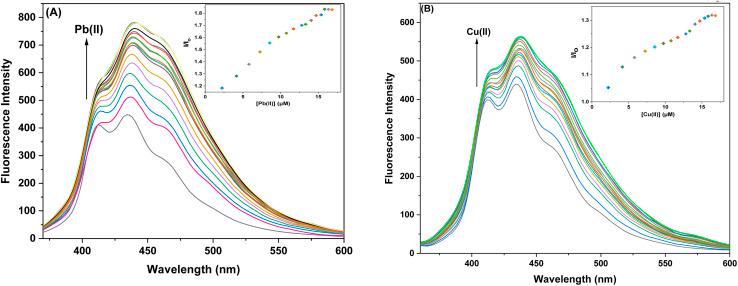
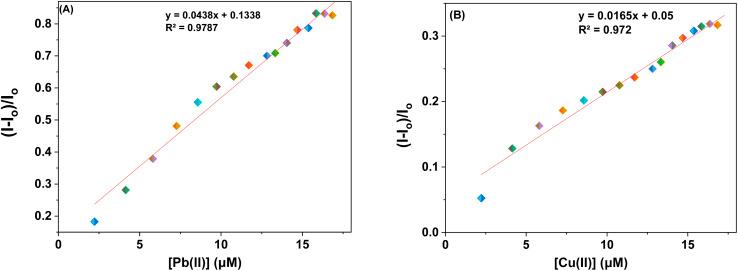
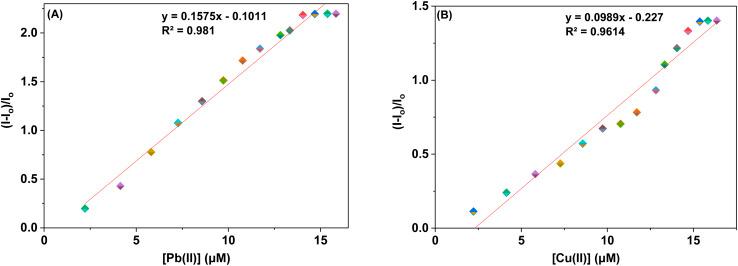
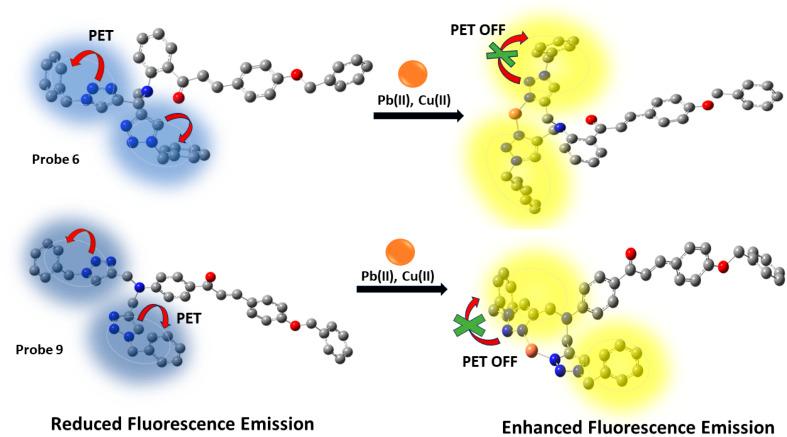
In this study, two novel chalcone-derived 1,2,3-triazole-appended positional isomers (probe 6 and probe 9) were synthesized the 'CuAAC' (Cu(i) - catalysed alkyne azide cycloaddition) methodology for the purpose of metal ion detection. The synthesized probes underwent characterization utilizing standard spectroscopic methodologies including FTIR, NMR (H and C), and mass spectrometry. Subsequently, the sensing capabilities of these probes were explored using UV-Vis and fluorescence spectroscopy, wherein their selective recognition potential was established for Pb(ii) and Cu(ii), both of which can pose serious health hazards when prevalent in the environment above permissible limits. Both the probes exhibited fairly low limits of detection (LoD), determined as 5.69 μM and 6.55 μM in the case of probe 6 for Pb(ii) and Cu(ii) respectively; whereas the probe 9 exhibited an LoD of 5.06 μM and 7.52 μM for Pb(ii) and Cu(ii), respectively. The job's plot for the probe demonstrates the formation of a 1 : 1 complex between the metal and ligand. Furthermore, the interaction of the free probes with the metal ions in the metal-ligand complex was elucidated through H NMR analysis and validated theoretically using Density Functional Theory (DFT) simulations with the B3LYP/6-311G++(d,p) and B3LYP/LANL2DZ basis sets for geometry optimization of the probes and their corresponding metal complexes. These findings offer a reliable approach to Cu(ii) and Pb(ii) ion detection and can be further used for the potential applications in environmental monitoring and analytical chemistry.
在本研究中,为了进行金属离子检测,采用“铜催化的叠氮炔环加成反应(CuAAC)”方法合成了两种新型的查尔酮衍生的1,2,3 - 三唑取代的位置异构体(探针6和探针9)。利用包括傅里叶变换红外光谱(FTIR)、核磁共振(氢谱和碳谱)以及质谱在内的标准光谱方法对合成的探针进行了表征。随后,使用紫外 - 可见光谱和荧光光谱探究了这些探针的传感能力,确定了它们对Pb(ii)和Cu(ii)的选择性识别潜力,当这两种离子在环境中的含量超过允许限度时,都会对健康构成严重危害。两种探针都表现出相当低的检测限(LoD),对于探针6,检测Pb(ii)和Cu(ii)的LoD分别为5.69 μM和6.55 μM;而探针9检测Pb(ii)和Cu(ii)的LoD分别为5.06 μM和7.52 μM。该探针的工作曲线表明金属与配体形成了1:1的配合物。此外,通过氢核磁共振分析阐明了游离探针与金属 - 配体配合物中金属离子的相互作用,并使用密度泛函理论(DFT)模拟进行了理论验证,采用B3LYP/6 - 311G++(d,p)和B3LYP/LANL2DZ基组对探针及其相应的金属配合物进行几何优化。这些发现为Cu(ii)和Pb(ii)离子检测提供了一种可靠的方法,可进一步用于环境监测和分析化学中的潜在应用。



 Zotero 插件