
不孕人群健康生活方式的障碍和促进因素:一项混合方法系统评价。
Barriers and enablers to a healthy lifestyle in people with infertility: a mixed-methods systematic review.
机构信息
Monash Centre for Health Research and Implementation, Monash University, Clayton, VIC, Australia.
Department of Obstetrics and Gynaecology, Monash University, Clayton, VIC, Australia.
出版信息
Hum Reprod Update. 2024 Oct 1;30(5):569-583. doi: 10.1093/humupd/dmae011.
BACKGROUND
While there is a recognized role of optimizing lifestyle (diet and physical activity) behaviours in the management of infertility, the best practice remains unknown and factors influencing the lifestyle of people with infertility are not well understood.
OBJECTIVE AND RATIONALE
This systematic review evaluated barriers and enablers to a healthy lifestyle in people with infertility, from the perspectives of people with infertility and health professionals, in order to inform optimal behavioural change strategies.
SEARCH METHODS
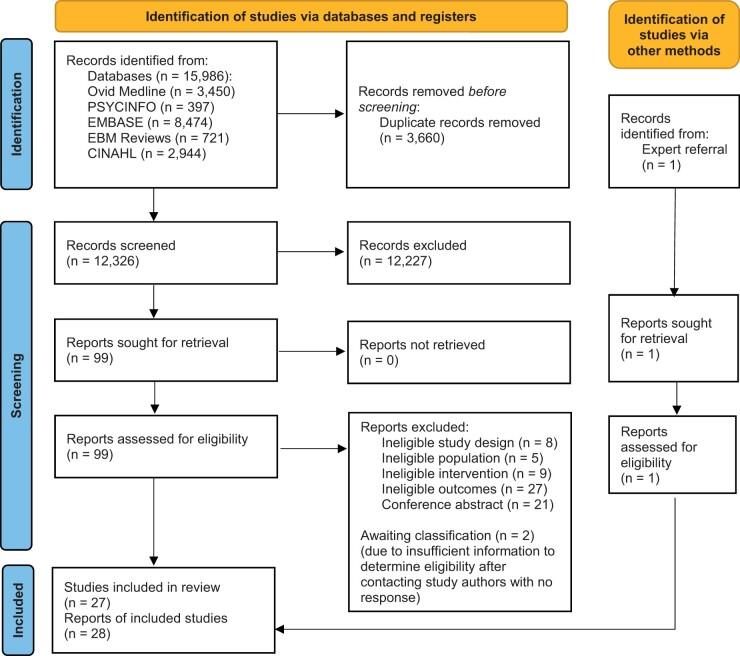
Ovid MEDLINE(R), PsycINFO, EMBASE, EBM Reviews, and CINAHL were searched from inception to 28 August 2023. Eligible studies were qualitative and quantitative primary studies that explored barriers and/or enablers to lifestyle for infertility management. Quality assessment was performed using the Centre for Evidence-Based Management Critical Appraisal of a Survey Tool and the Critical Appraisal Skills Programme Qualitative Checklist. Data were analysed by thematic analysis with themes mapped to the Capability, Opportunity, Motivation and Behaviour (COM-B) model and Theoretical Domains Framework (TDF).
OUTCOMES
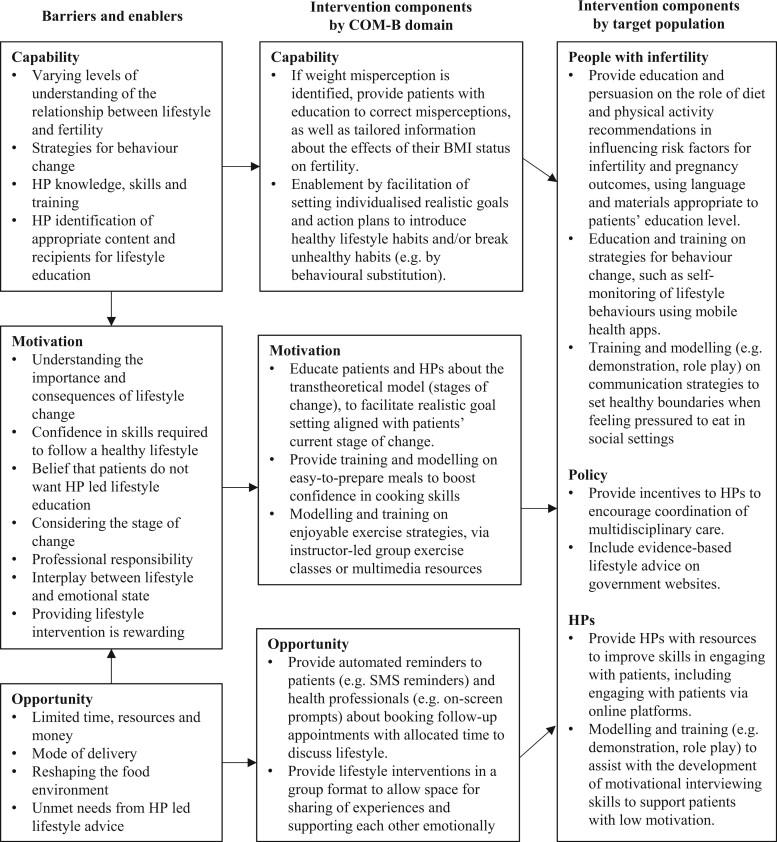
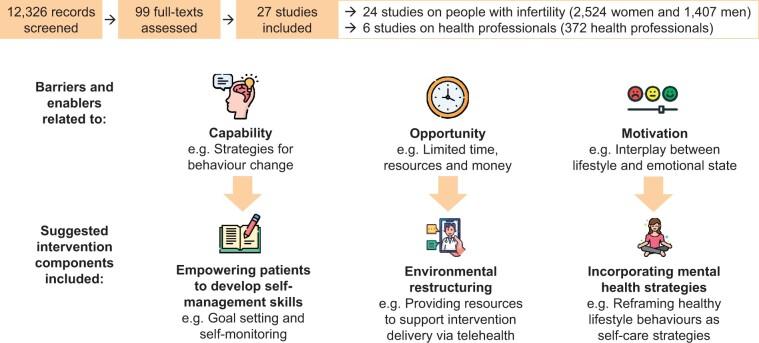
After screening 12 326 abstracts and 99 full-texts, 27 studies were included (12 quantitative, 6 qualitative and 9 mixed-methods) with 22 studies of women with infertility (n = 2524), 11 studies of men with infertility (n = 1407), and 6 studies of health professionals (n = 372). We identified barriers and enablers relating to capability (e.g. strategies for behaviour change), opportunity (e.g. limited time, resources, and money), and motivation (e.g. interplay between lifestyle and emotional state). Based on the identified themes, suggested intervention components to integrate into lifestyle management of infertility include facilitating development of self-management skills to support lifestyle change (e.g. self-monitoring, action planning, and goal setting) and incorporating mental health strategies (e.g. providing information about the benefits of healthy lifestyle behaviours for mental health and encouraging patients to reframe healthy lifestyle behaviours as self-care strategies).
WIDER IMPLICATIONS
The findings have identified important factors that influence lifestyle management in people with infertility and have suggested relevant intervention components to consider when designing interventions. Given the paucity of qualitative studies identified, more research is needed to further understand the complex and interacting factors that shape lifestyle during the fertility journey.
背景
虽然优化生活方式(饮食和体育活动)行为在不孕不育管理中具有公认的作用,但最佳实践仍不清楚,并且人们对影响不孕不育者生活方式的因素了解甚少。
目的和理由
本系统评价从不孕不育者和卫生专业人员的角度评估了不孕不育者健康生活方式的障碍和促进因素,以便为最佳行为改变策略提供信息。
检索方法
从建库到 2023 年 8 月 28 日,在 Ovid MEDLINE(R)、PsycINFO、EMBASE、EBM Reviews 和 CINAHL 中进行了检索。合格的研究是探索不孕不育管理中生活方式障碍和/或促进因素的定性和定量原始研究。使用循证管理中心调查工具的批判性评估和批判性评估技能计划定性清单对质量进行评估。使用主题分析对数据进行分析,主题映射到能力、机会、动机和行为(COM-B)模型和理论领域框架(TDF)。
结果
在筛选了 12326 篇摘要和 99 篇全文后,纳入了 27 项研究(12 项定量研究、6 项定性研究和 9 项混合方法研究),其中 22 项研究涉及女性不孕不育(n=2524),11 项研究涉及男性不孕不育(n=1407),6 项研究涉及卫生专业人员(n=372)。我们确定了与能力(例如行为改变策略)、机会(例如时间有限、资源有限和资金有限)和动机(例如生活方式和情绪状态之间的相互作用)相关的障碍和促进因素。基于确定的主题,建议将干预组件纳入不孕不育生活方式管理中,包括促进自我管理技能的发展,以支持生活方式的改变(例如自我监测、行动计划和目标设定),并纳入心理健康策略(例如提供有关健康生活方式行为对心理健康益处的信息,并鼓励患者将健康生活方式行为重新定义为自我保健策略)。
更广泛的影响
研究结果确定了影响不孕不育者生活方式管理的重要因素,并提出了在设计干预措施时应考虑的相关干预组件。鉴于确定的定性研究较少,需要进一步研究以更好地了解塑造生育过程中生活方式的复杂和相互作用的因素。
 Zotero 插件