
维持肝功能在经肝动脉灌注化疗联合酪氨酸激酶和程序性细胞死亡蛋白-1 抑制剂治疗不可切除肝细胞癌患者结局中的有益作用。
Beneficial effects of maintaining liver function during hepatic arterial infusion chemotherapy combined with tyrosine kinase and programmed cell death protein-1 inhibitors on the outcomes of patients with unresectable hepatocellular carcinoma.
机构信息
Department of General Surgery, the First Affiliated Hospital, Jiangxi Medical College, Nanchang University, No. 17, Yongwaizheng Street, Nanchang, 330006, Jiangxi, China.
Department of General Surgery, Ganjiang New Area People's Hospital, Nanchang, Jiangxi, China.
出版信息
BMC Cancer. 2024 May 14;24(1):588. doi: 10.1186/s12885-024-12355-x.
BACKGROUND AND AIM
Combination therapy is the primary treatment for unresectable hepatocellular carcinoma (u-HCC). The hepatic functional reserve is also critical in the treatment of HCC. In this study, u-HCC was treated with combined hepatic arterial infusion chemotherapy (HAIC), tyrosine kinase inhibitors (TKIs), and programmed cell death protein-1 (PD-1) inhibitors to analyze the therapeutic response, progression-free survival (PFS), and safety.
METHODS
One hundred sixty-two (162) patients with u-HCC were treated by combination therapy of HAIC, TKIs, and PD-1 inhibitors. PFS was assessed by Child-Pugh (CP) classification subgroups and the change in the CP score during treatment.
RESULTS
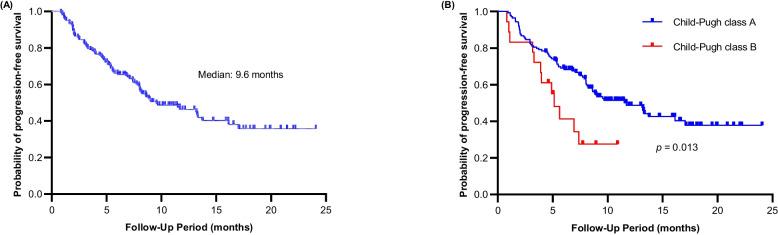
The median PFS was 11.7 and 5.1 months for patients with CP class A (CPA) and CP class B (CPB), respectively (p = 0.013), with respective objective response rates of 61.1 and 27.8% (p = 0.002) and conversion rates of 16 and 0% (p = 0.078). During treatment, the CP scores in patients with CPA worsened less in those with complete and partial response than in those with stable and progressive disease. In the CP score 5, patients with an unchanged CP score had longer PFS than those with a worsened score (Not reached vs. 7.9 months, p = 0.018). CPB was an independent factor negatively affecting treatment response and PFS. Patients with CPA responded better to the combination therapy and had fewer adverse events (AEs) than those with CPB.
CONCLUSIONS
Thus, triple therapy is more beneficial in patients with good liver function, and it is crucial to maintain liver function during treatment.
背景与目的
联合治疗是不可切除肝细胞癌(u-HCC)的主要治疗方法。肝脏功能储备在 HCC 的治疗中也很关键。在这项研究中,采用联合肝动脉灌注化疗(HAIC)、酪氨酸激酶抑制剂(TKI)和程序性死亡蛋白-1(PD-1)抑制剂治疗 u-HCC,分析治疗反应、无进展生存期(PFS)和安全性。
方法
对 162 例 u-HCC 患者采用 HAIC、TKI 和 PD-1 抑制剂联合治疗。采用 Child-Pugh(CP)分类亚组和治疗过程中 CP 评分变化评估 PFS。
结果
CP 分级 A(CPA)和 CP 分级 B(CPB)患者的中位 PFS 分别为 11.7 和 5.1 个月(p=0.013),客观缓解率分别为 61.1%和 27.8%(p=0.002),转化率分别为 16%和 0%(p=0.078)。在治疗过程中,CPA 患者中完全缓解和部分缓解患者的 CP 评分恶化程度低于稳定和进展性疾病患者。在 CP 评分 5 分的患者中,CP 评分无变化的患者 PFS 长于 CP 评分恶化的患者(未达到 vs. 7.9 个月,p=0.018)。CPB 是影响治疗反应和 PFS 的独立负性因素。CPA 患者对联合治疗反应更好,不良事件(AE)发生率低于 CPB 患者。
结论
因此,联合治疗在肝功能良好的患者中更有益,在治疗过程中维持肝功能至关重要。


 Zotero 插件