
肝纤维化严重程度对肝细胞癌肿瘤学预后的影响
Impact of Liver Fibrosis Severity on Oncological Prognosis in Hepatocellular Carcinoma.
作者信息
Yasukawa Koya, Shimizu Akira, Kubota Koji, Notake Tsuyoshi, Hosoda Kiyotaka, Hayashi Hikaru, Soejima Yuji
机构信息
Division of Gastroenterological, Hepato-Biliary-Pancreatic, Transplantation and Pediatric Surgery, Department of Surgery, Shinshu University School of Medicine, Matsumoto, Japan.
出版信息
Liver Cancer. 2023 Oct 31;13(2):150-160. doi: 10.1159/000533857. eCollection 2024 Apr.
INTRODUCTION
Cirrhosis is deemed to be a contributing factor to the postoperative recurrence of hepatocellular carcinoma (HCC); however, the precise impact of liver fibrosis on both cancer-specific prognoses remains unclear. This investigation sought to elucidate the effect of liver fibrosis severity on the cancer-specific prognosis.
METHODS
A total of 524 consecutive patients were included. Recurrence-free survival (RFS) and disease-specific survival (DSS) were compared according to fibrosis stage. Moreover, postoperative outcomes were subjected to analysis in cohorts of patients with F0 and F1-3, as well as in those with F1-3 and F4, who were carefully matched for background factors.
RESULTS
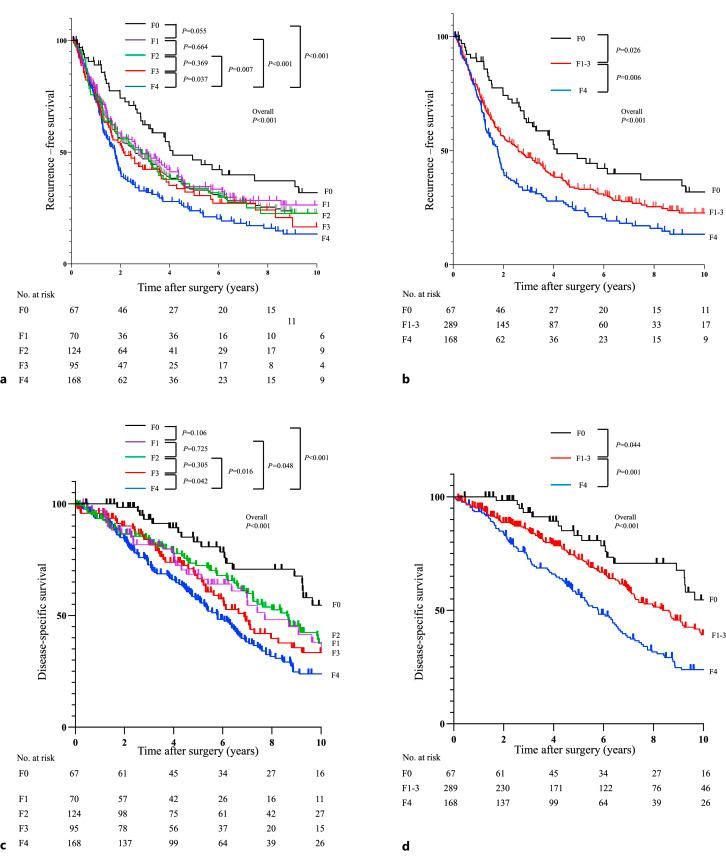
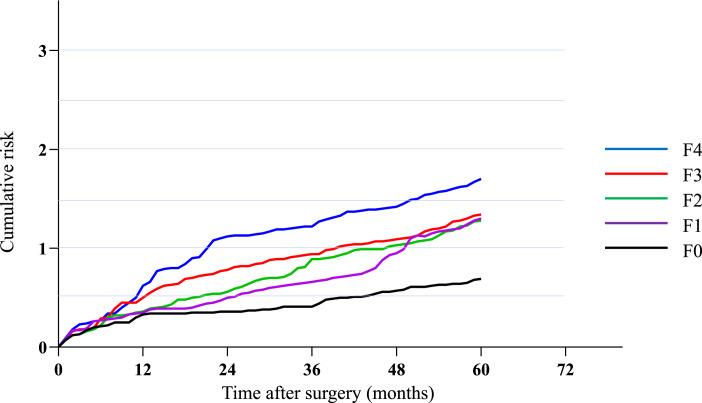
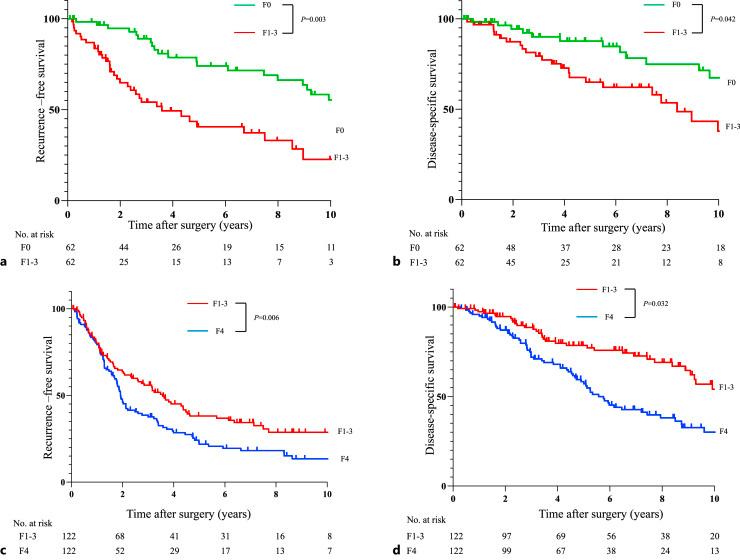
The 5-year RFS exhibited a significantly worse outcome in the F4 group compared to other stages of fibrosis: 5-year RFS - F0 (46.6%), F1-3 (33.1%), and F4 (23.5%), = 0.03 (F0 vs. F1-3) and < 0.01 (F1-3 vs. F4). Additionally, the 5-year DSS also presented a significantly worse prognosis in the F4 group: 5-year DSS - F0 (82.9%), F1-3 (73.6%), and F4 (57.4%), = 0.04 (F0 vs. F1-3) and < 0.01 (F1-3 vs. F4). In multivariate analysis, fibrosis 1, 2, 3, and 4 stage (compared with F0) (HR: 1.70, 1.81, 1.89, and 3.99, 95% confidence interval: 1.10-1.99, 1.39-2.22, 1.41-2.55, and 2.25-5.01, = 0.022, = 0.008, < 0.001, and < 0.001, respectively) was independent risk factor for RFS. After matched analysis, both RFS and DSS exhibited significantly worse prognoses in the presence of more advanced fibrosis. There was a significantly higher incidence of multiple recurrences in the F4 group than the F1-3 group, and a number of recurrences were observed both in the same hepatic segment as the resected side and in the contralateral lobe in F4 group.
DISCUSSION/CONCLUSION: The hazard and recurrence pattern of HCC signifies that the prognosis could potentially be poor, as the hepatic fibrosis likely owing to a higher hepatocarcinogenic potential, even in the absence of progression to cirrhotic condition. The risk of de novo recurrence may also increase with the progression of this fibrosis.
引言
肝硬化被认为是肝细胞癌(HCC)术后复发的一个促成因素;然而,肝纤维化对两种癌症特异性预后的确切影响仍不清楚。本研究旨在阐明肝纤维化严重程度对癌症特异性预后的影响。
方法
共纳入524例连续患者。根据纤维化分期比较无复发生存期(RFS)和疾病特异性生存期(DSS)。此外,对F0和F1 - 3组以及F1 - 3和F4组患者的术后结果进行分析,这些患者在背景因素方面进行了仔细匹配。
结果
与其他纤维化阶段相比,F4组的5年RFS结果明显更差:5年RFS - F0(46.6%),F1 - 3(33.1%),F4(23.5%),F0与F1 - 3比较P = 0.03,F1 - 3与F4比较P < 0.01。此外,F4组的5年DSS预后也明显更差:5年DSS - F0(82.9%),F1 - 3(73.6%),F4(57.4%),F0与F1 - 3比较P = 0.04,F1 - 3与F4比较P < 0.01。在多因素分析中,纤维化1、2、3和4期(与F0相比)(风险比:1.70、1.81、1.89和3.99,95%置信区间:1.10 - 1.99、1.39 - 2.22、1.41 - 2.55和2.25 - 5.01,P分别为0.022、0.008、< 0.001和< 0.001)是RFS的独立危险因素。匹配分析后,在存在更晚期纤维化的情况下,RFS和DSS的预后均明显更差。F4组的多次复发发生率明显高于F1 - 3组,并且在F4组中观察到在切除侧的同一肝段以及对侧叶均有复发。
讨论/结论:HCC的风险和复发模式表明预后可能较差,因为即使在未进展至肝硬化状态时,肝纤维化可能具有更高的致癌潜力。随着这种纤维化的进展,新发复发的风险也可能增加。

 Zotero 插件