
特瑞普利单抗联合化疗治疗美国复发性或转移性鼻咽癌患者的成本效果分析。
Toripalimab plus chemotherapy in American patients with recurrent or metastatic nasopharyngeal carcinoma: A cost-effectiveness analysis.
机构信息
School of Public Health, Fudan University, Shanghai, China.
National Health Commission Key Laboratory of Health Technology Assessment, Fudan University, Shanghai, China.
出版信息
Cancer Med. 2024 May;13(10):e7243. doi: 10.1002/cam4.7243.
BACKGROUND
Toripalimab, combined with gemcitabine and cisplatin, has been approved as the first-line treatment for recurrent or metastatic nasopharyngeal carcinoma (RM-NPC), representing a significant milestone as the first FDA-approved innovative therapy for this condition. Despite this achievement, there's a lack of data on the cost-effectiveness of toripalimab for RM-NPC patients in the American context.
METHODS
To assess the cost-effectiveness of toripalimab plus chemotherapy versus chemotherapy alone, a 3-state partitioned survival model was constructed. The study involved participants with characteristics matching those in the JUPITER-02 trial. Cost and utility inputs were collected from literature. Main outcomes measured were quality-adjusted life year (QALY), and incremental cost-effectiveness ratio (ICER). Univariate and probabilistic sensitivity analyses, subgroup analyses, and scenario analyses were conducted to verify the robustness of results.
RESULTS
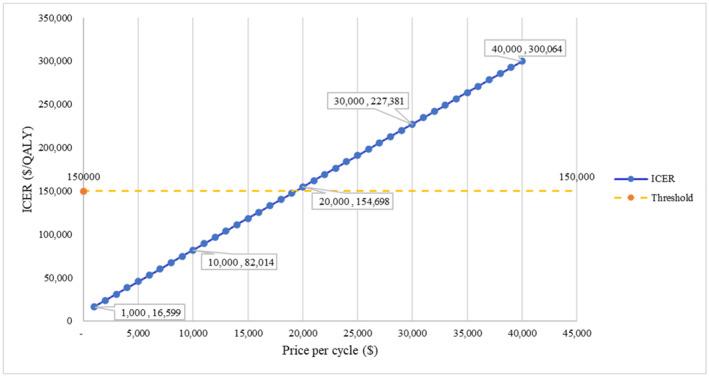
The study found that the toripalimab regimen resulted in 4.390 QALYs at a cost of $361,813, while the chemotherapy-only regimen yielded 1.685 QALYs at a cost of $161,632. This translates to an ICER of $74,004/QALY, below the willingness-to-pay threshold of $150,000/QALY. Sensitivity analyses indicated that utility values, discount rate, and the price of toripalimab significantly impact INMB. With an 87.10% probability of being cost-effective at a $150,000/QALY threshold, the probabilistic sensitivity analysis supports toripalimab plus chemotherapy as a viable option. Scenario analysis showed that toripalimab remains cost-effective unless its price increases by 125%. Additionally, a simulated 15-year study period increases the ICER to $88,026/QALY. Subgroup analysis revealed ICERs of $76,538/QALY for PD-L1 positive and $70,158/QALY for PD-L1 negative groups.
CONCLUSIONS
Toripalimab in combination with chemotherapy is likely to be a cost-effective alternative to standard chemotherapy for American patients with RM-NPC. This evidence can guide clinical and reimbursement decision-making in treating RM-NPC patients.
背景
特瑞普利单抗联合吉西他滨和顺铂已被批准用于复发性或转移性鼻咽癌(RM-NPC)的一线治疗,这是 FDA 批准的首个用于该疾病的创新疗法,具有重要意义。尽管取得了这一成就,但在美国,特瑞普利单抗治疗 RM-NPC 患者的成本效益数据仍然缺乏。
方法
为了评估特瑞普利单抗联合化疗与单纯化疗相比的成本效益,构建了一个三状态分区生存模型。研究纳入了与 JUPITER-02 试验特征匹配的参与者。成本和效用数据来自文献。主要结局指标是质量调整生命年(QALY)和增量成本效益比(ICER)。进行了单变量和概率敏感性分析、亚组分析和情景分析,以验证结果的稳健性。
结果
研究发现,特瑞普利单抗方案的成本为 361813 美元,可获得 4.390 个 QALY;而单纯化疗方案的成本为 161632 美元,可获得 1.685 个 QALY。这意味着 ICER 为 74004 美元/QALY,低于 150000 美元/QALY 的意愿支付阈值。敏感性分析表明,效用值、贴现率和特瑞普利单抗的价格对 INMB 有显著影响。在 150000 美元/QALY 的阈值下,特瑞普利单抗联合化疗具有 87.10%的成本效益概率,概率敏感性分析支持特瑞普利单抗联合化疗作为一种可行的选择。情景分析表明,除非特瑞普利单抗的价格上涨 125%,否则特瑞普利单抗仍具有成本效益。此外,15 年的模拟研究期将 ICER 提高至 88026 美元/QALY。亚组分析显示,PD-L1 阳性患者的 ICER 为 76538 美元/QALY,PD-L1 阴性患者的 ICER 为 70158 美元/QALY。
结论
对于美国的 RM-NPC 患者,特瑞普利单抗联合化疗可能是标准化疗的一种具有成本效益的替代方案。这一证据可以为治疗 RM-NPC 患者的临床和报销决策提供指导。


 Zotero 插件