
两阶段翻修术治疗人工关节感染的临床实践中即将出现的证据。
Upcoming evidence in clinical practice of two-stage revision arthroplasty for prosthetic joint infection.
机构信息
Service of Infectious Diseases, Cardarelli Hospital, Via A. Cardarelli 9, 80131, Naples, Italy.
Department of Public Health, Orthopedic Unit, "Federico II" University, Naples, Italy.
出版信息
J Orthop Traumatol. 2024 May 18;25(1):26. doi: 10.1186/s10195-024-00767-1.
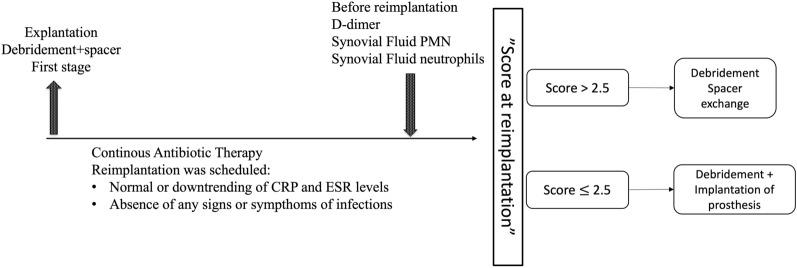
Total joint arthroplasty is the recommended treatment for patients with end-stage osteoarthritis, as it reduces disability and pain and restores joint function. However, prosthetic joint infection is a serious complication of this procedure, with the two-stage exchange being the most common treatment method. While there is consensus on diagnosing prosthetic joint infection, there is a lack of agreement on the parameters that can guide the surgeon in performing definitive reimplantation in a two-stage procedure. One approach that has been suggested to improve the accuracy of microbiologic investigations before definitive reimplantation is to observe a holiday period from antibiotic therapy to improve the accuracy of cultures from periprosthetic tissues, but these cultures report some degree of aspecificity. Therefore, several pieces of evidence highlight that performing reimplantation using continuous antibiotic therapy should be considered a safe and effective approach, leading to higher cure rates and a shorter period of disability. Dosage of C-reactive protein (CRP), erythrocyte sedimentation rate (ERS) and D-dimer are helpful in diagnosing prosthetic joint infection, but only D-dimer has shown sufficient accuracy in predicting the risk of infection recurrence after a two-stage procedure. Synovial fluid analysis before reimplantation has been shown to be the most accurate in predicting recurrence, and new cutoff values for leukocyte count and neutrophil percentage have shown a useful predictive rule to identify patients at risk of unfavourable outcome. A new scoring system based on a numerical score calculated from the beta coefficient derived through multivariate analysis of D-dimer levels, synovial fluid leukocytes and relative neutrophils percentage has demonstrated high accuracy when it comes to guiding the second step of two-stage procedure. In conclusion, reimplantation may be a suitable option for patients who are on continuous therapy without local symptoms, and with CRP and ERS within the normal range, with low synovial fluid leukocytes (< 952/mL) and a low relative neutrophil percentage (< 52%) and D-dimer below 1100 µg/mL. A numerical score derived from analysing these three parameters can serve as a valuable tool in determining the feasibility of reimplantation in these patients.
全关节置换术是治疗终末期骨关节炎患者的推荐方法,因为它可以减轻残疾和疼痛,恢复关节功能。然而,人工关节感染是该手术的严重并发症,两期置换术是最常见的治疗方法。虽然对于诊断人工关节感染已经达成共识,但对于可以指导外科医生在两期手术中进行确定性再植入的参数存在分歧。为了提高确定性再植入前微生物学检查的准确性,一种方法是观察抗生素治疗的假期,以提高假体周围组织培养的准确性,但这些培养报告存在一定程度的非特异性。因此,一些证据强调,使用连续抗生素治疗进行再植入应被视为一种安全有效的方法,可提高治愈率和残疾期。C 反应蛋白(CRP)、红细胞沉降率(ERS)和 D-二聚体的剂量有助于诊断人工关节感染,但只有 D-二聚体在预测两期手术后感染复发的风险方面显示出足够的准确性。再植入前的滑膜液分析已被证明是预测复发最准确的方法,白细胞计数和中性粒细胞百分比的新截断值已显示出一种有用的预测规则,可识别出有不良结果风险的患者。基于通过 D-二聚体水平、滑膜液白细胞和相对中性粒细胞百分比的多元分析得出的β系数计算的数值评分的新评分系统在指导两期手术的第二步时表现出很高的准确性。总之,对于持续接受治疗且无局部症状、CRP 和 ERS 在正常范围内、滑膜液白细胞低(<952/mL)、相对中性粒细胞百分比低(<52%)和 D-二聚体低于 1100 µg/mL 的患者,再植入可能是一种合适的选择。从分析这三个参数得出的数值评分可以作为确定这些患者再植入可行性的有价值工具。
 Zotero 插件