
酒精依赖患者戒断期间血浆食欲素水平与大脑活动改变的关系
Plasma Orexin Levels Related to Altered Brain Activity During Abstinence in Patients with Alcohol Dependence.
作者信息
Pan Jianshe, Chen Guangdong, Shan Peiwei, Chen Ce, Jiang Deguo, Wang Lina, Li Gongying, Chen Min, Zhuo Chuanjun, Fang Tao, Yu Haiping
机构信息
Department of Psychiatry, Wenzhou Kangning Hospital, Wenzhou, Zhejiang Province, China.
Department of Psychiatric-Neuroimage Center, Radiology Center, Wenzhou Seventh People's Hospital, Wenzhou, Zhejiang Province, China.
出版信息
Psychiatry Clin Psychopharmacol. 2021 Sep 1;31(3):286-291. doi: 10.5152/pcp.2021.20011. eCollection 2021 Sep.
OBJECTIVES
In vivo studies have correlated brain activity with alcohol-seeking behavior, while clinical studies have identified altered brain activity in patients with alcohol dependence (AD) even during abstinence. We aimed to explore the relationship between plasma orexin levels, brain activity, and alcohol-craving scores in patients with AD.
METHODS
In this pilot study, we evaluated 24 male patients with AD in remission and 25 male controls. Alcohol craving was assessed using the Obsessive Compulsive Drinking Scale (OCDS). An adapted MRI technique was used to assess global functional connectivity density (gFCD), and plasma orexin concentrations were measured by radioimmunoassay. Associations were analyzed by the Pearson correlation.
RESULTS
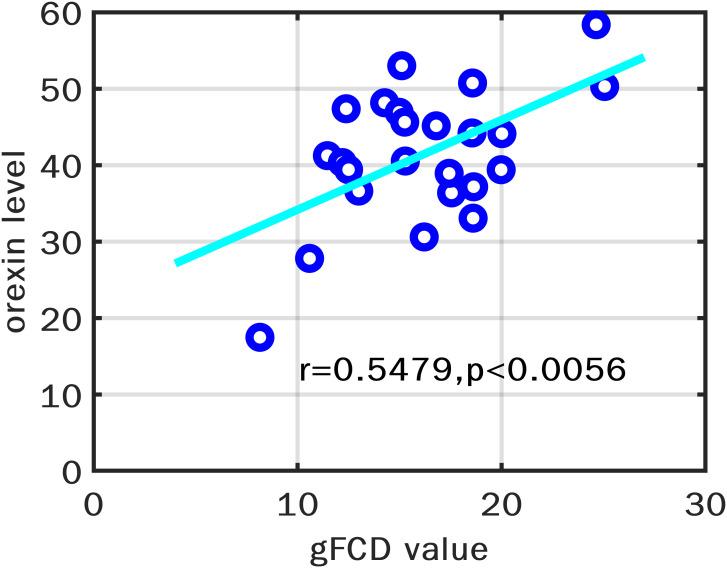
Plasma orexin levels in AD patients in remission were significantly higher than those in the controls. OCDS scores correlated to orexin concentrations ( = 0.47, < .05). Compared to the controls, all AD patients demonstrated reduced gFCD, primarily in the frontal, temporal, and parietal lobes, and increased gFCD in the accumbens nuclei and posterior insular cortex. Mean gFCD values in the accumbens nuclei significantly correlated to craving scores ( = 0.55, < .05). Although assessed during abstinence, the reward circuits in AD patients exhibited increased activity. Orexin levels correlated to increased activity in the accumbens nuclei and craving scores.
CONCLUSIONS
The potential clinical utility of plasma orexin levels to assess the risk of relapse in AD patients in treatment and prevention programs deserves further study.
目的
体内研究已将大脑活动与觅酒行为联系起来,而临床研究已确定酒精依赖(AD)患者即使在戒酒期间大脑活动也会发生改变。我们旨在探讨AD患者血浆中食欲素水平、大脑活动与酒瘾评分之间的关系。
方法
在这项初步研究中,我们评估了24名处于缓解期的男性AD患者和25名男性对照者。使用强迫性饮酒量表(OCDS)评估酒瘾。采用一种改良的MRI技术评估全脑功能连接密度(gFCD),并通过放射免疫分析法测量血浆中食欲素浓度。通过Pearson相关性分析进行关联分析。
结果
处于缓解期的AD患者血浆中食欲素水平显著高于对照组。OCDS评分与食欲素浓度相关(r = 0.47,P <.05)。与对照组相比,所有AD患者均表现出gFCD降低,主要在额叶、颞叶和顶叶,而伏隔核和岛叶后部皮质的gFCD增加。伏隔核的平均gFCD值与渴求评分显著相关(r = 0.55,P <.05)。尽管是在戒酒期间进行评估,但AD患者的奖赏回路活动增强。食欲素水平与伏隔核活动增强及渴求评分相关。
结论
血浆中食欲素水平在评估AD患者治疗和预防方案中复发风险方面的潜在临床应用价值值得进一步研究。

 Zotero 插件