
幼犬的哀鸣会影响家犬的母性行为。
Puppy whines mediate maternal behavior in domestic dogs.
机构信息
Equipe de Neuro-Ethologie Sensorielle Bioacoustics Research Laboratory, Centre de Recherche en Neurosciences de Lyon, University of Saint-Etienne, CNRS, Inserm, Saint-Etienne 42100, France.
Laboratoire de Dynamique du Langage, University Lyon 2, CNRS, Lyon 69363, France.
出版信息
Proc Natl Acad Sci U S A. 2024 May 28;121(22):e2316818121. doi: 10.1073/pnas.2316818121. Epub 2024 May 20.
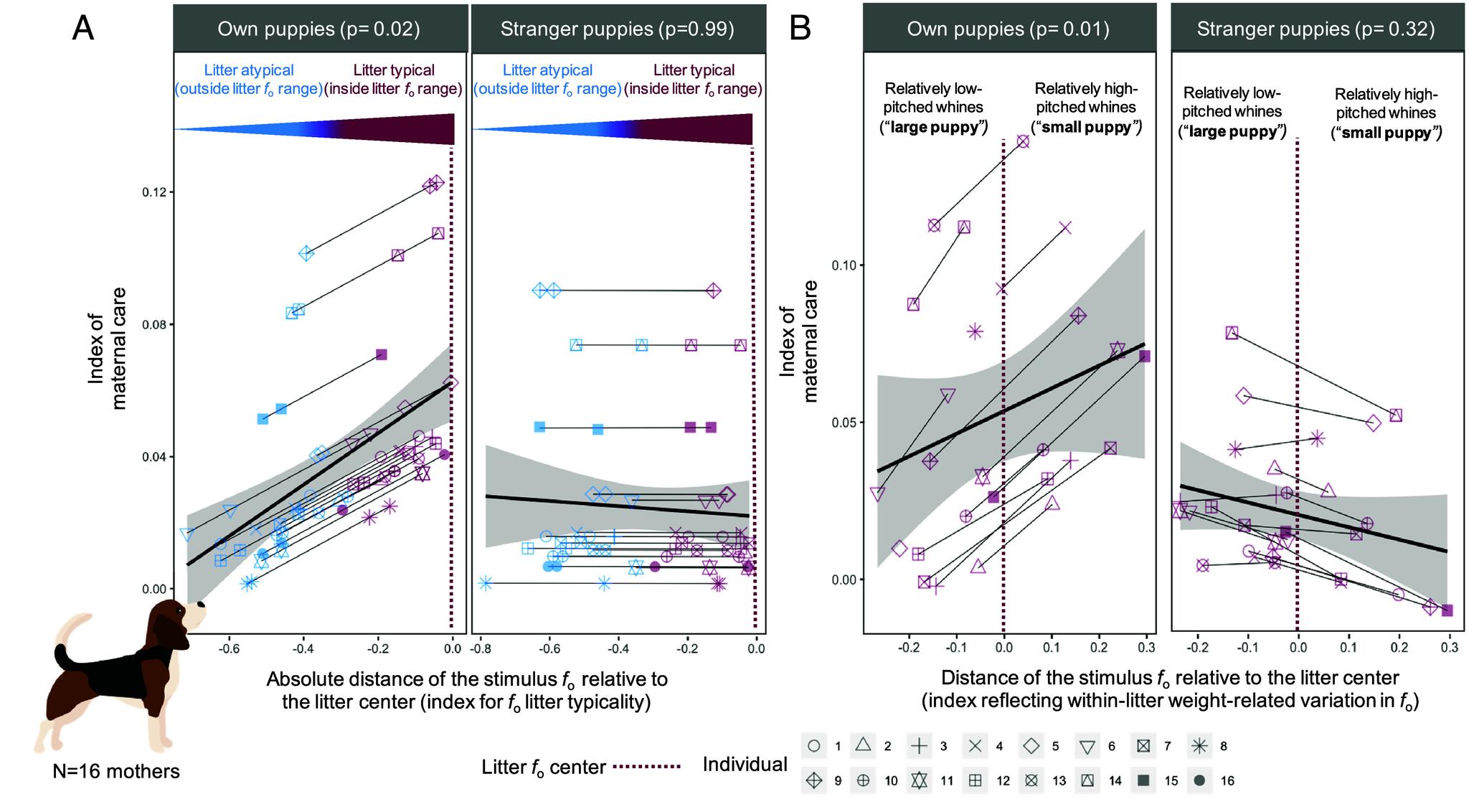
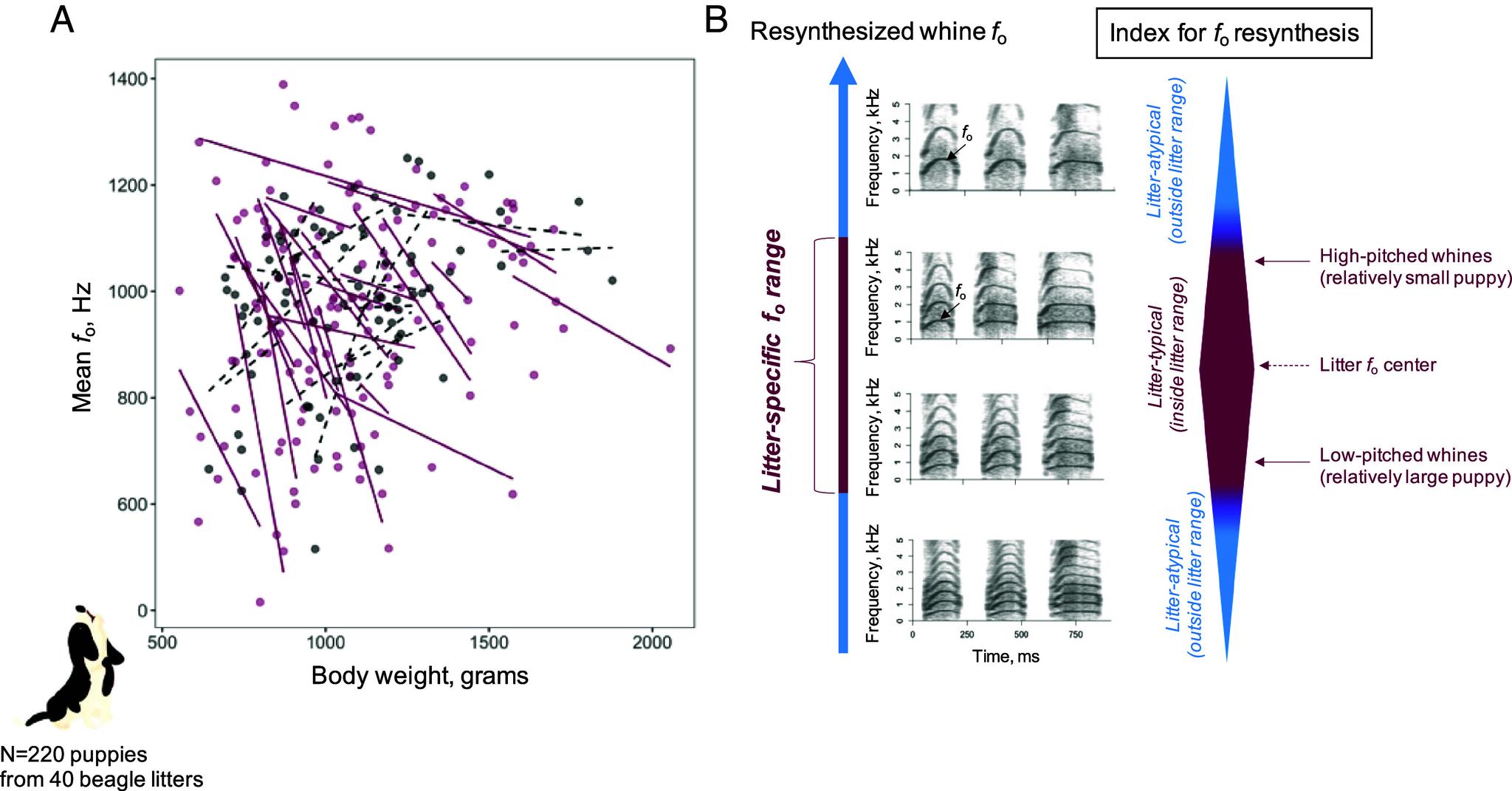
In mammals, offspring vocalizations typically encode information about identity and body condition, allowing parents to limit alloparenting and adjust care. But how do these vocalizations mediate parental behavior in species faced with the problem of rearing not one, but multiple offspring, such as domestic dogs? Comprehensive acoustic analyses of 4,400 whines recorded from 220 Beagle puppies in 40 litters revealed litter and individual (within litter) differences in call acoustic structure. By then playing resynthesized whines to mothers, we showed that they provided more care to their litters, and were more likely to carry the emitting loudspeaker to the nest, in response to whine variants derived from their own puppies than from strangers. Importantly, care provisioning was attenuated by experimentally moving the fundamental frequency (, perceived as pitch) of their own puppies' whines outside their litter-specific range. Within most litters, we found a negative relationship between puppies' whine and body weight. Consistent with this, playbacks showed that maternal care was stronger in response to high-pitched whine variants simulating relatively small offspring within their own litter's range compared to lower-pitched variants simulating larger offspring. We thus show that maternal care in a litter-rearing species relies on a dual assessment of offspring identity and condition, largely based on level-specific inter- and intra-litter variation in offspring call . This dual encoding system highlights how, even in a long-domesticated species, vocalizations reflect selective pressures to meet species-specific needs. Comparative work should now investigate whether similar communication systems have convergently evolved in other litter-rearing species.
在哺乳动物中,后代的叫声通常会编码有关身份和身体状况的信息,这使得父母能够限制代育并调整照顾行为。但是,在面临不是抚养一个而是多个后代的问题的物种中,例如家犬,这些叫声如何调节父母行为?对 220 只比格犬幼犬在 40 个窝中记录的 4400 次哀鸣进行了全面的声学分析,结果表明叫声的声学结构在窝内和个体(窝内)之间存在差异。然后,我们通过向母亲播放重新合成的哀鸣声,表明它们会根据源自自己幼犬的哀鸣变体(而不是陌生人的)提供更多的照顾,并更有可能将发声器带到巢穴中。重要的是,通过实验将其自身幼犬的哀鸣的基频(,被感知为音高)移到其特定窝的范围之外,从而减弱了提供护理的行为。在大多数窝中,我们发现幼犬的哀鸣与体重呈负相关。这与播放结果一致,表明当播放模拟自己窝内相对较小的后代的高音调哀鸣变体时,母亲的照顾行为更强,而播放模拟较大后代的低音调哀鸣变体时,母亲的照顾行为较弱。因此,我们表明,在窝内繁殖的物种中,母亲的照顾依赖于对后代身份和状况的双重评估,这主要基于窝内和窝间后代叫声的特定水平的差异。这种双重编码系统突出了即使在长期驯化的物种中,叫声也反映了满足特定物种需求的选择性压力。比较工作现在应该调查其他窝内繁殖的物种是否已经趋同进化出类似的通信系统。
 Zotero 插件