
糖尿病前期与慢性冠状动脉综合征患者临床结局的相关性:ISCHEMIA 和 ISCHEMIA-CKD 试验的事后分析。
Association of prediabetes with clinical outcomes in patients with chronic coronary syndrome: a post hoc analysis of the ISCHEMIA and ISCHEMIA-CKD trials.
机构信息
Department of Clinical Pharmacology, Medical University of Vienna, Vienna, Austria.
Division of Cardiology, Department of Medicine II, Medical University of Vienna, Vienna, Austria.
出版信息
Cardiovasc Diabetol. 2024 May 20;23(1):176. doi: 10.1186/s12933-024-02232-z.
BACKGROUND
There is conflicting evidence whether prediabetes is associated with adverse clinical outcomes in patients with chronic coronary syndrome. We aimed to assess the effect of prediabetes in patients with chronic coronary syndrome on clinical outcomes.
METHODS
This is a secondary analysis of data from the ISCHEMIA and ISCHEMIA-CKD trials, including patients with chronic coronary syndrome determined by coronary computed tomography angiography or exercise-stress testing. Participants were assigned to the normoglycemia group (HbA1c < 5.7% [< 39 mmol/mol]), prediabetes group (HbA1c 5.7-6.4% [40-47 mmol/mol]), or diabetes group (HbA1c ≥ 6.5% [≥ 48 mmol/mol]). The primary end point of this study was all-cause mortality. Secondary endpoints included major adverse cardiovascular events and composites thereof.
RESULTS
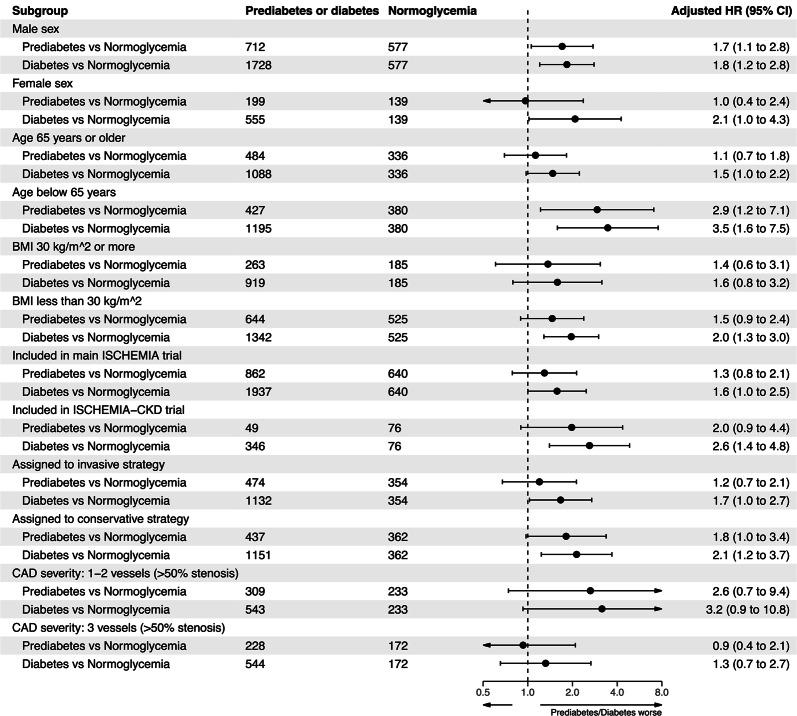
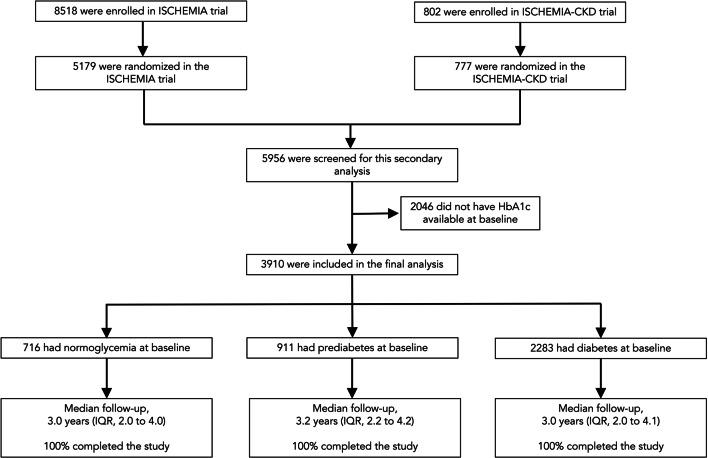
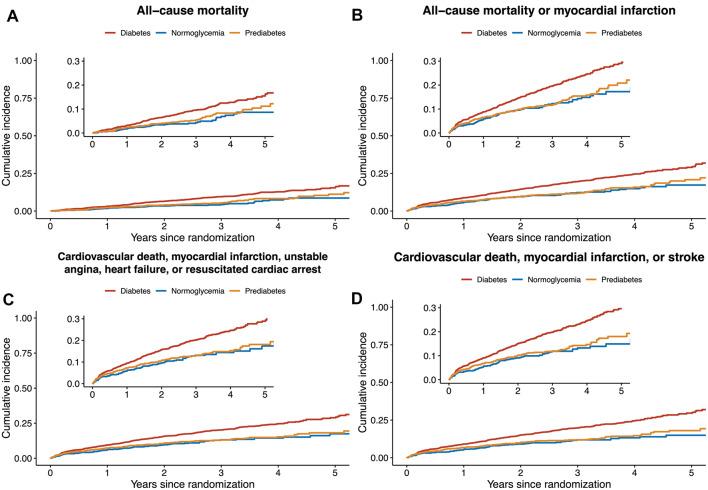
Overall, the primary endpoint all-cause mortality occurred in 330 (8.4%) of 3910 patients over a median follow-up time of 3.1 years (IQR 2.1-4.1). The primary endpoint all-cause mortality occurred in 37 (5.2%) of 716 patients in the normoglycemia group, in 63 (6.9%) of 911 in the prediabetes group, and in 230 (10.1%) of 2283 in the diabetes group. In the covariate-adjusted Cox model analysis, the estimated adjusted HR (aHR) in the prediabetes group as compared with the normoglycemia group was 1.45 (95%CI, 0.95-2.20). The aHR in the diabetes group as compared with the normoglycemia group was 1.84 (95%CI, 1.29-2.65). Prediabetes, compared with normoglycemia, was associated with an increased risk of stroke (aHR, 3.44, 95%CI, 1.15-10.25). Subgroup analyses suggested an increased risk of all-cause death associated with prediabetes in males and patients under 65 years.
CONCLUSIONS
In patients with chronic coronary syndrome, diabetes but not prediabetes was associated with significantly increased risk of all-cause death within a median follow-up period of 3.1 years. Trial Registration NCT01471522, BioLINCC ID 13936.
背景
关于糖尿病前期是否与慢性冠状动脉综合征患者的不良临床结局相关,目前仍存在争议。我们旨在评估糖尿病前期对慢性冠状动脉综合征患者临床结局的影响。
方法
这是对 ISCHEMIA 和 ISCHEMIA-CKD 试验数据的二次分析,纳入了通过冠状动脉计算机断层扫描血管造影或运动应激试验确定的慢性冠状动脉综合征患者。参与者被分配至正常血糖组(HbA1c<5.7%[<39mmol/mol])、糖尿病前期组(HbA1c 5.7-6.4%[40-47mmol/mol])或糖尿病组(HbA1c≥6.5%[≥48mmol/mol])。本研究的主要终点为全因死亡率。次要终点包括主要不良心血管事件及其复合终点。
结果
总体而言,中位随访时间为 3.1 年(IQR 2.1-4.1)时,3910 例患者中有 330 例(8.4%)发生全因死亡这一主要终点事件。正常血糖组中,37 例(5.2%)患者、糖尿病前期组中 63 例(6.9%)患者、糖尿病组中 230 例(10.1%)患者发生全因死亡。在经过协变量调整的 Cox 模型分析中,与正常血糖组相比,糖尿病前期组的校正后估计 HR(aHR)为 1.45(95%CI,0.95-2.20)。与正常血糖组相比,糖尿病组的 aHR 为 1.84(95%CI,1.29-2.65)。与正常血糖相比,糖尿病前期与卒中风险增加相关(aHR,3.44,95%CI,1.15-10.25)。亚组分析提示,在男性和年龄<65 岁的患者中,糖尿病前期与全因死亡风险增加相关。
结论
在慢性冠状动脉综合征患者中,与糖尿病前期相比,糖尿病与中位随访 3.1 年内全因死亡风险显著增加相关。
试验注册
NCT01471522,BioLINCC ID 13936。
 Zotero 插件