
墨西哥脂鲤表面和洞穴鱼染色体水平基因组组装用于特征变异发现。
Astyanax mexicanus surface and cavefish chromosome-scale assemblies for trait variation discovery.
机构信息
Department of Animal Sciences, University of Missouri, Bond Life Sciences Center, Columbia, MO 65211, USA.
Department of Surgery, University of Missouri, Bond Life Sciences Center, Columbia, MO 65211, USA.
出版信息
G3 (Bethesda). 2024 Aug 7;14(8). doi: 10.1093/g3journal/jkae103.
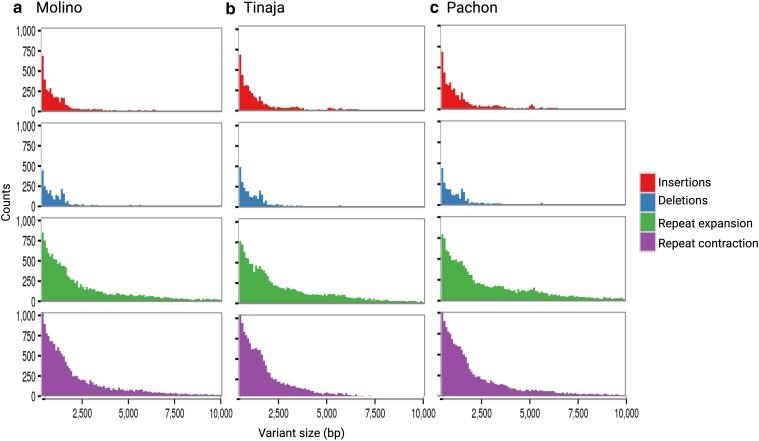
The ability of organisms to adapt to sudden extreme environmental changes produces some of the most drastic examples of rapid phenotypic evolution. The Mexican Tetra, Astyanax mexicanus, is abundant in the surface waters of northeastern Mexico, but repeated colonizations of cave environments have resulted in the independent evolution of troglomorphic phenotypes in several populations. Here, we present three chromosome-scale assemblies of this species, for one surface and two cave populations, enabling the first whole-genome comparisons between independently evolved cave populations to evaluate the genetic basis for the evolution of adaptation to the cave environment. Our assemblies represent the highest quality of sequence completeness with predicted protein-coding and noncoding gene metrics far surpassing prior resources and, to our knowledge, all long-read assembled teleost genomes, including zebrafish. Whole-genome synteny alignments show highly conserved gene order among cave forms in contrast to a higher number of chromosomal rearrangements when compared with other phylogenetically close or distant teleost species. By phylogenetically assessing gene orthology across distant branches of amniotes, we discover gene orthogroups unique to A. mexicanus. When compared with a representative surface fish genome, we find a rich amount of structural sequence diversity, defined here as the number and size of insertions and deletions as well as expanding and contracting repeats across cave forms. These new more complete genomic resources ensure higher trait resolution for comparative, functional, developmental, and genetic studies of drastic trait differences within a species.
生物体适应突发极端环境变化的能力产生了一些最剧烈的快速表型进化的例子。墨西哥脂鲤(Astyanax mexicanus)在墨西哥东北部的地表水层中大量存在,但洞穴环境的多次殖民化导致了几个种群中独立进化的洞穴形态。在这里,我们为这个物种提供了三个染色体尺度的组装,一个是地表种群,两个是洞穴种群,这使得首次对独立进化的洞穴种群进行全基因组比较,以评估适应洞穴环境的进化的遗传基础。我们的组装代表了最高质量的序列完整性,预测的蛋白编码和非编码基因指标远远超过了先前的资源,据我们所知,也超过了所有长读长组装的硬骨鱼基因组,包括斑马鱼。全基因组同线性比对显示,洞穴形式之间的基因排列高度保守,与其他系统发育上接近或遥远的硬骨鱼物种相比,染色体重排的数量更多。通过在羊膜动物的遥远分支上对基因直系同源性进行系统发育评估,我们发现了 A. mexicanus 特有的基因直系同源群。与代表性的地表鱼类基因组相比,我们发现了丰富的结构序列多样性,这里定义为插入和缺失的数量和大小,以及洞穴形式中扩展和收缩的重复。这些新的更完整的基因组资源确保了在一个物种内对剧烈表型差异进行比较、功能、发育和遗传研究的更高性状分辨率。


 Zotero 插件