
埃及临床铜绿假单胞菌分离株中质粒介导的喹诺酮耐药(PMQR)和超广谱β-内酰胺酶(ESBL)基因的共存。
Coexistence of plasmid-mediated quinolone resistance (PMQR) and extended-spectrum beta-lactamase (ESBL) genes among clinical Pseudomonas aeruginosa isolates in Egypt.
机构信息
Department of Medical Microbiology and Immunology, Faculty of Medicine, Minia University, Minia, 61511, Egypt.
Department of Microbiology and Immunology, Faculty of Pharmacy, Minia University, Minia, Egypt.
出版信息
BMC Microbiol. 2024 May 21;24(1):175. doi: 10.1186/s12866-024-03319-z.
BACKGROUND
Data about the prevalence of plasmid-mediated quinolone resistance (PMQR) and extended-spectrum beta-lactamase (ESBL) production in P. aeruginosa compared to the Enterobacteriaceae family is limited. The availability of limited therapeutic options raises alarming concerns about the treatment of multidrug-resistant P. aeruginosa. This study aimed to assess the presence of PMQR and ESBL genes among P. aeruginosa strains.
METHODS
Fifty-six P. aeruginosa strains were isolated from 330 patients with different clinical infections. Phenotypically fluoroquinolone-resistant isolates were tested by PCR for the presence of six PMQR genes. Then, blaTEM, blaSHV, and blaCTX-M type ESBL genes were screened to study the co-existence of different resistance determinants.
RESULTS
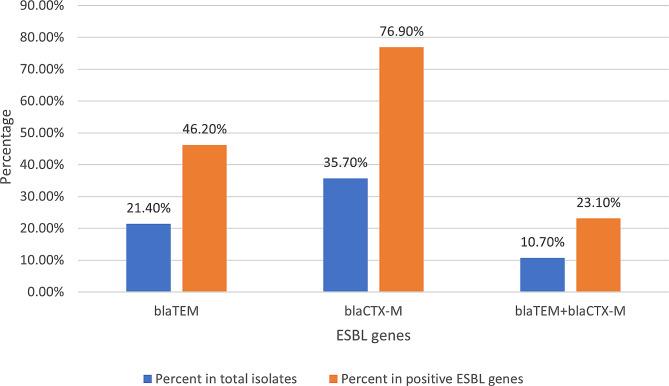
Overall, 22/56 (39.3%) of the studied P. aeruginosa isolates were phenotypically resistant to fluoroquinolones. PMQR-producing P. aeruginosa isolates were identified in 20 isolates (90.9%). The acc(6')-Ib-cr was the most prevalent PMQR gene (77.3%). The qnr genes occurred in 72.7%, with the predominance of the qnrA gene at 54.5%, followed by the qnrS gene at 27.3%, then qnrB and qnrC at 22.7%. The qepA was not detected in any isolate. The acc(6')-Ib-cr was associated with qnr genes in 65% of positive PMQR isolates. Significant differences between the fluoroquinolone-resistant and fluoroquinolone-susceptible isolates in terms of the antibiotic resistance rates of amikacin, imipenem, and cefepime (P value < 0.0001) were found. The ESBL genes were detected in 52% of cephalosporin-resistant P. aeruginosa isolates. The most frequent ESBL gene was blaCTX-M (76.9%), followed by blaTEM (46.2%). No isolates carried the blaSHV gene. The acc(6')-Ib-cr gene showed the highest association with ESBL genes, followed by the qnrA gene. The correlation matrix of the detected PMQR and ESBL genes indicated overall positive correlations. The strongest and most highly significant correlation was between qnrA and acc(6')-Ib-cr (r = 0.602) and between qnrA and blaCTX-M (r = 0.519).
CONCLUSION
A high prevalence of PMQR genes among the phenotypic fluoroquinolone-resistant P. aeruginosa isolates was detected, with the co-carriage of different PMQR genes. The most frequent PMQR was the acc(6')-Ib-cr gene. Co-existence between PMQR and ESBL genes was found, with 75% of PMQR-positive isolates carrying at least one ESBL gene. A high and significant correlation between the ESBL and PMQR genes was detected.
背景
与肠杆菌科相比,铜绿假单胞菌中质粒介导的喹诺酮耐药(PMQR)和超广谱β-内酰胺酶(ESBL)产生的数据有限。治疗选择有限,这引起了对多药耐药铜绿假单胞菌治疗的严重担忧。本研究旨在评估铜绿假单胞菌菌株中 PMQR 和 ESBL 基因的存在情况。
方法
从 330 名患有不同临床感染的患者中分离出 56 株铜绿假单胞菌。通过 PCR 检测表型氟喹诺酮耐药分离株中六种 PMQR 基因的存在情况。然后,筛选 blaTEM、blaSHV 和 blaCTX-M 型 ESBL 基因,以研究不同耐药决定因素的共存情况。
结果
总体而言,研究的 56 株铜绿假单胞菌分离株中有 22/56(39.3%)表型对氟喹诺酮耐药。在 20 株(90.9%)分离株中鉴定出产 PMQR 的铜绿假单胞菌。acc(6')-Ib-cr 是最常见的 PMQR 基因(77.3%)。qnr 基因的发生率为 72.7%,其中 qnrA 基因占主导地位(54.5%),其次是 qnrS 基因(27.3%),然后是 qnrB 和 qnrC 基因(22.7%)。qepA 未在任何分离株中检测到。acc(6')-Ib-cr 与阳性 PMQR 分离株中的 qnr 基因有 65%的关联。在氨基糖苷类抗生素(阿米卡星、亚胺培南和头孢吡肟)的耐药率方面,氟喹诺酮耐药和氟喹诺酮敏感分离株之间存在显著差异(P 值<0.0001)。在头孢菌素耐药的铜绿假单胞菌分离株中检测到 ESBL 基因,占 52%。最常见的 ESBL 基因是 blaCTX-M(76.9%),其次是 blaTEM(46.2%)。没有分离株携带 blaSHV 基因。acc(6')-Ib-cr 基因与 ESBL 基因的关联最高,其次是 qnrA 基因。检测到的 PMQR 和 ESBL 基因的相关矩阵表明总体上呈正相关。qnrA 和 acc(6')-Ib-cr 之间(r=0.602)以及 qnrA 和 blaCTX-M 之间(r=0.519)存在最强和最显著的相关性。
结论
在表型氟喹诺酮耐药的铜绿假单胞菌分离株中检测到 PMQR 基因的高流行率,同时携带不同的 PMQR 基因。最常见的 PMQR 是 acc(6')-Ib-cr 基因。发现 PMQR 和 ESBL 基因共存,75%的 PMQR 阳性分离株携带至少一种 ESBL 基因。检测到 ESBL 和 PMQR 基因之间存在高度和显著的相关性。

 Zotero 插件