
肿瘤科室工作人员利用人工智能辅助评估化疗患者的心功能。
Artificial intelligence-assisted evaluation of cardiac function by oncology staff in chemotherapy patients.
作者信息
Papadopoulou Stella-Lida, Dionysopoulos Dimitrios, Mentesidou Vaia, Loga Konstantia, Michalopoulou Stella, Koukoutzeli Chrysanthi, Efthimiadis Konstantinos, Kantartzi Vasiliki, Timotheadou Eleni, Styliadis Ioannis, Nihoyannopoulos Petros, Sachpekidis Vasileios
机构信息
Department of Cardiology, Papageorgiou General Hospital, Ring Road, Nea Efkarpia, Thessaloniki 56403, Greece.
Department of Medical Oncology, Papageorgiou Hospital, Aristotle University of Thessaloniki, School of Health Sciences, Faculty of Medicine, Ring Road, Nea Efkarpia, Thessaloniki 56403, Greece.
出版信息
Eur Heart J Digit Health. 2024 Feb 27;5(3):278-287. doi: 10.1093/ehjdh/ztae017. eCollection 2024 May.
AIMS
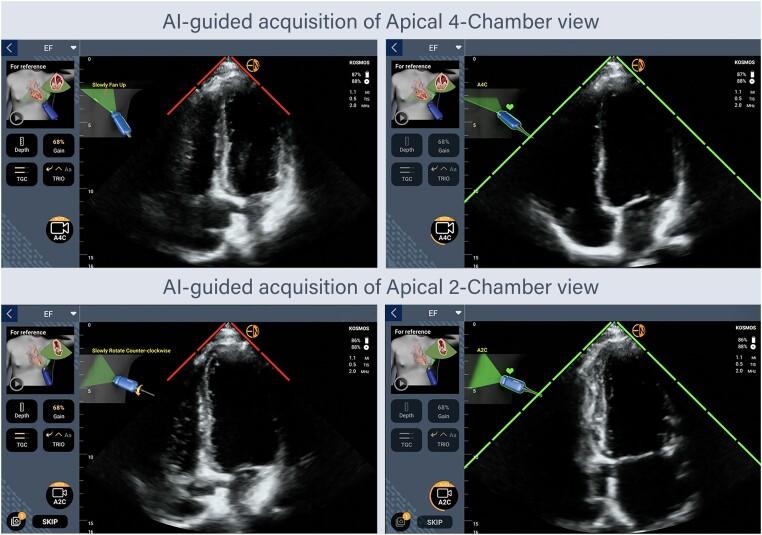
Left ventricular ejection fraction (LVEF) calculation by echocardiography is pivotal in evaluating cancer patients' cardiac function. Artificial intelligence (AI) can facilitate the acquisition of optimal images and automated LVEF (autoEF) calculation. We sought to evaluate the feasibility and accuracy of LVEF calculation by oncology staff using an AI-enabled handheld ultrasound device (HUD).
METHODS AND RESULTS
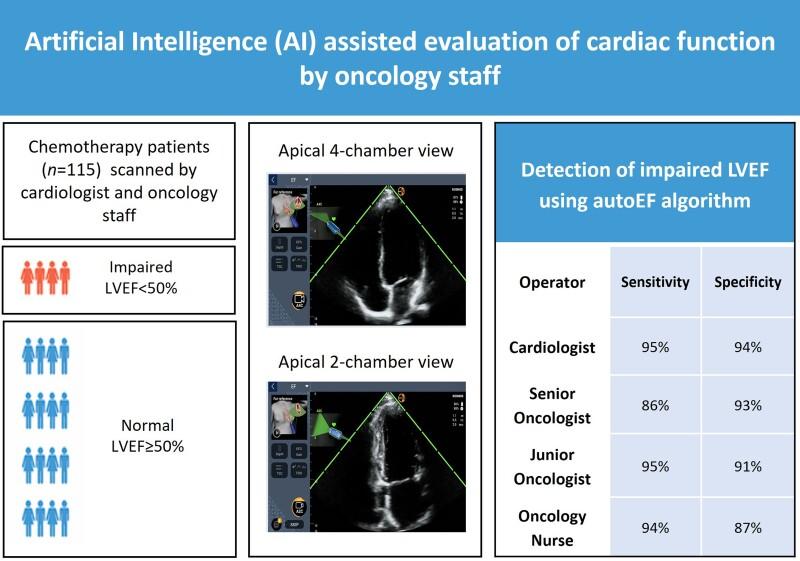
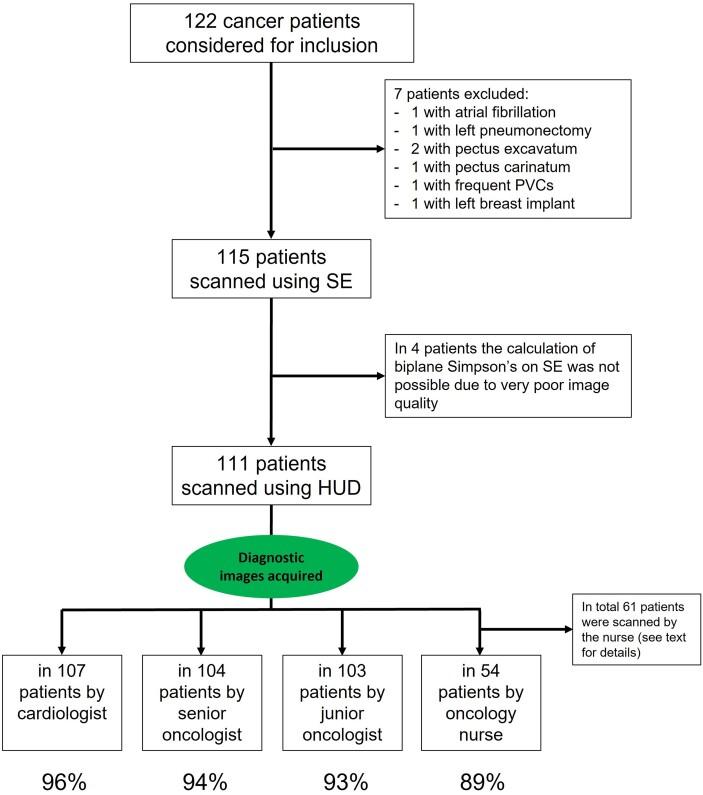
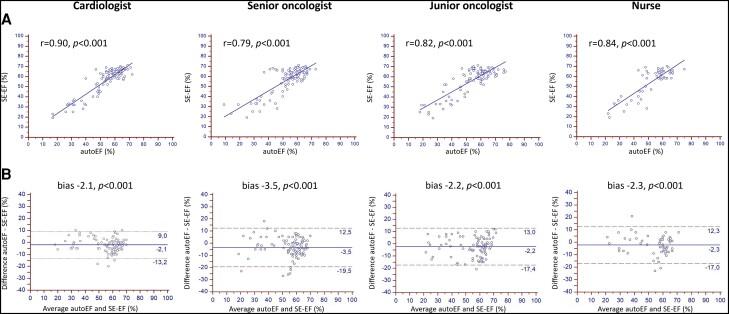
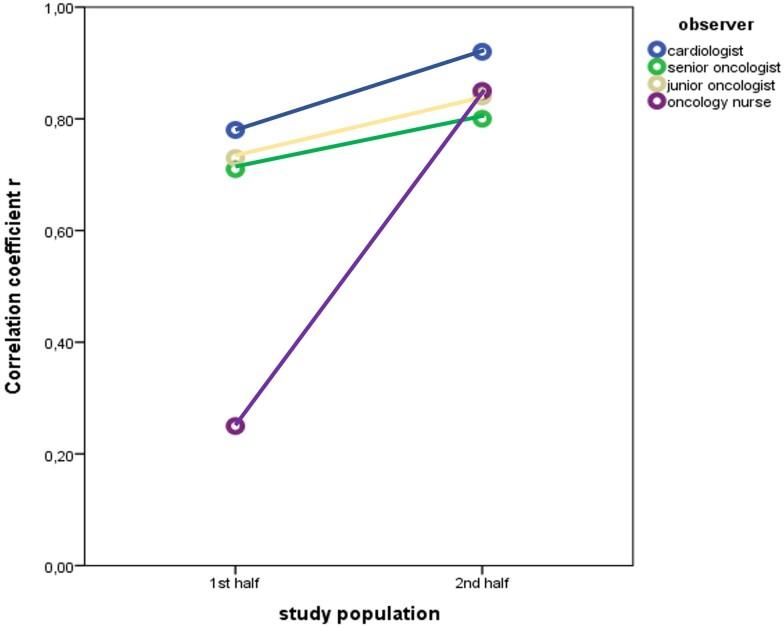
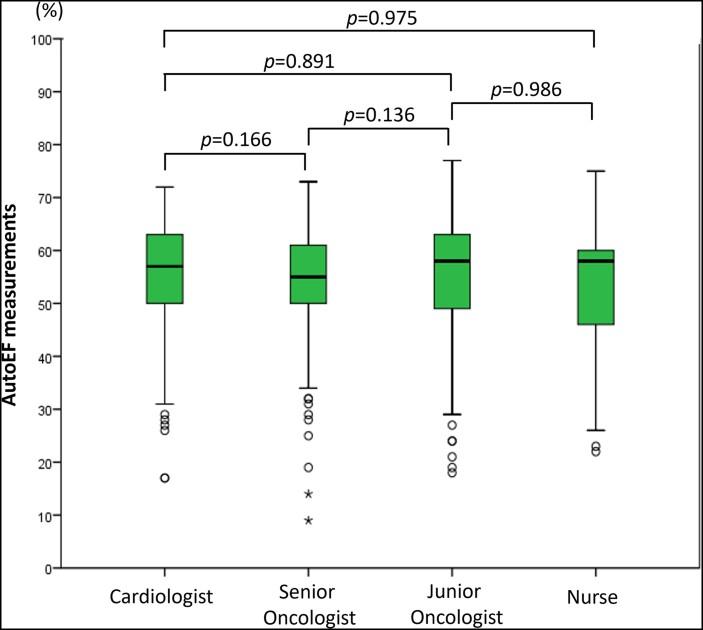
We studied 115 patients referred for echocardiographic LVEF estimation. All patients were scanned by a cardiologist using standard echocardiography (SE), and biplane Simpson's LVEF was the reference standard. Hands-on training using the Kosmos HUD was provided to the oncology staff before the study. Each patient was scanned by a cardiologist, a senior oncologist, an oncology resident, and a nurse using the TRIO AI and KOSMOS EF deep learning algorithms to obtain autoEF. The correlation between autoEF and SE-ejection fraction (EF) was excellent for the cardiologist ( = 0.90), the junior oncologist ( = 0.82), and the nurse ( = 0.84), and good for the senior oncologist ( = 0.79). The Bland-Altman analysis showed a small underestimation by autoEF compared with SE-EF. Detection of impaired LVEF < 50% was feasible with a sensitivity of 95% and specificity of 94% for the cardiologist; sensitivity of 86% and specificity of 93% for the senior oncologist; sensitivity of 95% and specificity of 91% for the junior oncologist; and sensitivity of 94% and specificity of 87% for the nurse.
CONCLUSION
Automated LVEF calculation by oncology staff was feasible using AI-enabled HUD in a selected patient population. Detection of LVEF < 50% was possible with good accuracy. These findings show the potential to expedite the clinical workflow of cancer patients and speed up a referral when necessary.
目的
通过超声心动图计算左心室射血分数(LVEF)对于评估癌症患者的心功能至关重要。人工智能(AI)有助于获取最佳图像并自动计算LVEF(自动EF)。我们旨在评估肿瘤学工作人员使用人工智能支持的手持式超声设备(HUD)计算LVEF的可行性和准确性。
方法与结果
我们研究了115名转诊进行超声心动图LVEF评估的患者。所有患者均由心脏病专家使用标准超声心动图(SE)进行扫描,双平面辛普森LVEF为参考标准。在研究前,为肿瘤学工作人员提供了使用Kosmos HUD的实践培训。每位患者由心脏病专家、高级肿瘤学家、肿瘤学住院医师和护士使用TRIO AI和KOSMOS EF深度学习算法进行扫描以获得自动EF。自动EF与SE射血分数(EF)之间的相关性对于心脏病专家(=0.90)、初级肿瘤学家(=0.82)和护士(=0.84)而言极佳,对于高级肿瘤学家(=0.79)而言良好。Bland-Altman分析显示,与SE-EF相比,自动EF存在轻微低估。心脏病专家检测LVEF<50%受损的可行性为敏感性95%、特异性94%;高级肿瘤学家的敏感性为86%、特异性为93%;初级肿瘤学家的敏感性为95%、特异性为91%;护士的敏感性为94%、特异性为87%。
结论
在选定的患者群体中,肿瘤学工作人员使用人工智能支持的HUD自动计算LVEF是可行的。检测LVEF<50%具有良好的准确性。这些发现表明有可能加快癌症患者的临床工作流程,并在必要时加快转诊速度。

 Zotero 插件