
决策与强化学习计算参数的可靠性
Reliability of Decision-Making and Reinforcement Learning Computational Parameters.
作者信息
Mkrtchian Anahit, Valton Vincent, Roiser Jonathan P
机构信息
Neuroscience and Mental Health Group, Institute of Cognitive Neuroscience, University College London, London, United Kingdom.
Applied Computational Psychiatry Lab, Mental Health Neuroscience Department, Division of Psychiatry and Max Planck Centre for Computational Psychiatry and Ageing Research, Queen Square Institute of Neurology, University College London, London, United Kingdom.
出版信息
Comput Psychiatr. 2023 Feb 8;7(1):30-46. doi: 10.5334/cpsy.86. eCollection 2023.
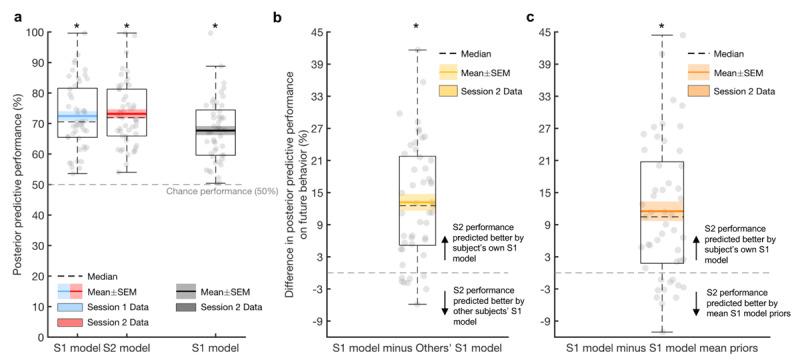
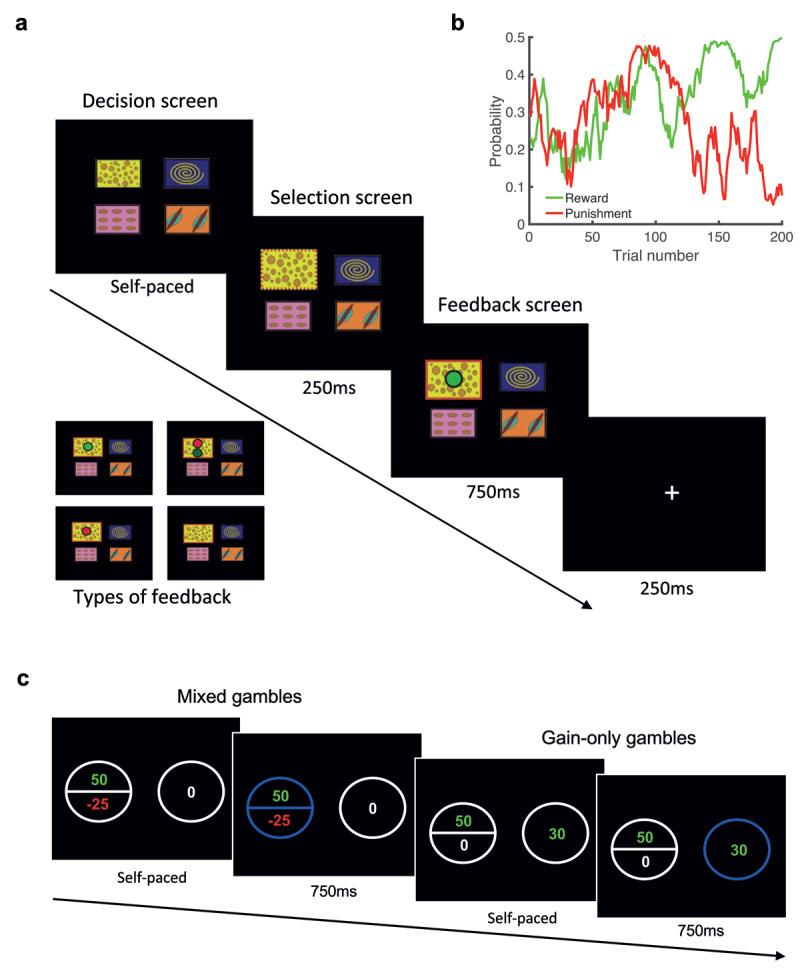
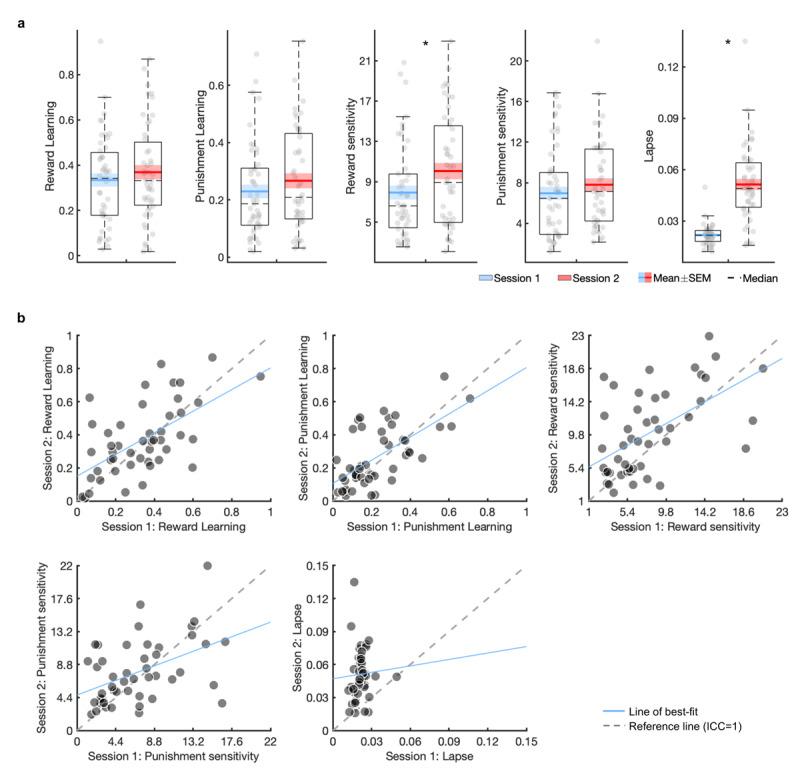
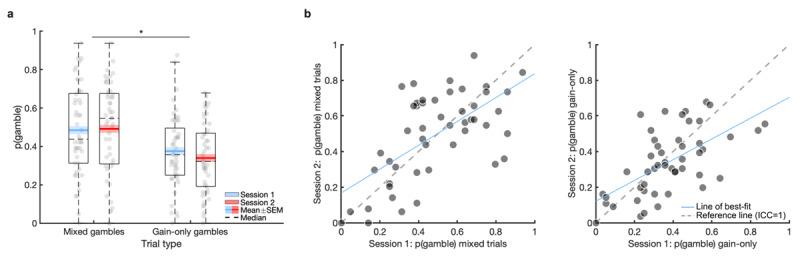
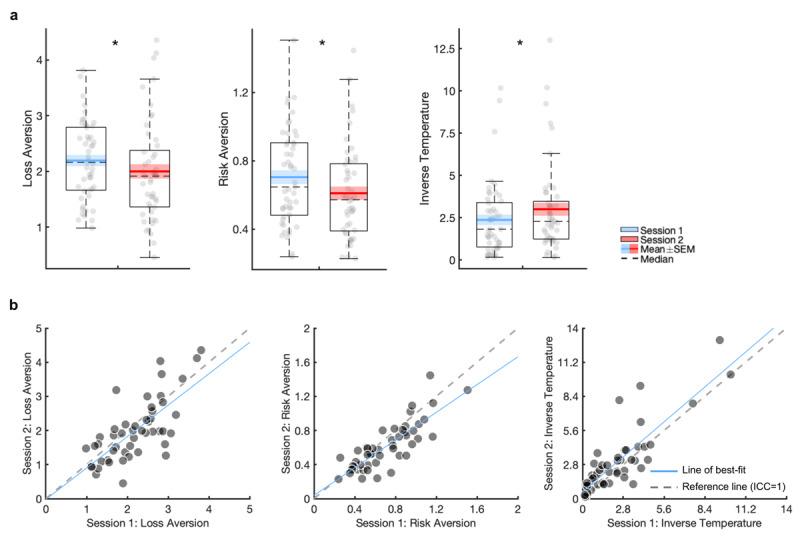
Computational models can offer mechanistic insight into cognition and therefore have the potential to transform our understanding of psychiatric disorders and their treatment. For translational efforts to be successful, it is imperative that computational measures capture individual characteristics reliably. Here we examine the reliability of reinforcement learning and economic models derived from two commonly used tasks. Healthy individuals (N = 50) completed a restless four-armed bandit and a calibrated gambling task twice, two weeks apart. Reward and punishment learning rates from the reinforcement learning model showed good reliability and reward and punishment sensitivity from the same model had fair reliability; while risk aversion and loss aversion parameters from a prospect theory model exhibited good and excellent reliability, respectively. Both models were further able to predict future behaviour above chance within individuals. This prediction was better when based on participants' own model parameters than other participants' parameter estimates. These results suggest that reinforcement learning, and particularly prospect theory parameters, as derived from a restless four-armed bandit and a calibrated gambling task, can be measured reliably to assess learning and decision-making mechanisms. Overall, these findings indicate the translational potential of clinically-relevant computational parameters for precision psychiatry.
计算模型能够为认知提供机制性见解,因此有潜力改变我们对精神疾病及其治疗的理解。为使转化研究取得成功,至关重要的是计算指标能够可靠地捕捉个体特征。在此,我们检验了源自两项常用任务的强化学习模型和经济模型的可靠性。50名健康个体间隔两周完成了两次不安分的四臂赌博机任务和一次校准赌博任务。强化学习模型中的奖励和惩罚学习率显示出良好的可靠性,同一模型中的奖励和惩罚敏感性具有尚可的可靠性;而前景理论模型中的风险厌恶和损失厌恶参数分别表现出良好和出色的可靠性。两个模型都能够在个体层面上对未来行为做出高于机遇水平的预测。基于参与者自身的模型参数进行预测比基于其他参与者的参数估计效果更好。这些结果表明,源自不安分的四臂赌博机任务和校准赌博任务的强化学习,尤其是前景理论参数,可以被可靠地测量以评估学习和决策机制。总体而言,这些发现表明了临床相关计算参数在精准精神病学中的转化潜力。


 Zotero 插件