
一项随机对照研究,旨在调查南非青少年群体睡眠干预(SAASI)对青少年睡眠和创伤后应激障碍(PTSD)的影响。
A pilot randomised control study to investigate the effect of the South African Adolescence Group Sleep Intervention (SAASI) on adolescent sleep and PTSD.
机构信息
Faculty of Medicine and Health Sciences, Department of Psychiatry, Stellenbosch University, Cape Town, South Africa.
Faculty of Medicine and Health Sciences, South African Medical Council Unit on the Genomics of Brain Disorders, Department of Psychiatry, Stellenbosch University, Cape Town, South Africa.
出版信息
Eur J Psychotraumatol. 2024;15(1):2350217. doi: 10.1080/20008066.2024.2350217. Epub 2024 May 22.
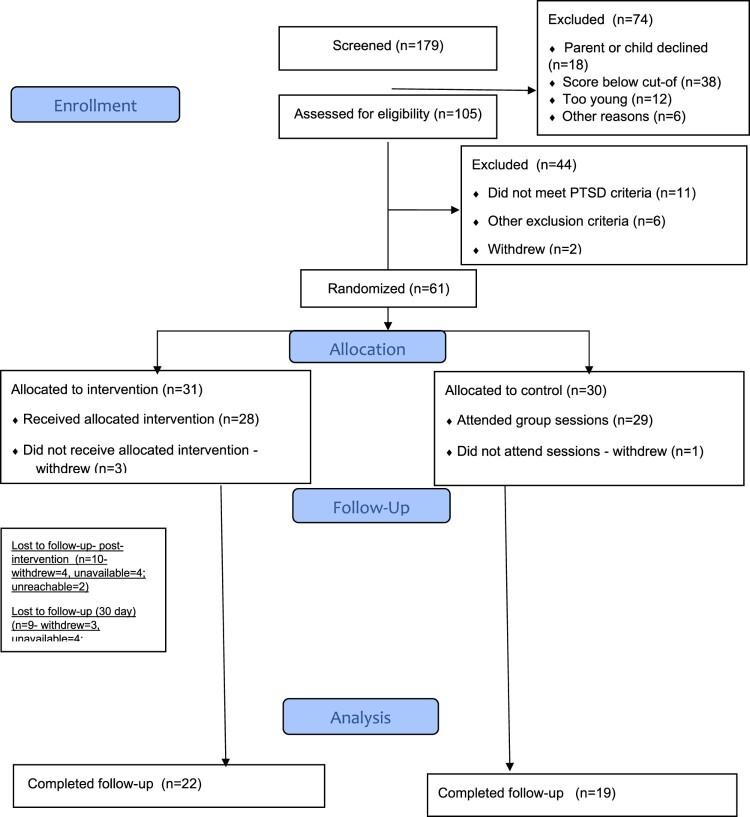
Trauma exposure prevalence and consequent post-traumatic stress disorder among South African adolescents are significant. Sleep disturbances are among the most frequently reported difficulties faced by those dealing with PTSD. The current study examined the feasibility and preliminary efficacy of the South African Adolescence Group Sleep Intervention on PTSD symptom severity and sleep disturbance. Sixty-one adolescents with PTSD diagnoses and sleep disturbance were randomly assigned (1:1) to one individual and four group sessions of a sleep intervention (SAASI) or a control group. Participants completed the Child PTSD symptom scale for DSM5 (CPSS-5) and the Pittsburgh Sleep Quality Index (PSQI) among other sleep and psychiatric measures. The trial was registered on the Pan African Trial Registry (PACTR202208559723690). There was a significant but similar decrease in PSQI scores in both groups over time indicating no overall intervention effect (Wald test = -2.18, = .029), mean slope = -0.2 (95% CI: -0.37 to -0.02) ( = .583). On the CPSS-5, interaction between groups was also not significant (p = .291). Despite this overall finding, the mean difference in CPSS-SR-5 scores increased over time, with the difference between groups post-treatment -9.10 (95%CI: -18.00 to -0.21), = .045 and the 1-month follow-up contrast - 11.22 (95%CI: -22.43 to -0.03), = .049 suggesting that PTSD symptom severity decreased more in the intervention group than the control group. The dropout rate was higher than expected for both the intervention ( = 10; 32%) and control ( = 8; 26.7%) groups. Dropout were mostly school commitments or travel related. Early findings suggest a trend towards dual improvement in sleep quality and PTSD symptom severity in adolescents with a sleep disturbance and PTSD receiving a group sleep intervention (SAASI). Further investigation in a properly powered RCT with detailed retention planning is indicated.
南非青少年创伤暴露的普遍性以及由此导致的创伤后应激障碍是很严重的。睡眠障碍是那些患有创伤后应激障碍的人最常报告的困难之一。本研究旨在检验南非青少年团体睡眠干预对创伤后应激障碍症状严重程度和睡眠障碍的可行性和初步疗效。61 名患有创伤后应激障碍和睡眠障碍的青少年被随机分配(1:1)到个体和 4 个团体的睡眠干预(SAASI)组或对照组。参与者完成了儿童创伤后应激障碍症状量表(CPSS-5)和匹兹堡睡眠质量指数(PSQI)以及其他睡眠和精神科测量。该试验在泛非试验注册处(PACTR202208559723690)注册。随着时间的推移,两组的 PSQI 评分都有显著但相似的下降,表明没有整体干预效果(Wald 检验=-2.18,=.029),平均斜率=-0.2(95%CI:-0.37 至-0.02)(=.583)。在 CPSS-5 上,组间的交互作用也不显著(p =.291)。尽管有了这一总体发现,但 CPSS-SR-5 评分的平均差异随着时间的推移而增加,治疗后组间差异为-9.10(95%CI:-18.00 至-0.21),=.045,1 个月随访时的差异为-11.22(95%CI:-22.43 至-0.03),=.049,这表明干预组的创伤后应激障碍症状严重程度比对照组下降更多。两组的辍学率都高于预期(干预组=10;32%;对照组=8;26.7%)。辍学主要是因为学校的承诺或旅行。早期的发现表明,在接受团体睡眠干预(SAASI)的睡眠障碍和创伤后应激障碍青少年中,睡眠质量和创伤后应激障碍症状严重程度都有双重改善的趋势。需要进行一项有详细保留计划的、适当功率的 RCT 进一步调查。
 Zotero 插件