
欧洲儿童基于机器学习的健康环境-临床风险评分
Machine learning-based health environmental-clinical risk scores in European children.
作者信息
Guimbaud Jean-Baptiste, Siskos Alexandros P, Sakhi Amrit Kaur, Heude Barbara, Sabidó Eduard, Borràs Eva, Keun Hector, Wright John, Julvez Jordi, Urquiza Jose, Gützkow Kristine Bjerve, Chatzi Leda, Casas Maribel, Bustamante Mariona, Nieuwenhuijsen Mark, Vrijheid Martine, López-Vicente Mónica, de Castro Pascual Montserrat, Stratakis Nikos, Robinson Oliver, Grazuleviciene Regina, Slama Remy, Alemany Silvia, Basagaña Xavier, Plantevit Marc, Cazabet Rémy, Maitre Léa
机构信息
ISGlobal, Barcelona, Spain.
Univ Lyon, UCBL, CNRS, INSA Lyon, LIRIS, UMR5205, F-69622, Villeurbanne, France.
出版信息
Commun Med (Lond). 2024 May 23;4(1):98. doi: 10.1038/s43856-024-00513-y.
BACKGROUND
Early life environmental stressors play an important role in the development of multiple chronic disorders. Previous studies that used environmental risk scores (ERS) to assess the cumulative impact of environmental exposures on health are limited by the diversity of exposures included, especially for early life determinants. We used machine learning methods to build early life exposome risk scores for three health outcomes using environmental, molecular, and clinical data.
METHODS
In this study, we analyzed data from 1622 mother-child pairs from the HELIX European birth cohorts, using over 300 environmental, 100 child peripheral, and 18 mother-child clinical markers to compute environmental-clinical risk scores (ECRS) for child behavioral difficulties, metabolic syndrome, and lung function. ECRS were computed using LASSO, Random Forest and XGBoost. XGBoost ECRS were selected to extract local feature contributions using Shapley values and derive feature importance and interactions.
RESULTS
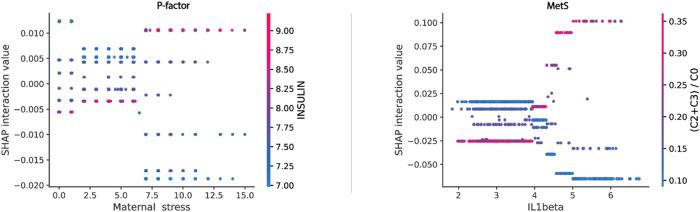
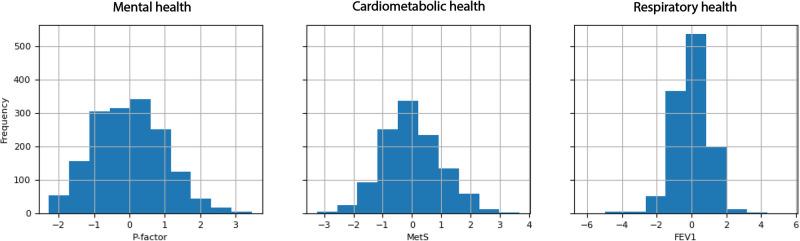
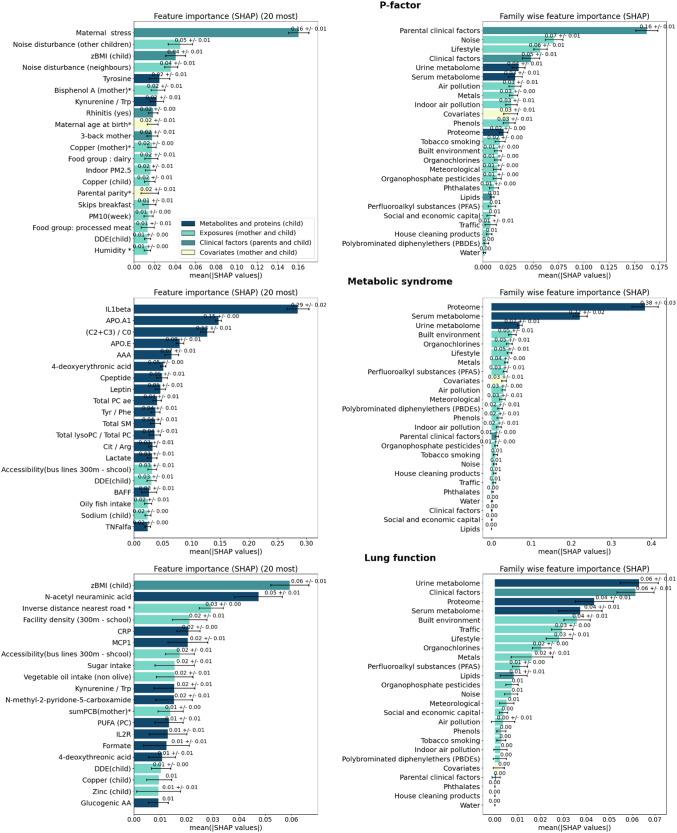
ECRS captured 13%, 50% and 4% of the variance in mental, cardiometabolic, and respiratory health, respectively. We observed no significant differences in predictive performances between the above-mentioned methods.The most important predictive features were maternal stress, noise, and lifestyle exposures for mental health; proteome (mainly IL1B) and metabolome features for cardiometabolic health; child BMI and urine metabolites for respiratory health.
CONCLUSIONS
Besides their usefulness for epidemiological research, our risk scores show great potential to capture holistic individual level non-hereditary risk associations that can inform practitioners about actionable factors of high-risk children. As in the post-genetic era personalized prevention medicine will focus more and more on modifiable factors, we believe that such integrative approaches will be instrumental in shaping future healthcare paradigms.
背景
早期生活环境应激源在多种慢性疾病的发展中起着重要作用。以往使用环境风险评分(ERS)来评估环境暴露对健康的累积影响的研究,受到所纳入暴露因素多样性的限制,尤其是对于早期生活决定因素而言。我们使用机器学习方法,利用环境、分子和临床数据,为三种健康结局构建早期生活暴露组风险评分。
方法
在本研究中,我们分析了来自欧洲HELIX出生队列的1622对母婴的数据,使用300多个环境指标、100个儿童外周指标和18个母婴临床指标,来计算儿童行为困难、代谢综合征和肺功能的环境 - 临床风险评分(ECRS)。ECRS使用套索回归(LASSO)、随机森林和极端梯度提升(XGBoost)进行计算。选择XGBoost ECRS,使用夏普利值(Shapley values)提取局部特征贡献,并得出特征重要性和相互作用。
结果
ECRS分别解释了心理、心脏代谢和呼吸健康方面13%、50%和4%的方差。我们观察到上述方法在预测性能上没有显著差异。最重要的预测特征是心理健康方面的母亲压力、噪音和生活方式暴露;心脏代谢健康方面的蛋白质组(主要是白细胞介素1β,IL1B)和代谢组特征;呼吸健康方面的儿童体重指数(BMI)和尿液代谢物。
结论
除了对流行病学研究有用外,我们的风险评分显示出巨大潜力,能够捕捉整体个体水平的非遗传风险关联,可为从业者提供有关高危儿童可采取行动的因素的信息。在后基因时代,个性化预防医学将越来越关注可改变因素,我们相信这种综合方法将有助于塑造未来的医疗保健模式。




 Zotero 插件