
一种蛋白质组学方法鉴定 TFEB 为新型 CB2R 双位点配体 FD22a 对抗β-淀粉样蛋白在神经胶质细胞中产生的有害作用的关键因子。
A Proteomic Approach Identified TFEB as a Key Player in the Protective Action of Novel CB2R Bitopic Ligand FD22a against the Deleterious Effects Induced by β-Amyloid in Glial Cells.
机构信息
Department of Pathology, University of Pisa, 56100 Pisa, Italy.
Department of Translational Research and New Technologies in Medicine and Surgery, University of Pisa, 56126 Pisa, Italy.
出版信息
Cells. 2024 May 19;13(10):875. doi: 10.3390/cells13100875.
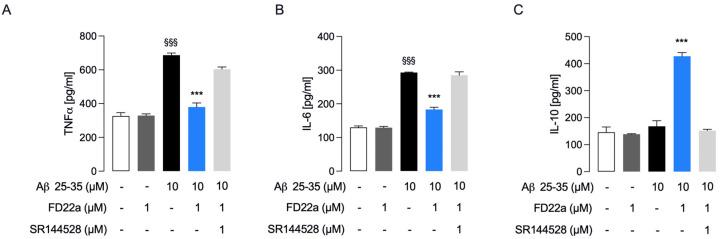
Neurodegenerative diseases (NDDs) are progressive multifactorial disorders of the nervous system sharing common pathogenic features, including intracellular misfolded protein aggregation, mitochondrial deficit, and inflammation. Taking into consideration the multifaceted nature of NDDs, development of multitarget-directed ligands (MTDLs) has evolved as an attractive therapeutic strategy. Compounds that target the cannabinoid receptor type II (CB2R) are rapidly emerging as novel effective MTDLs against common NDDs, such as Alzheimer's disease (AD). We recently developed the first CB2R bitopic/dualsteric ligand, namely FD22a, which revealed the ability to induce neuroprotection with fewer side effects. To explore the potential of FD22a as a multitarget drug for the treatment of NDDs, we investigated here its ability to prevent the toxic effect of β-amyloid (Aβ peptide) on human cellular models of neurodegeneration, such as microglia (HMC3) and glioblastoma (U87-MG) cell lines. Our results displayed that FD22a efficiently prevented Aβ cytotoxic and proinflammatory effects in both cell lines and counteracted β-amyloid-induced depression of autophagy in U87-MG cells. Notably, a quantitative proteomic analysis of U87-MG cells revealed that FD22a was able to potently stimulate the autophagy-lysosomal pathway (ALP) by activating its master transcriptional regulator TFEB, ultimately increasing the potential of this novel CB2R bitopic/dualsteric ligand as a multitarget drug for the treatment of NDDs.
神经退行性疾病(NDDs)是神经系统的进行性多因素紊乱,具有共同的发病特征,包括细胞内错误折叠的蛋白质聚集、线粒体缺陷和炎症。考虑到 NDDs 的多方面性质,开发多靶标导向配体(MTDLs)已成为一种有吸引力的治疗策略。靶向大麻素受体 2(CB2R)的化合物作为治疗常见 NDDs(如阿尔茨海默病(AD))的新型有效 MTDLs 迅速出现。我们最近开发了第一个 CB2R 双位点/双功能配体,即 FD22a,它显示出具有较少副作用的诱导神经保护的能力。为了探索 FD22a 作为治疗 NDDs 的多靶标药物的潜力,我们在此研究了它预防β-淀粉样蛋白(Aβ肽)对神经退行性变人类细胞模型(如小胶质细胞(HMC3)和神经胶质瘤(U87-MG)细胞系)的毒性作用的能力。我们的结果显示,FD22a 能够有效地预防两种细胞系中 Aβ的细胞毒性和促炎作用,并抵消 U87-MG 细胞中β-淀粉样蛋白诱导的自噬抑制。值得注意的是,U87-MG 细胞的定量蛋白质组学分析显示,FD22a 通过激活其主转录调节剂 TFEB 能够强有力地刺激自噬溶酶体途径(ALP),最终增加这种新型 CB2R 双位点/双功能配体作为治疗 NDDs 的多靶标药物的潜力。






 Zotero 插件