
探索儿童肥胖、过敏性疾病和睡眠呼吸障碍之间的复杂相互作用。
Exploring the Complex Interplay of Obesity, Allergic Diseases, and Sleep-Disordered Breathing in Children.
作者信息
Voltan Chiara, Concer Francesca, Pecoraro Luca, Pietrobelli Angelo, Piacentini Giorgio, Zaffanello Marco
机构信息
Pediatric Clinic, Department of Surgery, Dentistry, Gynecology and Pediatrics, University of Verona, 37129 Verona, Italy.
出版信息
Children (Basel). 2024 May 15;11(5):595. doi: 10.3390/children11050595.
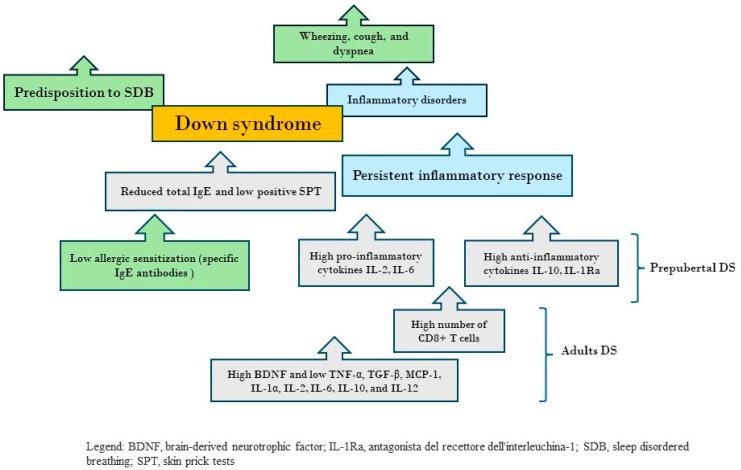
This narrative review study investigates the correlations between obesity, allergies, and sleep-disordered breathing in pediatric populations. Searches for pertinent articles were conducted on the Medline PubMed Advanced Search Builder, Scopus, and Web of Science databases from unlimited to April 2024. Sleep-disordered breathing causes repeated upper airway obstructions, leading to apneas and restless sleep. Childhood obesity, which affects around 20% of children, is often associated with sleep-disordered breathing and allergies such as asthma and allergic rhinitis. It is distinguished between diet-induced obesity (resulting from excess of diet and physical inactivity) and genetic obesity (such as is seen in Down syndrome and Prader-Willi syndrome). In children with diet-induced obesity, chronic inflammation linked to weight can worsen allergies and increase the risk and severity of asthma and rhinitis. Furthermore, the nasal congestion typical of rhinitis can contribute to upper respiratory tract obstruction and obstructive sleep apnea. A vicious circle is created between asthma and sleep-disordered breathing: uncontrolled asthma and sleep-disordered breathing can worsen each other. In children with genetic obesity, despite alterations in the immune system, fewer allergies are observed compared to the broader population. The causes of this reduced allergenicity are unclear but probably involve genetic, immunological, and environmental factors. Additional research is necessary to elucidate the underlying mechanisms. The present narrative review study emphasizes the importance of jointly evaluating and managing allergies, obesity, and obstructive sleep apnea in children considering their close interconnection.
本叙述性综述研究调查了儿科人群中肥胖、过敏和睡眠呼吸障碍之间的相关性。在Medline PubMed高级搜索构建器、Scopus和Web of Science数据库中进行了相关文章的检索,检索时间范围从不限至2024年4月。睡眠呼吸障碍会导致上呼吸道反复阻塞,进而引发呼吸暂停和睡眠不安。儿童肥胖影响约20%的儿童,常与睡眠呼吸障碍以及哮喘和过敏性鼻炎等过敏症相关。肥胖分为饮食诱导性肥胖(由饮食过量和缺乏身体活动导致)和遗传性肥胖(如唐氏综合征和普拉德-威利综合征中所见)。在饮食诱导性肥胖的儿童中,与体重相关的慢性炎症会加重过敏反应,增加哮喘和鼻炎的风险及严重程度。此外,鼻炎典型的鼻充血会导致上呼吸道阻塞和阻塞性睡眠呼吸暂停。哮喘和睡眠呼吸障碍之间形成了恶性循环:未得到控制的哮喘和睡眠呼吸障碍会相互恶化。在遗传性肥胖的儿童中,尽管免疫系统存在改变,但与更广泛的人群相比,观察到的过敏症较少。这种过敏反应降低的原因尚不清楚,但可能涉及遗传、免疫和环境因素。需要进一步的研究来阐明潜在机制。本叙述性综述研究强调了鉴于过敏、肥胖和阻塞性睡眠呼吸暂停之间的紧密联系,对儿童的这些问题进行联合评估和管理的重要性。


 Zotero 插件