
叶黄素和玉米黄质可增强高密度脂蛋白的生物学功能,而氧化、糖基化和低pH值则会损害其功能。
Lutein and Zeaxanthin Enhance, Whereas Oxidation, Fructosylation, and Low pH Damage High-Density Lipoprotein Biological Functionality.
作者信息
Zheng Jingyuan, Hong Brian V, Agus Joanne K, Tang Xinyu, Klebaner Nola R, Chen Siyu, Guo Fei, Harvey Danielle J, Lebrilla Carlito B, Zivkovic Angela M
机构信息
Department of Nutrition, University of California Davis, Davis, CA 95616, USA.
Department of Chemistry, University of California Davis, Davis, CA 95616, USA.
出版信息
Antioxidants (Basel). 2024 May 18;13(5):616. doi: 10.3390/antiox13050616.
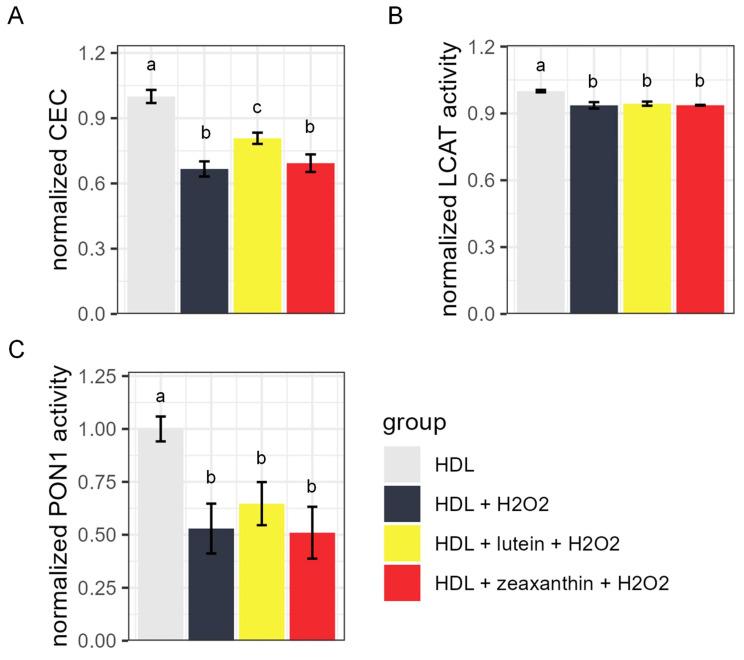
High-density lipoproteins (HDLs) are key regulators of cellular cholesterol homeostasis but are functionally altered in many chronic diseases. The factors that cause HDL functional loss in chronic disease are not fully understood. It is also unknown what roles antioxidant carotenoids play in protecting HDL against functional loss. The aim of this study was to measure how various disease-associated chemical factors including exposure to (1) Cu ions, (2) hypochlorous acid (HOCL), (3) hydrogen peroxide (HO), (4) sialidase, (5) glycosidase, (6) high glucose, (7) high fructose, and (8) acidic pH, and the carotenoid antioxidants (9) lutein and (10) zeaxanthin affect HDL functionality. We hypothesized that some of the modifications would have stronger impacts on HDL particle structure and function than others and that lutein and zeaxanthin would improve HDL function. HDL samples were isolated from generally healthy human plasma and incubated with the corresponding treatments listed above. Cholesterol efflux capacity (CEC), lecithin-cholesterol acyl transferase (LCAT) activity, and paraoxonase-1 (PON1) activity were measured in order to determine changes in HDL functionality. Median HDL particle diameter was increased by acidic pH treatment and reduced by HOCl, high glucose, high fructose, -glycosidase, and lutein treatments. Acidic pH, oxidation, and fructosylation all reduced HDL CEC, whereas lutein, zeaxanthin, and sialidase treatment improved HDL CEC. LCAT activity was reduced by acidic pH, oxidation, high fructose treatments, and lutein. PON1 activity was reduced by sialidase, glycosidase, HO, and fructose and improved by zeaxanthin and lutein treatment. These results show that exposure to oxidizing agents, high fructose, and low pH directly impairs HDL functionality related to cholesterol efflux and particle maturation, whereas deglycosylation impairs HDL antioxidant capacity. On the other hand, the antioxidants lutein and zeaxanthin improve or preserve both HDL cholesterol efflux and antioxidant activity but have no effect on particle maturation.
高密度脂蛋白(HDL)是细胞胆固醇稳态的关键调节因子,但在许多慢性疾病中其功能会发生改变。导致慢性疾病中HDL功能丧失的因素尚未完全明确。抗氧化类胡萝卜素在保护HDL免受功能丧失方面发挥何种作用也不清楚。本研究的目的是测定各种与疾病相关的化学因素,包括暴露于(1)铜离子、(2)次氯酸(HOCL)、(3)过氧化氢(HO)、(4)唾液酸酶、(5)糖苷酶、(6)高糖、(7)高果糖和(8)酸性pH值,以及类胡萝卜素抗氧化剂(9)叶黄素和(10)玉米黄质如何影响HDL功能。我们假设某些修饰对HDL颗粒结构和功能的影响比其他修饰更强,并且叶黄素和玉米黄质会改善HDL功能。从一般健康的人体血浆中分离出HDL样本,并与上述相应处理进行孵育。测量胆固醇流出能力(CEC)、卵磷脂胆固醇酰基转移酶(LCAT)活性和对氧磷酶-1(PON1)活性,以确定HDL功能的变化。酸性pH处理使HDL颗粒直径中位数增加,而HOCl、高糖、高果糖、糖苷酶和叶黄素处理使其降低。酸性pH、氧化和果糖基化均降低HDL CEC,而叶黄素、玉米黄质和唾液酸酶处理则改善HDL CEC。酸性pH、氧化、高果糖处理和叶黄素会降低LCAT活性。唾液酸酶、糖苷酶、HO和果糖会降低PON1活性,而玉米黄质和叶黄素处理则会提高PON1活性。这些结果表明,暴露于氧化剂、高果糖和低pH会直接损害与胆固醇流出和颗粒成熟相关的HDL功能,而去糖基化会损害HDL抗氧化能力。另一方面,抗氧化剂叶黄素和玉米黄质可改善或保留HDL胆固醇流出和抗氧化活性,但对颗粒成熟没有影响。


 Zotero 插件