
萝卜硫素对脂多糖诱导的认知记忆损伤可能具有的预防作用:通过调节大脑前额叶皮质区域的氧化应激和神经炎症蛋白来介导
Possible Prophylactic Effects of Sulforaphane on LPS-Induced Recognition Memory Impairment Mediated by Regulating Oxidative Stress and Neuroinflammatory Proteins in the Prefrontal Cortex Region of the Brain.
作者信息
Alzahrani Noor Ahmed, Bahaidrah Khulud Abdullah, Mansouri Rasha A, Aldhahri Rahaf Saeed, Abd El-Aziz Gamal S, Alghamdi Badrah S
机构信息
Department of Biochemistry, Faculty of Sciences, King Abdulaziz University, Jeddah 23218, Saudi Arabia.
Department of Biochemistry, Faculty of Sciences, University of Jeddah, Jeddah 23218, Saudi Arabia.
出版信息
Biomedicines. 2024 May 16;12(5):1107. doi: 10.3390/biomedicines12051107.
BACKGROUND
Alzheimer's disease (AD) presents a significant global health concern, characterized by neurodegeneration and cognitive decline. Neuroinflammation is a crucial factor in AD development and progression, yet effective pharmacotherapy remains elusive. Sulforaphane (SFN), derived from cruciferous vegetables and mainly from broccoli, has shown a promising effect via in vitro and in vivo studies as a potential treatment for AD. This study aims to investigate the possible prophylactic mechanisms of SFN against prefrontal cortex (PFC)-related recognition memory impairment induced by lipopolysaccharide (LPS) administration.
METHODOLOGY
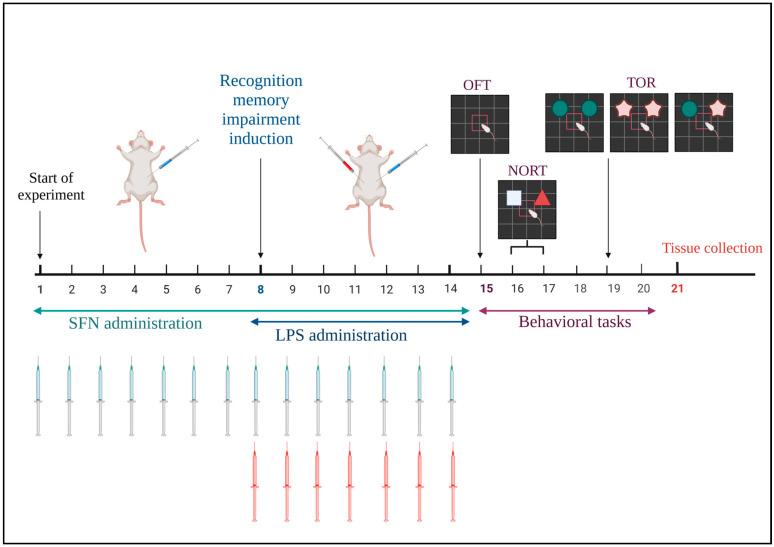
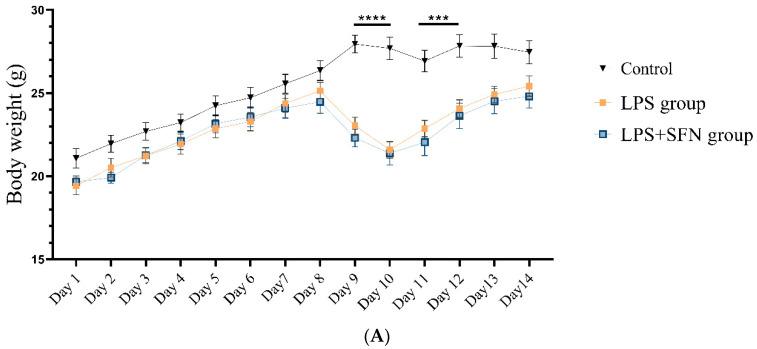
Thirty-six Swiss (SWR/J) mice weighing 18-25 g were divided into three groups ( = 12 per group): a control group (vehicle), an LPS group (0.75 mg/kg of LPS), and an LPS + SFN group (25 mg/kg of SFN). The total duration of the study was 3 weeks, during which mice underwent treatments for the initial 2 weeks, with daily monitoring of body weight and temperature. Behavioral assessments via novel object recognition (NOR) and temporal order recognition (TOR) tasks were conducted in the final week of the study. Inflammatory markers (IL-6 and TNF), antioxidant enzymes (SOD, GSH, and CAT), and pro-oxidant (MDA) level, in addition to acetylcholine esterase (AChE) activity and active (caspase-3) and phosphorylated (AMPK) levels, were evaluated. Further, PFC neuronal degeneration, Aβ content, and microglial activation were also examined using H&E, Congo red staining, and Iba1 immunohistochemistry, respectively.
RESULTS
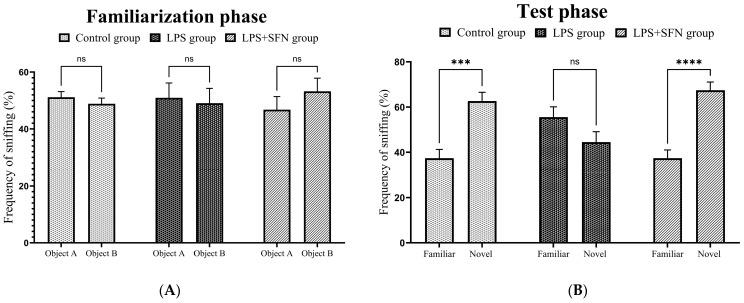
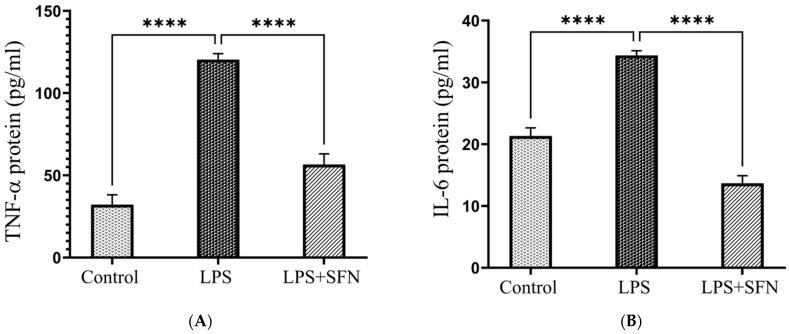
SFN pretreatment significantly improved recognition memory performance during the NOR and TOR tests. Moreover, SFN was protected from neuroinflammation and oxidative stress as well as neurodegeneration, Aβ accumulation, and microglial hyperactivity.
CONCLUSION
The obtained results suggested that SFN has a potential protective property to mitigate the behavioral and biochemical impairments induced by chronic LPS administration and suggested to be via an AMPK/caspase-3-dependent manner.
背景
阿尔茨海默病(AD)是一个重大的全球健康问题,其特征为神经退行性变和认知衰退。神经炎症是AD发生和发展的关键因素,但有效的药物治疗仍然难以实现。萝卜硫素(SFN)源自十字花科蔬菜,主要来自西兰花,通过体外和体内研究显示出作为AD潜在治疗方法的有前景的效果。本研究旨在探讨SFN对脂多糖(LPS)给药诱导的前额叶皮质(PFC)相关识别记忆损伤的可能预防机制。
方法
将36只体重18 - 25 g的瑞士(SWR/J)小鼠分为三组(每组n = 12):对照组(溶剂)、LPS组(0.75 mg/kg LPS)和LPS + SFN组(25 mg/kg SFN)。研究总时长为3周,在此期间小鼠在最初2周接受治疗,每天监测体重和体温。在研究的最后一周通过新物体识别(NOR)和时间顺序识别(TOR)任务进行行为评估。评估炎症标志物(IL - 6和TNF)、抗氧化酶(SOD、GSH和CAT)以及促氧化剂(MDA)水平,此外还评估乙酰胆碱酯酶(AChE)活性以及活性(caspase - 3)和磷酸化(AMPK)水平。此外,分别使用苏木精 - 伊红(H&E)染色、刚果红染色和Iba1免疫组织化学检查PFC神经元变性、Aβ含量和小胶质细胞活化情况。
结果
SFN预处理显著改善了NOR和TOR测试期间的识别记忆表现。此外,SFN可免受神经炎症、氧化应激以及神经退行性变、Aβ积累和小胶质细胞过度活跃的影响。
结论
所得结果表明,SFN具有潜在的保护特性,可减轻慢性LPS给药诱导的行为和生化损伤,并提示其作用可能通过AMPK/caspase - 3依赖性方式实现。







 Zotero 插件