
法属圭亚那儿童癌症发病率:与全球估计数相比情况如何?
Incidence of Pediatric Cancers in French Guiana: How Does It Compare to Global Estimates?
作者信息
Nacher Mathieu, Wang Qiannan, Osei Lindsay, Faivre Benjamin, Elenga Narcisse, Adenis Antoine, Deschamps Nathalie, Drak Alsibai Kinan
机构信息
Centre d'Investigation Clinique (INSERM 1424), Institut Santé des Populations en Amazonie, Centre Hospitalier de Cayenne, 97300 Cayenne, French Guiana.
Université de Guyane, 97300 Cayenne, French Guiana.
出版信息
Cancers (Basel). 2024 May 10;16(10):1829. doi: 10.3390/cancers16101829.
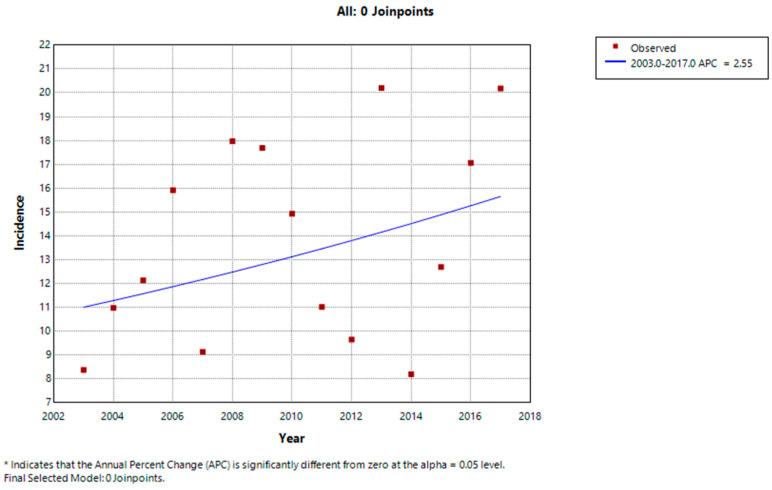
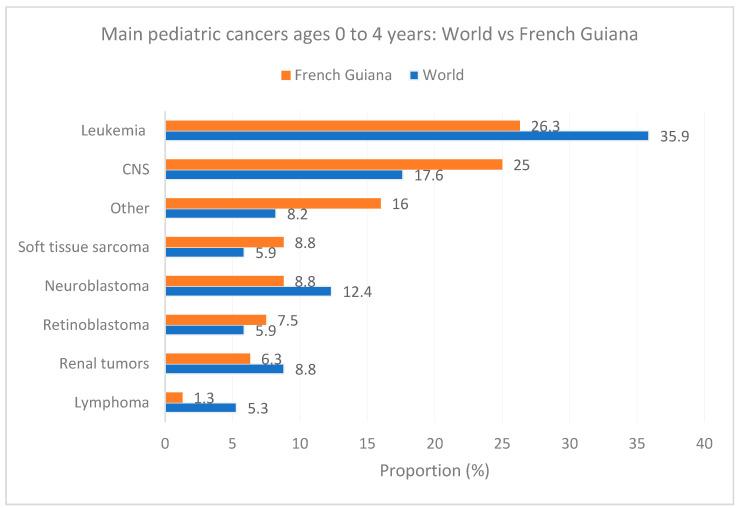
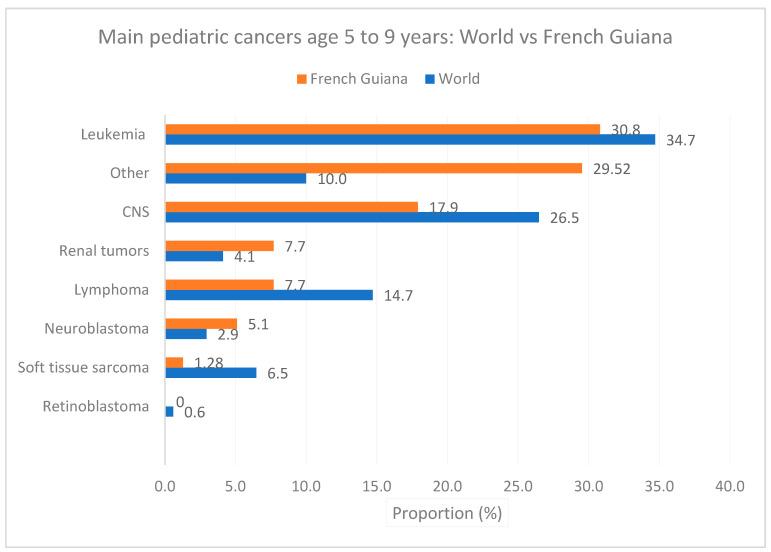
French Guiana is a French territory in South America. The exposome of persons living there is quite different from that in mainland France and the ethnic make-up of the population is also quite different. Poverty is also widespread with difficulties in accessing care magnified by the low medical-professional density. In this singular context, we aimed to measure the incidence of pediatric cancers and to compare it with other continents. We used French Guiana's certified cancer registry to study this between 2003 and 2017. Incidences were standardized using the world population with three strata: 0-4 years, 5-9 years, and 10-14 years. There were 164 solid tumors or hematologic malignancies diagnosed in children under the age of 15 (92 in boys and 72 in girls). Over the study period, the standardized incidence rate was 14.1 per 100,000 among children aged under 15 years. There was no significant trend during the study period. The three most common causes of cancer were leukemias-mostly lymphoblastic-CNS tumors, and sarcoma. The standardized incidence of pediatric cancers in French Guiana was similar to those in Western Europe and North America. As others have discovered, we found that males tended to be more likely to develop cancer, notably leukemia, CNS tumors, sarcoma, and retinoblastoma. As elsewhere, the predominant cancer types changed with age. Our initial assumption was that given the singular context of French Guiana, there may have been differences in pediatric cancer incidences. Here we showed that overall, contrary to our assumption and to trends in tropical countries, the incidence of pediatric cancers was in a range between Western Europe and North America with some apparent but non-significant differences in the main types of cancers observed in global statistics. Quality cancer registry data in this tropical region confirm the suspicion that lower incidences in tropical low- and middle-income countries are likely to result from incomplete diagnosis and data collection.
法属圭亚那是南美洲的一个法国属地。居住在那里的人群的暴露组与法国本土人群有很大不同,人口的种族构成也大不相同。贫困现象也很普遍,医疗专业人员密度低加剧了获得医疗服务的困难。在这种独特的背景下,我们旨在测量儿童癌症的发病率,并将其与其他各大洲进行比较。我们利用法属圭亚那经认证的癌症登记处,对2003年至2017年期间的数据进行研究。发病率采用世界人口标准进行标准化,分为三个年龄组:0至4岁、5至9岁和10至14岁。15岁以下儿童共诊断出164例实体瘤或血液系统恶性肿瘤(男孩92例,女孩72例)。在研究期间,15岁以下儿童的标准化发病率为每10万人14.1例。研究期间没有明显趋势。癌症的三个最常见病因是白血病(主要是淋巴细胞性)、中枢神经系统肿瘤和肉瘤。法属圭亚那儿童癌症的标准化发病率与西欧和北美的发病率相似。正如其他人所发现的,我们发现男性患癌症的可能性往往更高,尤其是白血病、中枢神经系统肿瘤、肉瘤和视网膜母细胞瘤。与其他地方一样,主要癌症类型随年龄而变化。我们最初的假设是,鉴于法属圭亚那的独特背景,儿童癌症发病率可能存在差异。在此我们表明,总体而言,与我们的假设以及热带国家的趋势相反,儿童癌症发病率处于西欧和北美之间的范围,在全球统计数据中观察到的主要癌症类型存在一些明显但不显著的差异。这个热带地区高质量的癌症登记数据证实了一种怀疑,即热带低收入和中等收入国家较低的发病率可能是由于诊断和数据收集不完整所致。



 Zotero 插件