
基于铜离子调制的银纳米簇的 L-组氨酸荧光传感器的检测。
Fluorescence Sensors for the Detection of L-Histidine Based on Silver Nanoclusters Modulated by Copper Ions.
机构信息
Department of Chemistry and Chemical Engineering, Jinzhong University, Jinzhong 030619, China.
出版信息
Molecules. 2024 May 7;29(10):2167. doi: 10.3390/molecules29102167.
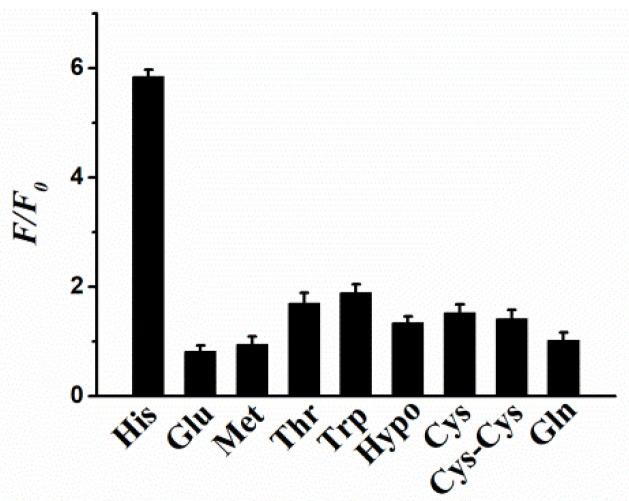
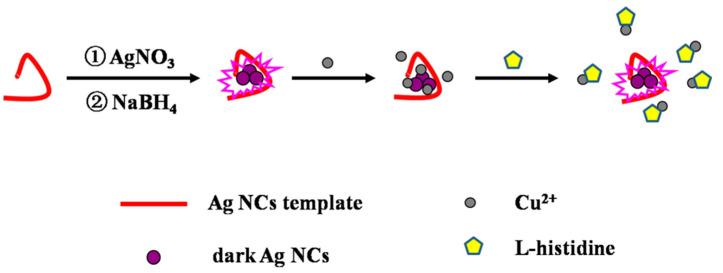
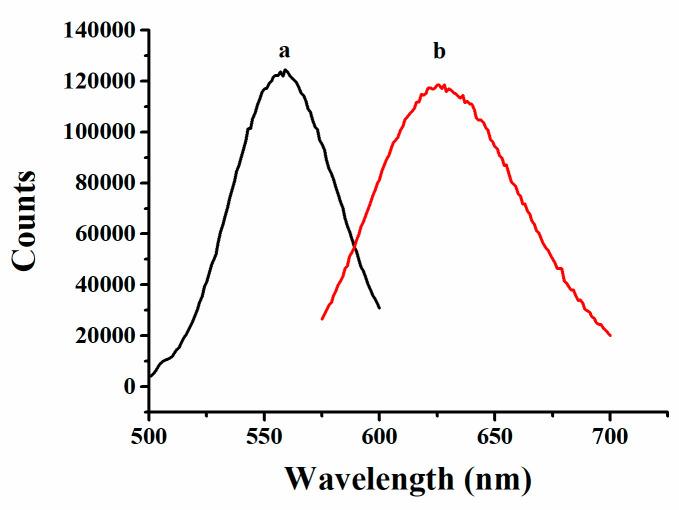
In this study, Cu modulated silver nanoclusters were constructed for the turn-on, label-free detection of L-histidine. Six Ag NCs protected by oligonucleotides (DNA-Ag NCs) were tested in a series of experiments. Finally, A-DAN-Ag NCs were chosen as the best candidate due to their excellent fluorescent properties. The fluorescence of A-DAN-Ag NCs was quenched using Cu through energy or electron transfer. However, quenched fluorescence could be restored dramatically in the presence of L-histidine due to Cu liberation from A-DAN-Ag NCs and because of the chelation between the imidazole group of L-histidine and Cu. The proposed sensor exhibited high selectivity towards L-histidine over other amino acids, with a limit of detection (LOD) of 0.096 μM ranging from 0 to 8 μM. The proposed sensor succeeded in detecting L-histidine in diluted human urine. Therefore, the sensor has promising practical applications in biological systems.
在这项研究中,构建了铜调节的银纳米簇,用于 L-组氨酸的开启式、无标记检测。在一系列实验中测试了六种由寡核苷酸(DNA-Ag NCs)保护的 Ag NCs。最后,由于其出色的荧光特性,选择了 A-DAN-Ag NCs 作为最佳候选物。通过能量或电子转移,铜使 A-DAN-Ag NCs 的荧光猝灭。然而,由于 Cu 从 A-DAN-Ag NCs 中释放出来,并且由于 L-组氨酸的咪唑基团与 Cu 的螯合作用,L-组氨酸的存在可以显著恢复猝灭的荧光。该传感器对 L-组氨酸具有很高的选择性,对其他氨基酸的选择性较低,LOD 为 0.096 μM,检测范围为 0 至 8 μM。该传感器成功地检测到稀释后的人尿中的 L-组氨酸。因此,该传感器在生物系统中有很好的实际应用前景。


 Zotero 插件