
富氢水连续饮用 14 天可缓解疲劳,但不能改善长新冠患者的呼吸困难:一项初步的、单盲、随机、对照试验。
The Effect of 14-Day Consumption of Hydrogen-Rich Water Alleviates Fatigue but Does Not Ameliorate Dyspnea in Long-COVID Patients: A Pilot, Single-Blind, and Randomized, Controlled Trial.
机构信息
School of Strength and Conditioning Training, Beijing Sport University, Beijing 100084, China.
College of Swimming, Beijing Sport University, Beijing 100084, China.
出版信息
Nutrients. 2024 May 19;16(10):1529. doi: 10.3390/nu16101529.
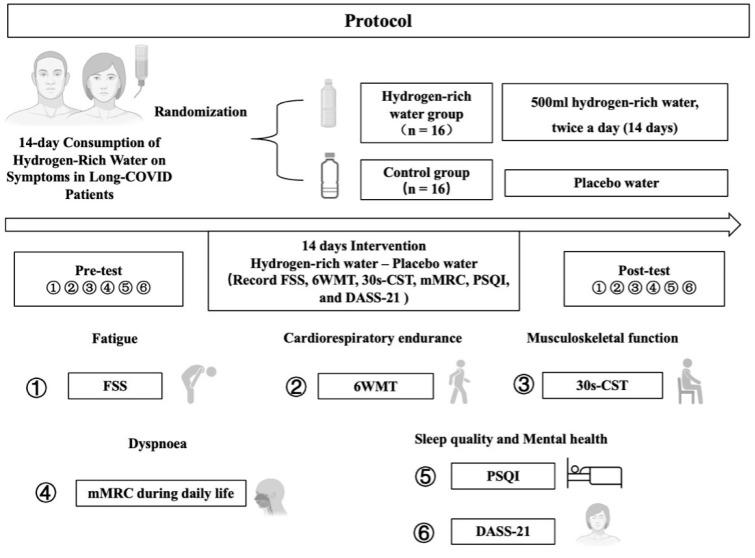
(1) Background: Hydrogen (H) may be a potential therapeutic agent for managing Long COVID symptoms due to its antioxidant and anti-inflammatory properties. However, more scientific literature is needed to describe the effects of H administration on treating symptoms. A study aimed to investigate the impact of hydrogen-rich water (HRW) administration on the fatigue and dyspnea of Long-COVID patients for 14 consecutive days. (2) Methods: In this randomized, single-blind, placebo-controlled study, 55 participants were recruited, and 23 of them were excluded. A total of 32 eligible participants were randomized into a hydrogen-rich water (HRW) group ( = 16) and a placebo water (PW) group ( = 16) in which they were instructed to consume hydrogen-rich water or placebo water for 14 days, respectively. The participants completed the Fatigue Severity Scale (FSS), Six-Minute Walk Test (6MWT), 30 s Chair Stand Test (30s-CST), Modified Medical Research Council Dyspnea Rating Scale (mMRC), Pittsburgh Sleep Quality Index (PSQI), and depression anxiety stress scale (DASS-21) before and after the intervention. A linear mixed-effects model was used to analyze the effects of HRW. Cohen's d values were used to assess the effect size when significance was observed. The mean change with 95% confidence intervals (95% CI) was also reported. (3) Results: The effects of HRW on lowering FSS scores ( = 0.046, [95% CI = -20.607, -0.198, d = 0.696] and improving total distance in the 6WMT ( < 0.001, [95% CI = 41.972, 61.891], d = 1.010), total time for the 30s-CST ( = 0.002, [95% CI = 1.570, 6.314], d = 1.190), and PSQI scores ( = 0.012, [95% CI = -5.169, 0.742], d = 1.274) compared to PW were of a significantly moderate effect size, while there was no significant difference in mMRC score ( = 0.556) or DASS-21 score ( > 0.143). (4) Conclusions: This study demonstrates that HRW might be an effective strategy for alleviating fatigue and improving cardiorespiratory endurance, musculoskeletal function, and sleep quality. Still, it does not ameliorate dyspnea among Long-COVID patients.
(1)背景:由于具有抗氧化和抗炎特性,氢气(H)可能是管理长新冠症状的潜在治疗剂。然而,需要更多的科学文献来描述 H 给药对治疗症状的影响。一项研究旨在调查连续 14 天给氢水(HRW)对长新冠患者疲劳和呼吸困难的影响。
(2)方法:在这项随机、单盲、安慰剂对照研究中,招募了 55 名参与者,其中 23 名被排除在外。共有 32 名符合条件的参与者被随机分为富氢水(HRW)组(n=16)和安慰剂水(PW)组(n=16),他们分别被指示连续 14 天饮用富氢水或安慰剂水。参与者在干预前后完成疲劳严重程度量表(FSS)、六分钟步行测试(6MWT)、30 秒椅子站立测试(30s-CST)、改良医学研究委员会呼吸困难评分量表(mMRC)、匹兹堡睡眠质量指数(PSQI)和抑郁焦虑压力量表(DASS-21)。采用线性混合效应模型分析 HRW 的影响。当观察到显著性时,使用 Cohen's d 值来评估效应大小。还报告了平均变化和 95%置信区间(95%CI)。
(3)结果:HRW 对降低 FSS 评分(=0.046,[95%CI=-20.607,-0.198,d=0.696])和提高 6MWT 总距离(<0.001,[95%CI=41.972,61.891],d=1.010)、30s-CST 总时间(=0.002,[95%CI=1.570,6.314],d=1.190)和 PSQI 评分(=0.012,[95%CI=-5.169,0.742],d=1.274)的效果具有显著的中等效应大小,而 mMRC 评分(=0.556)或 DASS-21 评分(>0.143)无显著差异。
(4)结论:本研究表明,HRW 可能是一种缓解疲劳和改善心肺耐力、肌肉骨骼功能和睡眠质量的有效策略。然而,它并不能改善长新冠患者的呼吸困难。


 Zotero 插件