
疫情期间封闭政策和流动限制不一致所带来的意外后果。
The unintended consequences of inconsistent closure policies and mobility restrictions during epidemics.
作者信息
Althouse Benjamin M, Wallace Brendan, Case B K M, Scarpino Samuel V, Allard Antoine, Berdahl Andrew M, White Easton R, Hébert-Dufresne Laurent
机构信息
University of Washington, Seattle, 98105 WA USA.
New Mexico State University, Las Cruces, 88003 NM USA.
出版信息
BMC Glob Public Health. 2023;1(1):28. doi: 10.1186/s44263-023-00028-z. Epub 2023 Dec 4.
BACKGROUND
Controlling the spread of infectious diseases-even when safe, transmission-blocking vaccines are available-may require the effective use of non-pharmaceutical interventions (NPIs), e.g., mask wearing, testing, limits on group sizes, venue closure. During the SARS-CoV-2 pandemic, many countries implemented NPIs inconsistently in space and time. This inconsistency was especially pronounced for policies in the United States of America (US) related to venue closure.
METHODS
Here, we investigate the impact of inconsistent policies associated with venue closure using mathematical modeling and high-resolution human mobility, Google search, and county-level SARS-CoV-2 incidence data from the USA. Specifically, we look at high-resolution location data and perform a US-county-level analysis of nearly 8 million SARS-CoV-2 cases and 150 million location visits, including 120 million church visitors across 184,677 churches, 14 million grocery visitors across 7662 grocery stores, and 13.5 million gym visitors across 5483 gyms.
RESULTS
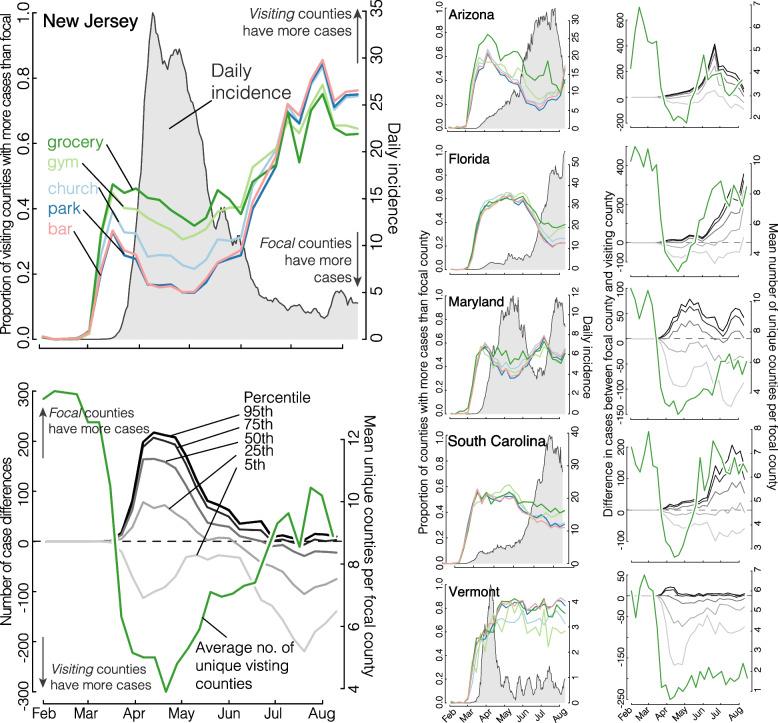
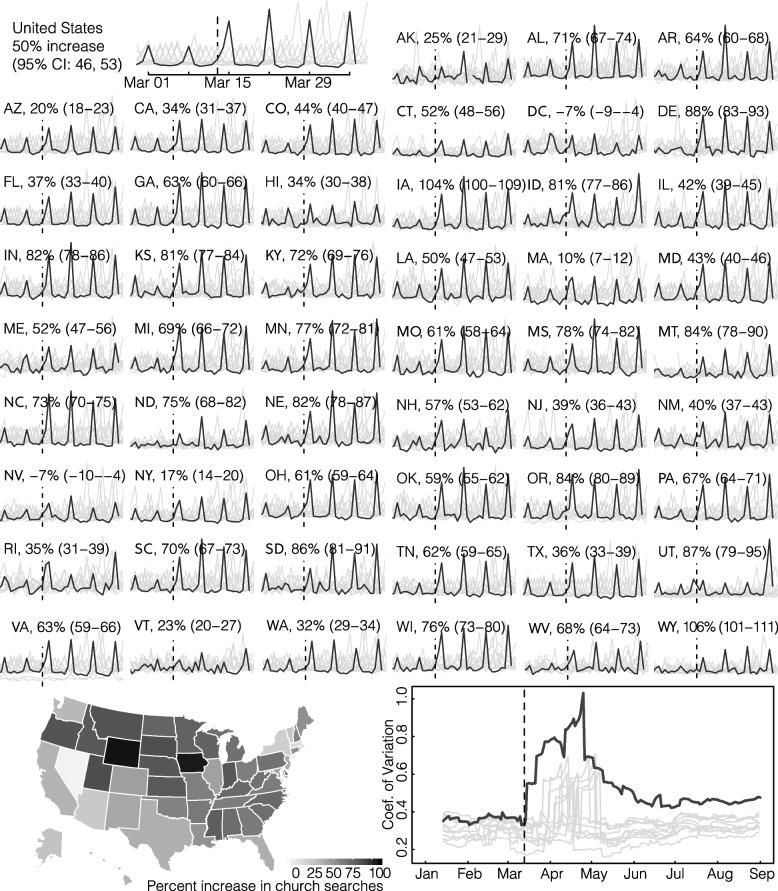
Analyzing the interaction between venue closure and changing mobility using a mathematical model shows that, across a broad range of model parameters, inconsistent or partial closure can be worse in terms of disease transmission as compared to scenarios with no closures at all. Importantly, changes in mobility patterns due to epidemic control measures can lead to increase in the future number of cases. In the most severe cases, individuals traveling to neighboring jurisdictions with different closure policies can result in an outbreak that would otherwise have been contained. To motivate our mathematical models, we turn to mobility data and find that while stay-at-home orders and closures decreased contacts in most areas of the USA, some specific activities and venues saw an increase in attendance and an increase in the distance visitors traveled to attend. We support this finding using search query data, which clearly shows a shift in information seeking behavior concurrent with the changing mobility patterns.
CONCLUSIONS
While coarse-grained observations are not sufficient to validate our models, taken together, they highlight the potential unintended consequences of inconsistent epidemic control policies related to venue closure and stress the importance of balancing the societal needs of a population with the risk of an outbreak growing into a large epidemic.
SUPPLEMENTARY INFORMATION
The online version contains supplementary material available at 10.1186/s44263-023-00028-z.
背景
即使有安全的阻断传播疫苗,控制传染病传播可能仍需要有效运用非药物干预措施(NPIs),例如佩戴口罩、检测、限制群体规模、关闭场所。在新冠疫情期间,许多国家在空间和时间上对非药物干预措施的实施并不一致。这种不一致在美国与场所关闭相关的政策中尤为明显。
方法
在此,我们利用数学建模以及来自美国的高分辨率人员流动、谷歌搜索和县一级新冠病毒发病率数据,研究与场所关闭相关的不一致政策的影响。具体而言,我们查看高分辨率位置数据,并对近800万例新冠病毒病例和1.5亿次位置访问进行美国县级分析,其中包括184,677所教堂的1.2亿次教堂访问、7662家杂货店的1400万次杂货店访问以及5483家健身房的1350万次健身房访问。
结果
使用数学模型分析场所关闭与变化的流动性之间的相互作用表明,在广泛的模型参数范围内,与完全不关闭场所的情况相比,不一致或部分关闭在疾病传播方面可能更糟。重要的是,由于疫情防控措施导致的流动模式变化可能会导致未来病例数增加。在最严重的情况下,前往具有不同关闭政策的相邻辖区的个体可能会导致原本可以得到控制的疫情爆发。为了支持我们的数学模型,我们转向流动数据,发现虽然居家令和场所关闭减少了美国大多数地区的接触,但一些特定活动和场所的出勤人数增加,且访客前往参与活动的距离也增加了。我们使用搜索查询数据支持这一发现,该数据清楚地显示了信息搜索行为的转变与不断变化的流动模式同步。
结论
虽然粗略的观察不足以验证我们的模型,但综合来看,它们突出了与场所关闭相关的不一致疫情防控政策可能产生的意外后果,并强调了平衡人群的社会需求与疫情爆发演变为大规模流行风险的重要性。
补充信息
在线版本包含可在10.1186/s44263 - 023 - 00028 - z获取的补充材料。



 Zotero 插件