
青少年社交焦虑的途径:测试神经社会奖励功能与日常生活中感知到的社会威胁之间的相互作用。
Pathways to adolescent social anxiety: Testing interactions between neural social reward function and perceived social threat in daily life.
作者信息
Sequeira Stefanie L, Silk Jennifer S, Jones Neil P, Forbes Erika E, Hanson Jamie L, Hallion Lauren S, Ladouceur Cecile D
机构信息
Department of Psychology, University of Virginia, Charlottesville, VA, USA.
Department of Psychology, University of Pittsburgh, Pittsburgh, PA, USA.
出版信息
Dev Psychopathol. 2024 May 27:1-16. doi: 10.1017/S0954579424001068.
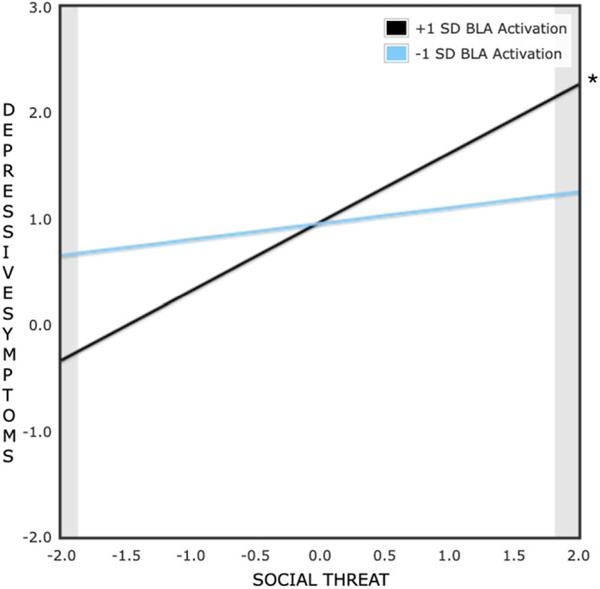
Recent theories suggest that for youth highly sensitive to incentives, perceiving more social threat may contribute to social anxiety (SA) symptoms. In 129 girls (ages 11-13) oversampled for shy/fearful temperament, we thus examined how interactions between neural responses to social reward (vs. neutral) cues (measured during anticipation of peer feedback) and perceived social threat in daily peer interactions (measured using ecological momentary assessment) predict SA symptoms two years later. No significant interactions emerged when neural reward function was modeled as a latent factor. Secondary analyses showed that higher perceived social threat was associated with more severe SA symptoms two years later only for girls with higher basolateral amygdala (BLA) activation to social reward cues at baseline. Interaction effects were specific to BLA activation to social reward (not threat) cues, though a main effect of BLA activation to social threat (vs. neutral) cues on SA emerged. Unexpectedly, interactions between social threat and BLA activation to social reward cues also predicted generalized anxiety and depression symptoms two years later, suggesting possible transdiagnostic risk pathways. Perceiving high social threat may be particularly detrimental for youth highly sensitive to reward incentives, potentially due to mediating reward learning processes, though this remains to be tested.
近期理论表明,对于对激励高度敏感的青少年而言,感知到更多的社会威胁可能会导致社交焦虑(SA)症状。在129名因害羞/恐惧气质而被过度抽样的女孩(年龄在11 - 13岁之间)中,我们因此研究了对社会奖励(与中性相比)线索的神经反应(在预期同伴反馈期间测量)与日常同伴互动中感知到的社会威胁(使用生态瞬时评估测量)之间的相互作用如何预测两年后的SA症状。当将神经奖励功能建模为一个潜在因素时,未出现显著的相互作用。二次分析表明,仅对于基线时基底外侧杏仁核(BLA)对社会奖励线索激活较高的女孩,两年后较高的感知社会威胁与更严重的SA症状相关。相互作用效应特定于BLA对社会奖励(而非威胁)线索的激活,不过BLA对社会威胁(与中性相比)线索的激活对SA产生了主效应。出乎意料的是,社会威胁与BLA对社会奖励线索的激活之间的相互作用也预测了两年后的广泛性焦虑和抑郁症状,提示可能存在跨诊断风险途径。感知到高社会威胁可能对那些对奖励激励高度敏感的青少年特别有害,这可能是由于介导了奖励学习过程,尽管这仍有待验证。


 Zotero 插件